

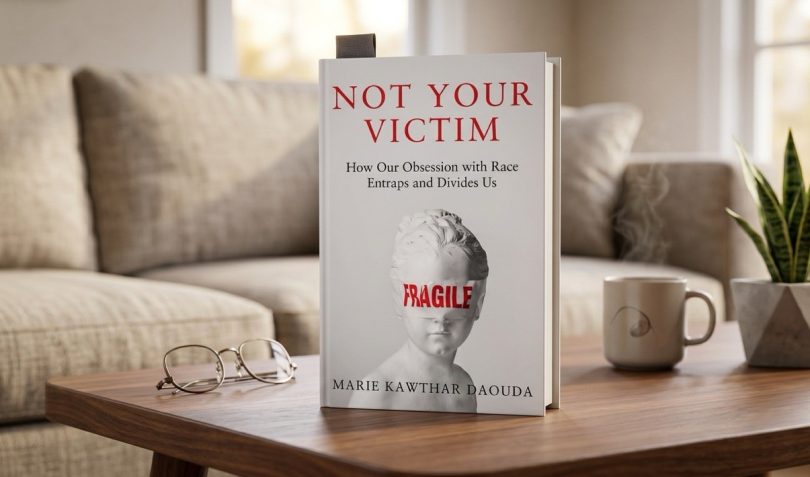

Amazon Link: Not Your Victim: How Our Obsession with Race Entraps and Divides Us, by Marie Kawthar Daouda (Polity, 171pp.,)
Dr Marie Daouda, a lecturer in French at Oriel College, Oxford, is probably well-known to many History Reclaimed readers. Ethnically and intellectually, she exudes hybridity, being Moroccan born, French educated, and professionally and emotionally British – of a decidedly Oxonian caste. Courageously and intelligently, she refuses to toe the political line expected of a person of café au lait colour, and her new, short, readable and very necessary book says as much in its title: Not Your Victim: How Our Obsession with Race Entraps and Divides Us.
In explaining why she believes this is so, she tells us of her Moroccan origins, mischievously noting that her distant ancestors might well have owned white slaves. Rather more important is her fierce commitment to education and still more to intellectual challenge: bravely, aged seventeen, she took off to a Parisian lycée, patronised the dying breed of once ubiquitous second-hand bookshops and bookstalls, was a fan of The Cure and donned lace and long skirts, and read Balzac and Baudelaire.
After the Sorbonne, she taught at a Catholic school and would surely have made it as an academic had she championed post-colonialism. She did not. Britain, minus the complications of a colonial relationship with Morocco and still blessed with vestiges of its noble liberal tradition, ultimately proved more hospitable. Daouda writes movingly at the end of the book about Elizabeth Anscombe ‘teaching philosophy, smoking cigars, and opposing the nuclear attacks on Japan with a handful of babies around her’; Saint John Henry Newman, also of Oriel; and Oscar Wilde (actually far more privileged than ‘the Irish boy’ that she calls him, with Trinity College, Dublin and Magdalen College, Oxford behind him).
Then there are ‘the green hills beyond the ghost gates of Oxford, and… the hills’ deep soil full of stories, and… the blue sky behind the hazy clouds, full of the dreams that rise with the chiming bells…’. She links these with her ‘desire for what is beautiful and true, against… the raging yells of the crowds’. Teaching Mallarmé, Zola and perhaps Gissing to clever young students, her own life is devoted to just this.
But Daouda is far more important than some gushing, latter-day Betjemanite girl. She is passionate and she is angry: this century, she believes, education has been transmogrified and trivialised with the decolonisation of the curriculum; the jettisoning of the canon (for example, Chaucer cancelled from the University of Leicester English Literature syllabus; one wonders how their enrolments are faring); and likewise the loss of any sense of historical perspective and possibility (‘everywhere became the here and now’).
This was aggravated by the fact that ‘we were the first settlers of the digital village – the first to have moved out of reality’. Thanks to the later, lethal cocktail of the Covid lockdown and George Floyd’s killing, identity politics, which she had fondly hoped was but a passing mad fad, has become far more deeply entrenched, while gender, sexual and still more virulently racial ‘victimhood means power’.
Daouda laments that ‘the young people I see around me have no trust in the future. Victimhood is reassuring, as it gives a sense of community, a sense of purpose, and even a narrative to interpret the big mess that life can be’. It does this ‘through fostering divisive anxiety through blame and through guilt. There is a dreadful complementarity between those who deal with anxiety by blaming all the problems of the modern world on an egregious image of the colonial white man, and those who deal with anxiety by showcasing their guilt through farcical self-flagellation’.
Trigger warnings and easily taking offence have replaced the more robust environment that Daouda was (just) old enough to experience: ‘No one needed to show DNA credentials to be allowed to enjoy or to criticise European, Asian or African art’. Now, she claims, ‘The very idea of appreciating Europe, its art, and its history is suspicious. Anything western is deemed bad’.
Daouda believes this cultural shift ultimately brings no joy to its recipients, whatever their ethnicity or gender. She does not quite say so, but the whole curriculum is now founded on joyless condemnation, negativity and guilt. What a tragic replacement this is of the television series and publication that probably did more than anything else to shape this reviewer, Kenneth Clark’s celebratoryCivilisation: A Personal View (1969). Much of her book is devoted to an exposé of the historical simplifications and falsifications that are the foundation of the decolonised curriculum. The latter celebrates the supposedly idyllic condition of pre-colonial cultures and condemns the unmitigated evils of colonialism, with its attendant capitalistic greed, racism and slavery (in which the Anglo world was, of course, the chief offender).
Daouda traces the origins of the pre-colonial Eden to Jean-Jacques Rousseau and the cult of the noble savage, which is plausible. But rather less forgivable is the short shrift that she gives to the Enlightenment in general. This is ironical given that the educational ideals that she most values have their intellectual origins in that complicated movement. Daouda could do worse than consult a counterpart to Clark, Peter Gay’s Age of Enlightenment (1966) from the Time-Life ‘Great Ages of Man’ [sic] series.
Rather more convincingly, she derides the phony floating signifier of the ‘Global South’, ‘simultaneously below the Western norm by… standardized indicators of development and above it according to the Western fantasies of a pure, untainted humanity in tune with itself and with nature’. On the question of slavery reparations, Daouda asserts: ‘European self-flagellation about imperialism, colonialism and slavery has devastating consequences in Africa. It tells Africans they have no agency, and that since everything is irremediably ruined by white people, they should whine until they get money’.
Daouda devotes two admirable chapters to the statue wars, the first addressing ‘Iconoclasm, old and new’, where she examines the distinctions between iconoclasm and vandalism. There was surely a mindless coalescence of the two in the toppling of the Edward Colston statue, which was a tragic sequel to George Floyd’s death (See in History Reclaimedhttps://historyreclaimed.co.uk/considerations-on-the-colston-statue/ )
Daouda astutely observes: ‘We could not accept… that Floyd may have been a criminal and also the victim of police violence, or that Colston may have been a benefactor and also a slave trader, and that none of these facts erases the existence of the other’. This reviewer has remarkably similar thoughts: a litmus test for wokery is whether someone describes Colston as a ‘slave trader’ tout court.
The Rhodes statue is on Daouda’s doorstep at Oriel, and is a gift for her eloquence. My sympathies are again close to hers, not least when she diagnoses the ‘Rhodes Must Fall’ standpoint as ‘iconoclasm’ which is ‘nothing but the inverted image of a latent idolatry, projecting issues onto objects without any care for factual accuracy, or the architectural meaning of what is targeted’. Indeed, Basil Champneys’ Rhodes Building (1911) facing onto the Oxford High Street was expressly designed to accommodate Rhodes’ and other statues in the heyday of the New Sculpture movement. There are a couple of infelicities, nevertheless, in Daouda’s account. The contentious statue is not, as she claims, four feet tall but life-sized. Moreover, her suggestion that ‘Rhodes did not ask for any plaque or statue’ is somewhat naïve, as the only living people granted that privilege are monarchs.
In a later chapter, Daouda writes eloquently of the ‘tyranny of low expectations’, where cultural levels in education have been ‘lowered in the name of inclusion’. She bemoans ‘the current generation of educators’ who believe ‘that everything they get from their own senses should be doubted, but that other people’s subjectivity is absolutely sacred. This untenable position is at the core of modern education, where… knowledge [has] been replaced by emotions’. This reviewer would add that you can have the privilege of being emotional when you have learnt something, and normally not till then. For any half-decent art historian, Ernst Gombrich’s dictum should always hold good: ‘You see what you know’.
‘Where do we go from here?’ we may well ask, in a world that is worryingly ethno-nationalist, surely a backlash against the cultural excesses that Daouda dissects. Touchingly, she feels there is hope yet in the Britain she obviously loves. She regards it as ‘a diverse and inclusive country… remarkably good at giving people a chance to excel’, where the British have ‘fought narrow-mindedness by excellence’. She can wave no magic wand; in a recent interview, Daouda confessed that privately she prays for a more loving and accepting world, and also hopes for a revival of pub conversations, with face-to-face encounters, as opposed to being glued to tribalized social media. I’ll drink to that!
***
Mark Stocker is the former Curator, Historical International Art, at the Museum of New Zealand Te Papa Tongarewa, Wellington. He has taught at the universities of Canterbury and Otago. His publications include numerous contributions to the Burlington Magazine and When Britain Went Decimal: The Coinage of 1971 (2021).


