


Land acknowledgment in the United States, as well as Canada, Australia, and elsewhere in the Anglosphere, is predicated on the notion that Native peoples were the traditional stewards of the land and should be recognized as such. There is no question about the priority and antiquity of the first Americans who likely arrived in North America as early 23,000 years ago, a doubling of previous estimates, based on the recent archaeology of sites in White Sands National Park in New Mexico.
However, given the size of the precontact population of the area that became the United States, one may well question the extent of indigenous stewardship or the actual size of the footprint of the Native American economy. The British economist Angus Maddison estimated the size of precontact America at 2 million souls—and precontact Canada at 250,000 (see Maddison, The World Economy: Historical Statistics, 2003). Native Americans worked sophisticated hunting, gathering, and fishing economies that, in terms of productivity, equaled, or perhaps even surpassed, those found anywhere else in the world.
Farming in pre-contact North America, on the other hand, differed profoundly from farming in Africa and Eurasia. The labour involved in agriculture in the New World rested entirely on human muscle and sweat because there was an absence there of large draft animals, e.g., horses, oxen, water buffalo, donkeys, and camels. The llama, the only meat and pack animal in the Americas apart from dogs, was confined exclusively to the high lands of South America.
In short, the New World’s agricultural revolution was only half a revolution in comparison with the transformation that had occurred in the Old World, where the domestication of plants and animals, including chickens, goats, and sheep, produced a powerful double helix of human culture. And of crucial importance was the “secondary products revolution” that followed the domestication of animals, allowing for the exploitation of renewables such as milk, eggs, wool, and manure.
This difference helps explain why European explorers encountered dense populations in the Middle East, India, and China, but not in North America (or Australia), at least above the Rio Grande. In contrast to Upper North America, Maddison estimated Mexico’s pre-contact population at 7.5 million. Moreover, the size of all of Upper North America’s post-Columbian (1492) native populations, already relatively small and thinly dispersed across the continent, would be tragically reduced by the introduction of terrible new diseases, such as smallpox, measles, and influenza, to which neither conquerors nor conquered had immunity, and the subsequent stress caused by dislocation and the forced imposition of assimilationist policies.
By the time of the California Gold Rush in 1848-9, which opened the American West to white settlement, the Native population had plummeted to 228,000—a horrifying, slow-motion decline of 88.6 percent over three and a half centuries. This meant that the U.S. Native population in 1850 was roughly only 0.9 percent of the entire U.S. population of 23,580,000 at the time.
Given this extreme demographic asymmetry, which grew worse over time, it is perhaps not surprising that European America regarded the New World as terra nullius, that is, land which belonged to no one, or at least was land not effectively utilized, a concept expounded upon in John Locke’s Second Treatise of Government (1690). In 1893, the University of Wisconsin historian Frederick Jackson Turner repackaged the idea in his famous ‘Frontier Thesis’, arguing that the westward expansion of the United States into empty wilderness shaped American democracy, individualism, and character. The American wilderness, of course, was not empty—but nor was it full.
The myth of free land pulled the rug over a messier reality and has been rightly debunked by modern scholarship. Unfortunately, the myth of free land has been replaced by a new, countervailing myth—the myth of maximum occupation. This latter myth airily holds that every acre of land once belonged to the continent’s original inhabitants. Since there are 1.9 billion acres in the lower 48 or contiguous American states alone, this would mean, if we use Maddison’s pre-contact figures, a ratio of one person for every 950 acres—a massive area, the equivalent of no less than 720 American football fields!
And yet this absurdity has become central to the counter “settler-colonial” narrative—the myth of stolen land, the evil twin of the myth of maximum occupation. The contention that every acre of North America was stolen—that America is ill-gotten and Canada, too, for that matter—ignores demography, social development, a long history of diplomacy, purchase, and war, to say nothing of the good work of the Indian Claims Commission, established by the U.S. Congress
in 1946 to address treaty violations and other past wrongs. It nevertheless continues, obstinately, to find its way into classrooms as well as popular culture—as evidenced by Billie Eilish’s “stolen land” speech at this year’s Grammys and the growing calls for accountability. History, however, should be based on data, not dogma; math, not myth.
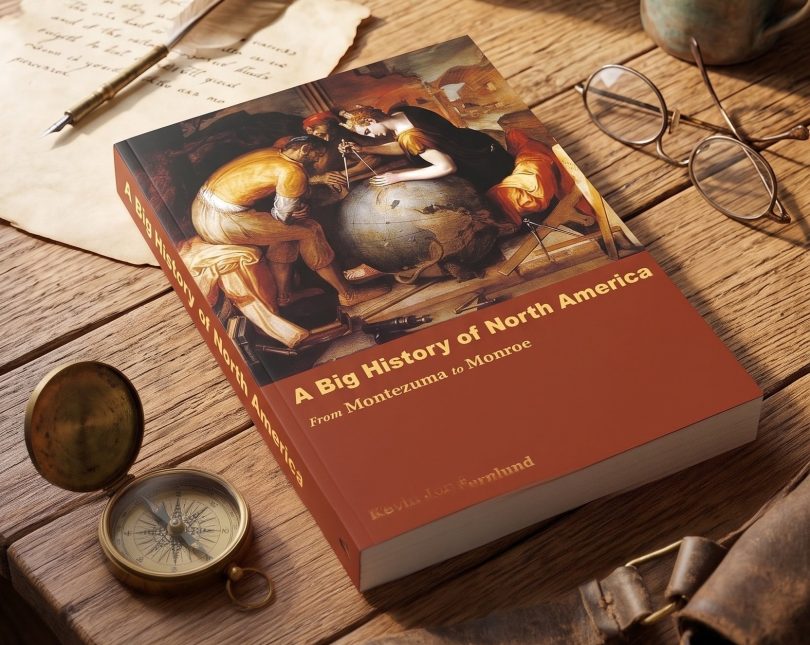
Kevin Jon Fernlund is a Professor Emeritus of History at the University of Missouri – St. Louis, a Fulbright Scholar, and a former Director of the Western History Association. He is also the author of A Big History of North America, from Montezuma to Monroe (Columbia: University of Missouri Press, 2022).


