


The UN General Assembly passed a non-binding resolution in March 2026 declaring the transatlantic slave trade to be the gravest crime and urged reparations for its ‘historical wrongs’. The UN Secretary-General Antonio Guterres, in making clear who would be paying the reparations, declared that the wealth of many Western nations was ‘built on stolen lives and stolen labour’ of African slaves trafficked to the Americas. The UN resolution was led by the Ghana President, John Dramani Mahama.
The UN resolution was opposed by three countries and 52 abstained; generally, on the grounds it would create an undesirable hierarchy of historical atrocities and, as Ambassador Dan Negrea, the US representative to the UN Economic and Social Council, noted, her country ‘does not recognise a legal right to reparations for historical wrongs that were not illegal under international law at the time they occurred’.
Others were quick to point out that the resolution was focused on the shameful trans-Atlantic trade and European slave traders without acknowledging the equally abhorrent African slave trades within Equatorial Africa, the Trans-Saharan caravan slave trade to the Maghreb, the East African trade from Swahili city-states via the Indian Ocean to the Red Sea, Persian Gulf and the west of India, or the Nile Valley trade from Sudan to Egypt. It also did not take account of modern chattel slavery in states like Mauritania, Mali, Niger, Libya, and Sudan.
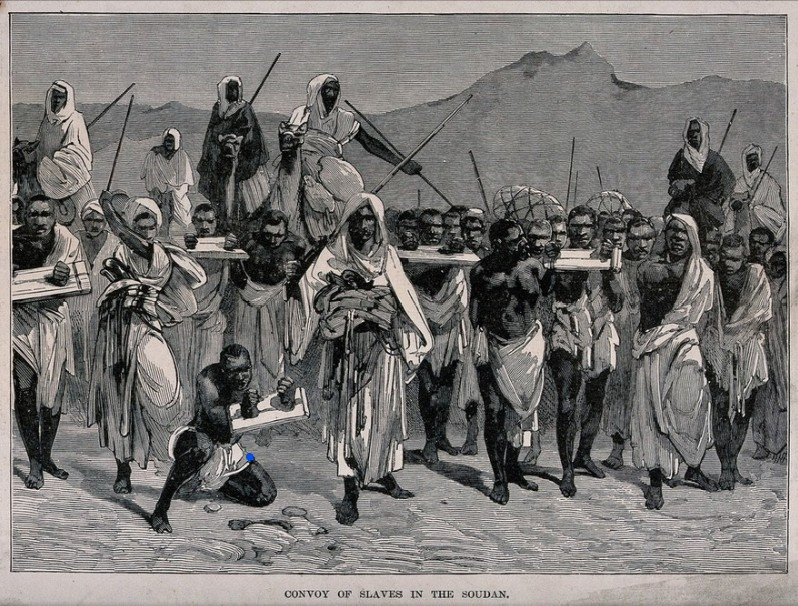
Trans-Saharan Slave Trade, Sudan (Woodcut, Wellcome collection, V0041263)
Without detailed written records, estimates for the quantum of the other African slave trades vary considerably. Overall, historians estimate that, between the years 650 and 1900, some 11 to 18 million peoples were enslaved and taken from Africa across the Red Sea, Indian Ocean, and Sahara Desert[1] – ‘… ancient and persistent and between them over very many centuries they perhaps delivered as many Africans into foreign servitude as did the massive Atlantic trade during its much shorter existence’.[2]
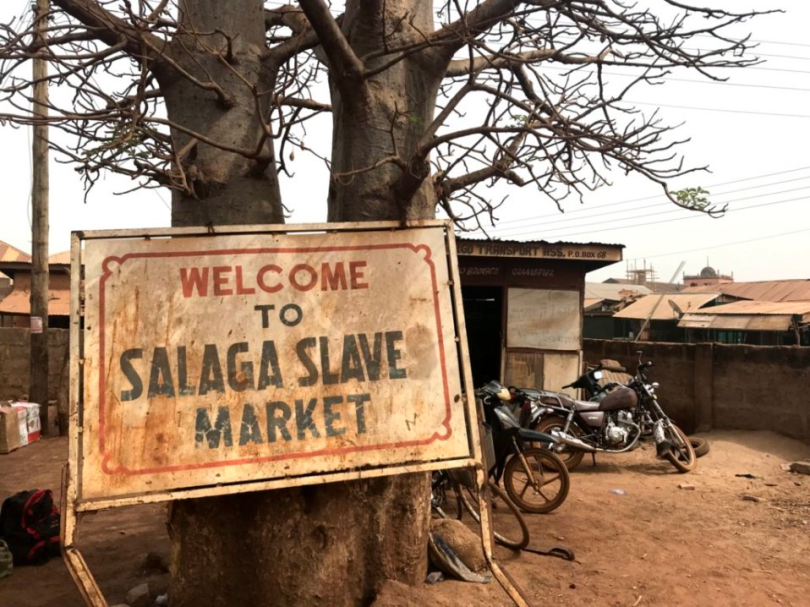
The massive number of enslaved Africans forced into ships for the trans-Atlantic voyages did not freely walk down to the coast. Excepting some early slavery raids, largely by the Portuguese, they were generally captured and enslaved by Africans and then forcibly taken to the coast to be sold. One estimate is that nearly 10%, or 1.209 million of the trans-Atlantic slaves, were taken from the Gold Coast or present-day Ghana (https://www.slavevoyages.org/). Others suggest that more than half a million people from Northern Ghana were sold into slavery in the period 1732 to 1897 while thousands of others were killed in the slave raids[3], with the bulk of slaves sold on the Gold Coast coming from the Salaga slave market[4] located in northern Ghana, 600 km from the Cape Coast Castle. In considering historical wrongs, it would also be right to examine this part of the trade.
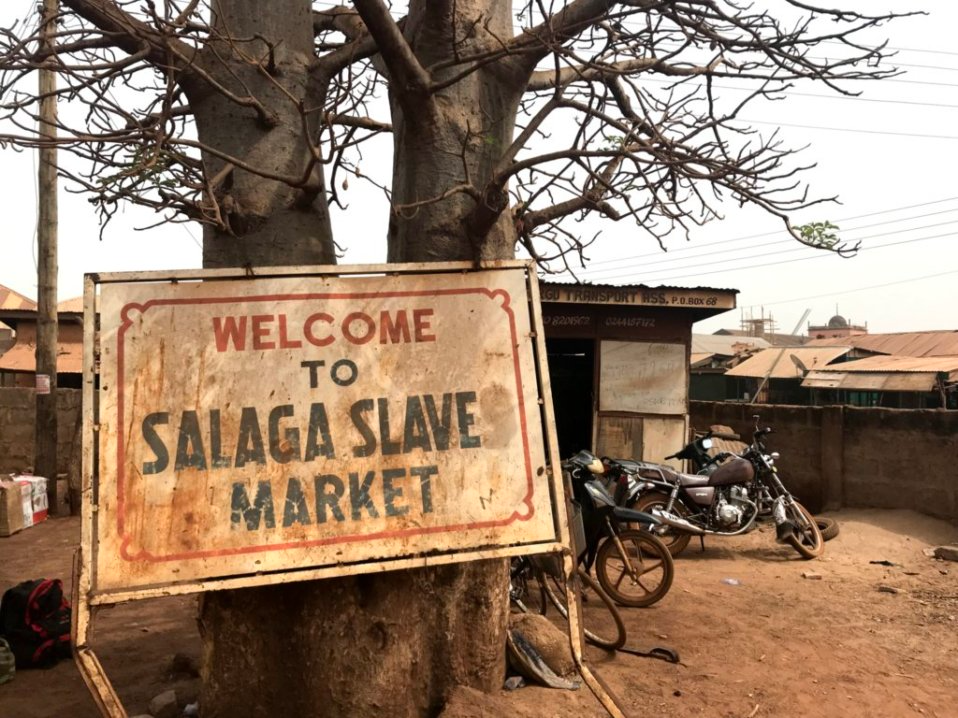
Site of the former Salaga Slave Market, northern Ghana
President John Dramani Mahama is a distinguished member of his local society. He was born in Bole, a northern town in what is now the Savannah Region but was once the western capital of a divisional chieftainship of the Gonja kingdom. His father, the first MP for the West Gonja, is said to have held (was ‘enskinned’) the Zenpe chieftainship (Zenpewura, ‘skin’ or stool of Bole), and his grandfather, the Gbenfu chieftainship. Mahama is therefore, according to Alhaji Abass Dangba, the leader of the Kuntunure Clan of Damango[5], Royal of Bole, and can ascend to the paramount chieftainship of Bole where succession is rotated among four groups. The Bole chieftainship is one of seven providing, again by rotation, the ultimate ceremonial Gonja chieftain (Yagbongwura or King).[6] Being Royal of Bole (Ngbanya), the President is considered to be a descendent of Sumaila Ndewura Jakpa (King of Gonja 1675-97).
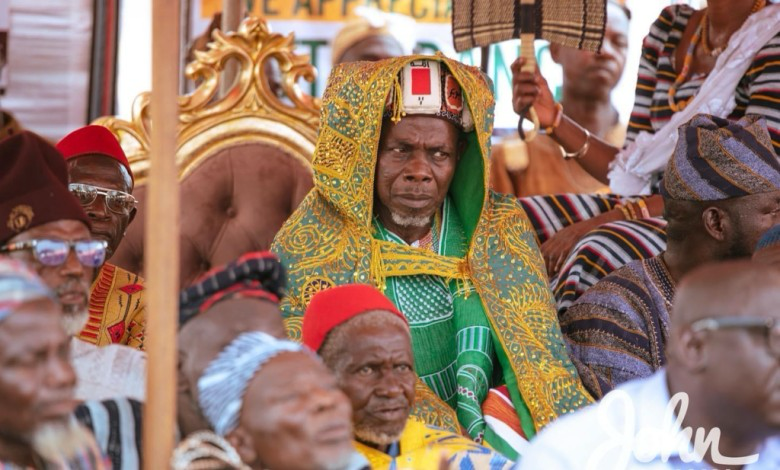
The current King and Overlord of the Gonja Kingdom, Yagbonwura Bii-Kunuto Jewu Soale I
The Gonja kingdom is said to have been established by Mandingo Muslim cavalry, invading from Mali in the 17th century, as part of the interminable tribal warfare from the 11th to 18th centuries in the northern part of Ghana where ‘domestic slavery was an immemorial institution’[7] with constant warfare being the engine of enslavement. Domestic, or indigenous, slavery provided labour for agriculture, bureaucracy, mining, trade and industry as well as for household services, distinguishing those from slaves exported beyond West Africa.
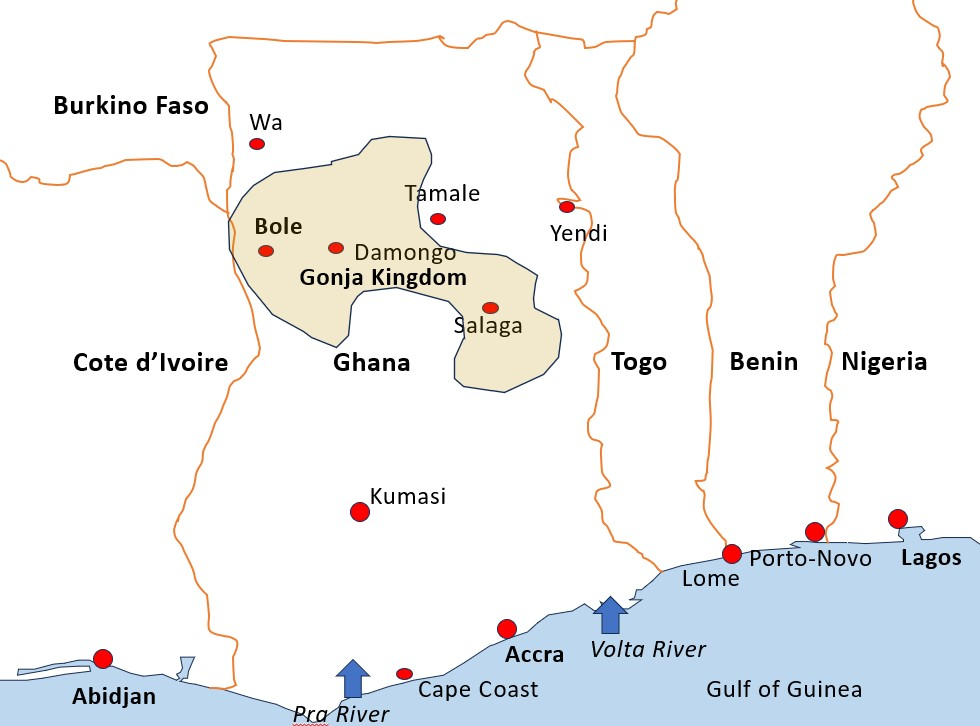
Map of the Gonja Kingdom
Sumaila Ndewura Jakpa established by conquest in the late 17th century a loosely knit federation of states that extended over areas of the northern part of present-day Ghana and parts of Togo and Benin. Pre-colonial Gonja society was heavily stratified, relying on a slave class for labour, with an economy largely dependent on kola nuts, gold and slave trading.
‘When the external slave trade was introduced in Ghana from the 17th Century onwards, domestic slavery and trade were well established institutions. The external trade did not decrease or destroy the domestic trade; the two systems existed side by side sustaining each other’.[8]
The early 17th century slave trading included the Portuguese buying slaves from other parts of West Africa, particularly from Benin, and then selling them in Ghana for gold, a practice also followed by the Dutch and the Danes.[9] In the northern region there were four main slave markets: Salaga, Yendi, Bole and Wa, with Salaga being the most famous and most important market in Ghana for both the trans-Atlantic and trans-Sahara trades.[10] According to the German researcher Heinrich Klose in 1899, in Salaga ‘in former times, it was estimated by older travellers, there was a turnover of 15,000 slaves annually’.[11]
The Asante empire emerged in 1696 with King (Asantehene) Osei Tutu taking the crown in his capital Kumasi. After the Asante invasion and conquest of Gonja in 1732 and Dagomba in 1744, those states were required to pay annual tribute to their overlords which they did by raiding lesser clans like the Kasena, Sisala, Kusasi, Builsa and Frafra to make the tribute of some 1000 – 1500 slaves per division or chieftainship per year.[12] The slaves were moved along four main slaving routes from the northern territories to Kumasi. These included the route from Wa and Bole to the Asante capital and then to the coast.
The Asante hegemony was disrupted by the British, firstly with the 1806 Foreign Slave Trade Abolition Act outlawing slave trading with foreigners, which ended near two-thirds of the West African export trade, and secondly, in armed conflicts. These conflicts included three wars over the period 1806-14 until an 1821 treaty; then four wars over the years 1823-96, after which Asante became a British Protectorate in 1897. There followed a rebellion in 1900.
From 1631, the English, along with other European nations, had established coastal trading posts or forts along a thin 300-mile coastal strip which initially stretched between the Volta and Pra rivers on land rented from local chiefs. After the establishment of the Royal African Company in 1672, these were also used as slaving hubs. By 1700, England had 13 forts of various sizes largely located near the Cape Coast Castle,[13] which, after 1752, was run by the African Company of Merchants. It was their President between the years 1830-47, Capt. George Maclean, who secured the 1821 treaty with the Asante.
Whilst Maclean was highly valued in the Gold Coast, the British Government came under pressure from abolitionists who considered he was not doing enough to end slavery after the 1833 Slavery Abolition Act.[14] Consequently, in 1843 the Government took back control of the colony whose sovereignty only extended to the forts’ walls and no further, as was still the case in 1874.[15] Colonial ‘Ghana’ did not come into being until 1902.[16]
The 1874 Treaty of Fommanah (Fomena), ending the Third Anglo-Asante War[17], required the Asante to end slave tributes and human sacrifices and accept free trade. The unforeseen consequences from the collapse of the Asante regime[18] were secession attempts by members of the Asante federation, independence declarations from conquered states like Gonja, Asante moves to regain territory, and the emergence of new warlords in the north taken to slave raiding. All this led to constant and endemic warfare and further enslavement. This period witnessed a tremendous surge in the ‘domestic’ use of slave labour[19] as the economy transitioned from exporting slaves to exporting other commodities.[20]
The British, long inclined to indirect rule and a colonial policy of reconciliation, had relied on chieftainships where they existed, and they strengthened them in areas where they were non-existent or weakened by civil wars or slave raiding. This was formalised in the 1883 Native Jurisdiction Ordinance. Whilst in 1866 the Secretary of State for the Colonies had reminded the Governor at Lagos that slavery was not permitted within the colony and that neighbouring chiefs should be warned that any slaves entering the territory would be freed,[21] the colonial government pragmatically sought to balance the ‘native custom’ of ‘domestic slavery’ against the abolitionists’ pressure.
The end of the Third Anglo-Ashanti War in 1874 led to a great British public debate on slavery in the Gold Coast with the Under-Secretary of State noting in Parliament:
‘… unhappily, domestic slavery was an institution on the Gold Coast… If we were to insist on the total and immediate abolition of slavery on the Gold Coast, the Government must ask … for something like a million either to compensate the owners of the slaves or to maintain troops for carrying on another war. Therefore, the Government proposed to seek the gradual…abolition of domestic slavery’.[22]
Governor Strachan’s careful announcement later that year that protection would be available to any slave in the Colony who fled or complained but that ‘slaves will be entirely free to stay or leave their masters’ was seen by some in the press as sensible in the circumstances.[23]
Ongoing concern was stoked by British Commissioner Reginald Firminger, resident in Salaga in 1887-89, who critically reported that ‘From the evidence given by the King and Chiefs which I verified by numerous independent inquiries, it appears that about 20,000 slaves are disposed of in one way or another annually’.[24] The pressure to suppress slavery continued and, having been long reluctant to extend control with greater expense and no material gain,[25] the British began to expand control outside the Colony to the Asante and the Northern Territories, partly to suppress slave raiding, partly to secure free trade to improve the Colony’s viability, and partly to keep out the French and Germans.
The Governor sent the civil servant George Ferguson to secure friendship treaties in the Northern Territories in the period 1890-95 with various rulers including the chiefs of Bole, Daboya, Yendi, Bimbilla, Wa and Gambaga[26] but ‘he took it upon himself to persuade local communities in the Northern Territories that treaties of friendship with the British offered protection against slave-raiding, and that they should not engage in the slave trade themselves.’[27] By 1902, the Governor reported that ‘In the Northern Territories … slave raiding has been completely stamped out, but slave dealing is prevalent’[28] and the practice did not die out until after the 1928 Abolition of Slavery ordinance.
The endemic conflict between tribes, or ‘ethnic majority groups’, over territory and chieftains, continued in the post-colonial history of the Gonja people, the smallest of the majority ethnic groups. They endured numerous conflicts, colloquially referred to as the Bull Cow War (1940), Pito Bar War (1981), Nawuri-Gonja War (1991-92), Guinea Fowl War (1994-95) and Nanumba Dagomba Gonja v Konkombo War (1995-97).[29]
This long and violent history of indigenous slavery is not unknown in West Africa. In 1994 the then-Ghanian President, Jerry John Rawlings, apologised for Africa’s role in slavery[30] noting
‘I am not enthusiastic about (financial) reparations. Those taken during the transatlantic slave trade must decide. If they return, we should offer them land and dual citizenship as restorative and social justice’.[31]
In 2009, the Civil Rights Congress of Nigeria demanded that traditional Nigerian rulers apologize for their ancestors’ roles in the trans-Atlantic and trans-Saharan slave trades. They argued that African chiefs collaborated with European and Arab traders by raiding communities and selling people: thus Africans must accept responsibility rather than only blaming Europeans.[32] In response to President Mahama’s role in leading the recent UN resolution, the Ghana Minority Leader, Alexander Afenyo-Markin, remarked;
‘When a vessel docks at Cape Coast and you travel to Bono, Ashanti or Assin areas to capture your strongest among your own people, then after a century, demand compensation – who compensates whom? We maltreated our own and invited the white man to do the same. The story must be told in proper context’.[33]
In Ghana, early post-independence historians tended to characterise West African slavery as near-benevolent in contrast to the harsh Americas’ experience. They also overlooked enslavement through warfare and raiding. They focused on the struggle for freedom rather than the opposition to abolition. They pointed to the trans-Atlantic trade rather than the trans-Saharan or Indian Ocean trades. Obviously the ‘militarisation of the West-African peoples expanded the slave trade, as the demand for European firearms incentivized the capture of slaves, while the weapons made enslaving easier’,[34] and European slave demand created profitable opportunities for those who could control the supply.
After 1806 British imperialism largely aimed at abolishing the African slave trade, securing free trade, and forestalling the Germans and French in Africa in general. It now stands condemned by a Ghanaian leadership whose own ancestors fought against the prevention of slavery. President Mahama blames the colonialists and refuses to join the British and other Europeans in the league of infamy he has constructed. The truth is clear, however: Mahama’s royal ancestors were slaveholders and slave traders long before, and also long after, Europeans came to the coasts to collect and transport slaves.


