

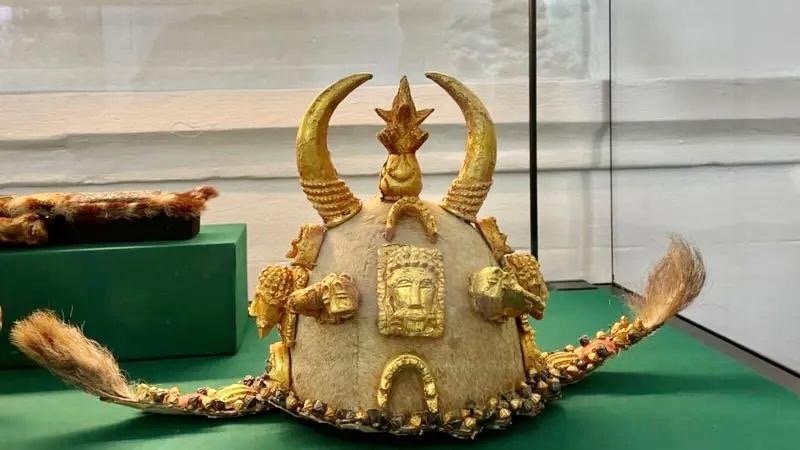

Belgium has a new law[1] enabling state museums to return violently acquired artefacts to their former colonies. Last month a similar bill was presented to the French ministerial council for debate in their parliament in September. Tristram Hunt, director of the Victoria & Albert Museum, recently noted that “our entire society, and therefore our museums, reflect hierarchies and structures that are rooted in colonialism” and he set out “how museums can engage with, and develop from, the coming era of restitution and repatriation”.[2] While recognising that the law[3] wholly prevents the ‘de-accession’ of any objects, the ‘cultural partnership’ route around that is “long term loans of artefacts to source nations” for renewable three-year periods, up to a maximum of nine years.
Accordingly, in May 2024, 32 pieces of Asante (Ashanti) gold and silver regalia, from both the V&A and the British Museum,[4] were returned to Kumasi (Coomassie), the capital of the Asanti people, and loaned to a Ghanaian citizen, Otumfuo Nana Osei Tutu II, the Asantehene or chief [5] of the present Asante region which is about the same size as Wales.

Asante King Otumfuo Nana Osei Tutu II
Hunt had explained that his museum pieces derived from a punitive expedition in 1874 which “stripped the royal palace of the Asantehene of its vast treasures. This was not an episode of frenzied theft, but a rather calculated affair,”[6] and that
After the 1807 abolition of the transatlantic slave trade, the empire’s focus turned to gold reserves and coastal trading routes. The Asante refused to succumb to the British protectorate and cede commercial rights. In response, the British army launched a ‘punitive expedition’ to exact reprisals against the Asante king … led by Major General Garnet Wolseley[7] – the Kurtz of 19th-century British colonial violence …. After burning towns and defeating Asante troops, the 42nd (Royal Highland) Regiment of Foot[8] paved the way to enter Kumasi on 3 February. There Wolseley forced upon the Asante a grossly unequal treaty and exponential indemnity payments, and then appointed prize agents to gather the most valuable material from the palace to be sold at auction, with profits distributed among the troops.[9]
Others, like Dr Kwame Opoku, a former UN legal adviser in Vienna, described the expedition as oppressive colonialism, invading in order to violently loot cultural artefacts of indigenous people against the law of the international community leaving modern British museums as “voracious, monstrous and omnivorous citadels of loot”.[10]
These perspectives depend upon the rewriting of evidential history, even acknowledging the point made by Henry Morton Stanley[11], the New York Herald correspondent who was there at the time, that tracing the history of an African nation that “has no written record for its basis, would appear too much like romancing”,[12] although he was confident he had understood the oral history.
Firstly, what has often been described as the ‘Asante Confederation’ was, in fact, an empire that violently colonised, ravaged and enslaved the adjoining peoples of the Fanti, Akeyah, Becquah, Accra, Denkera, Assin, Wassaw, Akim, Kroomen, Adansi and other tribes. As The Times special correspondent then noted, “Every village was a kingdom; at every thirty miles another dialect was spoken”.[13] At its height, the Asante Empire was said to encompass three million people.[14]
Two key sections of the February 1874 (supposedly) ‘grossly unequal treaty’[15] at Fommanah (Fomena) explicitly required that the “King of Ashantee, on the part of himself and his successors, renounces all right or title to any tribute or homage” from these other tribes, and forgoes “for ever all pretensions of supremacy over Elmina, or over any of the tribes formerly connected with the Dutch Government, and to any tribute or homage from such tribes.”[16] The treaty also required the end of human sacrifices and the introduction of free trade.
The ‘exponential indemnity payment’ in the treaty was 50,000 ounces of gold dust, though only 1,040 oz was actually paid.[17] As Wolseley reported to the government, “the main point was to obtain the treaty of peace, and that the money being important chiefly as a proof of complete submission, the quantity actually now paid was a matter of comparatively secondary importance” given that “the payment of a few thousand pounds cannot be a matter of relatively so great importance as the maintenance of peace.” (13 Feb 1874).
The Asanti economy, in common then with many in the region like those of Dahomey, Benin and the Yoruba people, was substantially a slave economy. The economic argument for the conflict at the time was that the landlocked Asanti Kingdom had to trade its gold dust and some slaves through the Fanti costal tribe who unduly exploited their position as ‘middlemen’ with high tariffs. Frederick Boyle, theDaily Telegraph correspondent on the scene, contended that this was inconsistent with the facts: “The only middle man in the commerce of this coast is King Koffee[18] himself, and he does the agency with a vengeance. The whole interior trade … passes through his hands”[19]. Whilst Henry Stanley thought the ‘middlemen’ issue plausible, he considered it to be purely an Ashanti versus Fanti war. He noted that “the Ashantees have simply invaded the Protectorate, at which the British Government might have smiled undisturbed, for all that the Ashantees might have injured any of England’s actual possessions along the seaboard.”[20]
His point only makes sense if one understands that Britain then had no colony to protect. It was only in possession of the coastal trade forts established by the Dutch, Portuguese and the English Royal African charter company. English trading forts had been established as early as 1553[21], before the emergence of the Asante nation in about 1700. Slowly, West African trade reorientated to face the Atlantic rather than the Arab states across the Sahara. Settlements grew up next to the European trade forts,[22] and the Asanti and Fanti states gradually coalesced.
Following years of conflict, the Asante launched an invasion of the coastal tribes in 1806, killed 20,000 Fanti[23] and gained control over the Gold Coast. After British slave trade abolition in 1807, the local economy collapsed and the British government’s inclination was to abandon the Gold Coast forts altogether, but the abolitionists argued against this.[24] After a Commission of Inquiry’s report (July 1811) recommended that some forts should be retained by the charter company to promote civilisation and legitimate trade, and in order to end the slave trade, Britain retained the key trading forts. Conflict with the Asante continued, however, as both the British and Asante claimed sovereignty over them.
Commodore Sir James Yeo reported in 1821 that slave trading was still continuing,[25] and Lord Liverpool’s tory government decided to directly administer the Gold Coast forts and place them under the control of Sir Charles McCarthy, Governor of Sierra Leone,[26] which was located 900 miles away. After one of his local militia was murdered by the Asante, McCarthy decided on a punitive expedition. He was supported by all the coastal tribes and two inland tribes – effectively, they were all rebelling against the Asante. It was the first of the three Anglo-Ashante Wars and it didn’t go well. McCarthy’s skull became the base of a gold-rimmed drinking cup, used by the Asante rulers.[27]
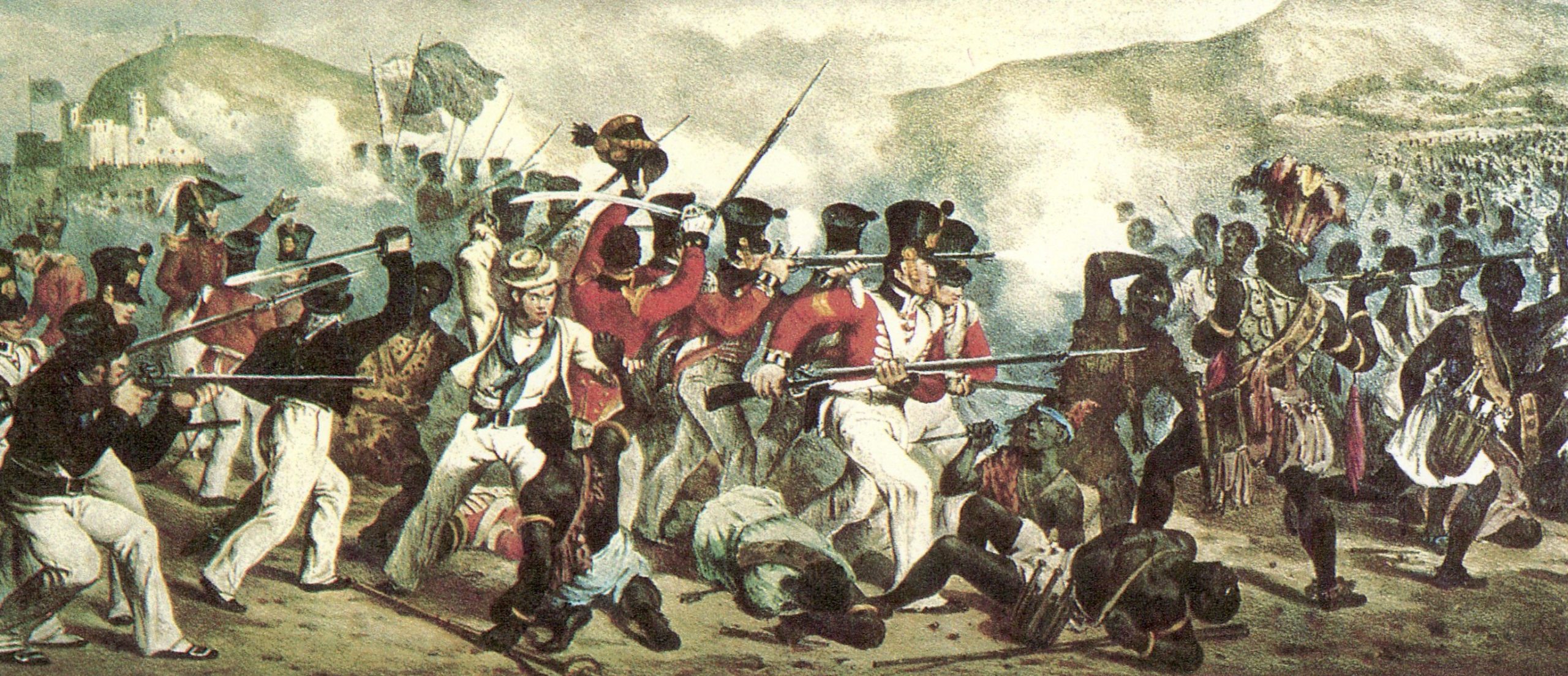
‘Defeat of the Ashantees by the British Forces under the command of Col. Sutherland, July 11th 1824′, National Army Museum.
The replacement Governor doubted that the forts were worth retaining and recommended that either the British withdrew completely, or secured the coast properly. The Colonial Office, however, did not endorse either course of action.[28] After two further Asante invasions and varying attempts to reach some agreement with them, the Government decided in 1826 to drop disengagement plans and return control to British merchants, with a subsidy to help with defence. The President of the Merchants’ Council, Capt. George McClean, secured a peace treaty in 1831 which provided that he be the arbiter in any dispute between the Asante and their subject tribes, and which implied future protection for local tribes against Asante aggression. For approximately three decades following, the British in the forts held judicial authority over the coastal hinterland,[29] which grew to become a protecting power, though without any formal sovereignty. The British government expressly forbade the territorial expansion of the forts.[30]
Unfortunately, the British anti-slavery movement considered that McClean was not doing enough to extirpate slavery, so the government decided in 1843 to take back control of the forts and to regularise the purely judicial function over non-British territories.[31] The Asante remained aggrieved by this Protectorate, by their loss of the Assin, Akim, Akwapin and Denkyera states in the 1831 treaty, and by the British prohibition of the slave trade. They invaded in 1863 and the defence was so mis-managed that the Asante ravaged the coast. The debacle led to yet another formal inquiry with the coastal chiefs losing all confidence in their ‘protectorate’ and many in Britain seeking full withdrawal from the region. The conclusion was for a phased withdrawal from all bar Sierra Leone and no expansion. Further conflict followed, particularly after the Dutch withdrawal, and the Asante invaded again in 1868 at a time when the British were increasing their interference in the affairs of the coastal states. In 1873 the Asante invaded the coastal tribe areas, intent on a full scale war.[32]
The Secretary of State for the Colonies had made it clear (17 May 1869) to the Protectorate chiefs that “the wars that they engage themselves in are their wars and not the wars of this country, and the British Government is unable to make itself responsible for their defence.” The coastal tribes, however, failed to unify, consolidate and effectively resist the Asante invasion. With the forts under possible threat, the Government sent two companies of the Royal Marines, four companies of the 2nd West India Regiment and further supplies for reinforcement. British thinking then developed further, tending to a punitive expedition[33] to Kumasi as necessary to restore the status quo.
The first Gladstone administration, taking office in late 1868 and full of firm believers in fiscal rectitude including balanced budgets, low taxes and minimal expenditure[1][34], was well aware that such expeditions were expensive and unpopular and, if they failed, could lose them office.[35] But after seven Asante invasions of the coastal areas it became clear to the Colonial Secretary, in Wolseley’s words, “that all hope of making definite and lasting peace with the Ashantee king until his army had been utterly defeated was merely the dream of timid men.” On the Secretary’s insistence, Colonel Sir Garnet Wolseley was appointed Governor and military leader of 4,000 European, West Indian and African troops who, with the advantage of quick reloading rifles and two Maxim machine guns, eventually forced their way into Kumasi after a short campaign in early 1874.
When they got there they found what reporter Frederick Boyle described as
a town over which the smell of death hangs everywhere, and pulsates on each sickly breath of air — a town where vultures hop at one’s very feet, too gorged to join the filthy flock preening itself on gaunt dead trunks that line the road; where blood is plastered, like a pitch coating over trees and floors and stools — blood of a thousand victims, yearly renewed …Verily this is the metropolis of murder.[36]
Henry Stanley suggested that “at the rate of a thousand victims a year, it would be no exaggeration to say that over 120,000 people must have been slain for ‘custom’ since Ashantee became a kingdom.”[37] This description of the remains of mass human sacrifice in Kumasi is very like the scenes of similar ritual human slaughter that the British encountered in Benin City in 1897 when they entered the kingdom of Benin. In both cases, the objects derived from these slave-owning, sacrificial states, and taken to the west – whether Ashante Gold or Benin Bronze – have become controversial today.
Upon entry to Kumasi, “the Fantees, Kroomen, and native levies at once began to loot, and in an hour’s time houses were blazing. Tired as they were, our men had to turn out to preserve order, and to save the town … although it seems probable that the most valuable articles have been removed.”[38] Wolseley had given orders forbidding any unsanctioned plundering[39] of the fabled ‘barbaric gold’ treasures and consequently one of the Fanti troops was hanged and a dozen African policemen flogged for the offence.[40]
The correspondents also reported that ‘thousands’ of Asante were still in the town. Wolseley ordered they be left alone and so overnight they all slowly departed – “They had departed, with their guns on their shoulders, and their treasures on their persons, with their slaves, overnight” and “I presume that this sort of thing had been going on all the night. Some golden treasure was still left in the palace ; how much then must have been taken away.”[41]
The next day, the “the prize agents went into the palace and principal chiefs’ houses, and proceeded to pack up the most costly things they could discover to sell, for the benefit of the army after arrival at Cape Coast,” although, as Stanley related,
had Sir Garnet Wolseley planted a cordon of guards around Coomassie when he first arrived, and ordered every person desirous of leaving the city to be searched, he might have been able to have secured much wealth of gold dust and valuable plunder. As he neglected to do so, it is unnecessary to say that the troops will suffer in the loss of prize-money…”[42]
It appears, therefore, that the major or a substantial part of the Asante treasure was carried off into the bush by the Asante themselves, and then the remainder looted by the native tribal infantry in Wolseley’s army, who perhaps considered this recompense for the Asante looting from them. The treasures forming the army prize money that were auctioned, with express Crown permission, at the coast for about £4,000 (approximately £390,000 today) and largely to locals, were later judged inadequate by the Disraeli government who awarded 30 days extra pay in compensation.[43] The indemnity gold objects were acquired for £11,000 in April by Garrard & Co. in London for retail sale and these largely form the two London museums’ collections today. In short, very few of the Asante treasures ever reached London, and most of the ‘loot’, if that is the preferred term, was spirited away by the Asante themselves.
War ‘booty’, spoils of war, or war trophies had been an intrinsic aspect of warfare for centuries. Several of the Asante trophies still lie in regimental museums or messes today. Booty, alongside treaty indemnities, was also then partly seen as a way of recovering the cost of war by the victor. It was common during the Napoleonic Wars, though the Duke of Wellington in the Peninsular Campaign evolved restrictions, and also a mechanism to ensure his troops remained in formation rather than dissipating to plunder. Under Wellington, booty was collected and sold and army prize money was then fairly distributed. Looting, an Anglo-Indian colloquial term, was common in India but the restrictions, and custom and practice, developed[44] to the point where Major Anson MP could contend that “our Army was the only army in the world where there was any system of distribution of the prizes of war.”[45]
The taking of war booty was not then illegal under international law, a form of law which is essentially contracts between nation states. The Hague Convention of 1899 provided the first restraints on the taking of civilian property but the wartime plunder of cultural objects was only explicitly forbidden in the 1954 Hague Convention.[46]
Hence, in 1874, forcibly taking gold artefacts from people was not unusual, or illegal, in the British, Asante, or Fanti armies The British invasion of Asante lands was not colonial oppression since it did not involve the planned establishment of a colony. Nor was it a response to an attack on the trade forts. It was a reaction to an invasion of the neighbouring Gold Coast tribal kingdoms. It may have been partly in defence of trade but it was also, judging from the main articles of the treaty, to prevent human sacrifices, slavery, and the oppression of the coastal tribes.
The conventional historical narrative tell us that what immediately happened next was the passage, on the 24 July 1874, of the ‘Gold Coast Colony Act’ or “the British, following their defeat of Asante in 1874, proclaimed the former coastal protectorate a crown colony, the Gold Coast Colony” (Wikipedia), so perhaps it was oppressive colonialism after all? However, one will find no such Act on the statute books of Parliament. There were extensive debates in the House of Commons over March – August 1874, which included Disraeli’s and Gladstone’s accounts of the war ,[47] and a reminder by the Under-Secretary of State for the Colonies that there was a great deal of difference “between the system which prevailed in ports under the British flag and in the adjacent districts”, namely that “beyond the very walls of the forts there is no sovereignty, properly speaking, vested in the British Crown, but that the whole adjacent country is subject to the dominion of the native Powers.”[48] In essence, the debate lay between those who felt Britain should withdraw from the Gold Coast altogether, and the anti-slavers who considered Britain’s role should be extended there.
In the debate in early May 1874, one MP argued that
we could not leave the friendly native tribes exposed to the revenge of their great enemy, the Ashantees; we could not honourably extricate ourselves from the obligation we had come under to protect them. The treaties we had entered into began only in this century; the most notable of them was that of 1831 … We were not there for honour or for profit, but simply in fulfilment of a responsibility which we had incurred, and from which we could not, for the present at least, escape.
However, another MP noted that
They had spent not much less than a million of money … They had sacrificed a considerable number of valuable lives, either in battle, or from the pestilential nature of the climate … They had destroyed thousands of those savages, burnt down their principal city, together with the villages and towns on the line of march, and had come back bringing with them an old umbrella, £10,000 worth of old barbaric jewellery, and a treaty not worth the paper on which it was written.[49]
It was a war that cost, in today’s equivalent, nearly £98 million, offset by about £1 million of indemnity money. Many wondered why the war was necessary and thought the treaty “will be of little worth, nor can any treaty be accepted as in any way a compensation for the sacrifices we have made in a war which, however glorious its issue, was always unnecessary.” [50]
One MP moved in June that “no arrangements for the government of the territories on the Gold Coast will be satisfactory which involve the recognition of slavery in any form”.[51] The Under-Secretary replied that
unhappily, domestic slavery was an institution on the Gold Coast… If we were to insist on the total and immediate abolition of slavery on the Gold Coast, the Government must ask … for something like a million either to compensate the owners of the slaves or to maintain troops for carrying on another war. Therefore, the Government proposed to seek the gradual…abolition of domestic slavery.
Yet no firm and clear policy emerged until, largely by legal stealth with bills like the 1894 Crown Lands Bill, and the 1897 Lands Bill, the Gold Coast suzerainty emerged at the turn of the 20th century without any formal conquest, cession, or treaty.[52] This was despite costs exceeding revenue over 1895-1900 by an average £53,112 per annum, and gold dust exports falling from £86,186 to £38,096, then equating to 4.32% of all exports from the Gold Coast.[53]
Tristram Hunt has a point about restitution. These events took place more than 150 years ago, museums should not be ‘sites of transitional justice’, and the gold artefacts that reside in the British Museum and Victoria and Albert Museum remain of great cultural significance to the Asante. Why not build cultural partnerships based on the loan of such objects?
However, in making such a case, Hunt and others should also strive to get the history right. The story of British engagement with the Asante empire is not the one-sided account of colonial exploitation and suppression that Hunt published in The Guardian in 2024, but a complex history in which the British also acted in defence of Africans, whether tribes that were menaced by the Asante, those enslaved by them, or those ritually sacrificed by them. Not did they simply loot Asante gold: most of it was spirited away by other Asante in the night. Loan these beautiful objects if you wish, but please ensure at the same time that everyone is in possession of the full facts.
Alistair Parker is a retired town planner and commercial real estate agent in London with a particular interest in the EEIC over 1625-1725, East African colonial history, various British Army regiments, Canterbury’s municipal government 1700-1835 and the Northamptonshire boot trade 1775-1948, largely as an as an amateur genealogist.
[1] Restitution Bill, June 2022.
[2] “Decolonisation at the V&A”, Global Humanities Initiative lecture. University of Cambridge. 25 Jun 2025.
[3] National Heritage Act of 1983 and British Museum Act 1963.
[4] Adding to the 7 pieces just returned by the Fowler Museum at UCLA, originally derived from the Wellcome Collection.
[5] Ghana, Chieftaincy Act, 2008 (Act 759), s.58
[6] ‘Colonialism and Collecting: Decolonisation at the Victoria and Albert Museum’, Magdalen College, Oxford, May 2024
[7] It was actually Colonel Sir Garnet Wolseley as he was made ‘acting’ Major General after the conflict and confirmed as such in 1877, three years later.
[8] Known then as the Black Watch; supported by the Rifles, 23rd Welsh Fusiliers, Royal Marines and 1st / 2nd West Indian.
[9] Tristram Hunt, Guardian 27 Jan 2024
[10] Online Modern Ghana, 6 Jul 2019 & 13 Jun 2025
[11] Stanley of ‘Dr Livingston, I presume’ fame.
[12] Stanley, H., 1876. Coomassie and Magdala: the story of two British campaigns in Africa. New York: Harper, p.240.
[13] Reade, W., 1874. The Story of the Ashantee Campaign. London: Smith, Elder & Co, p.7
[14] Although in 1901 the population of Asante, Coast and the Northern Territories was estimated at only 1.34 million, 1901 Gold Coast Colonial Annual Report, HMSO 1902 (no.375).
[15] Reproduced entirely in most newspapers; e.g. Hampshire Chronicle 21 Mar 1874.
[16] Article 3 & 4
[17] Boyle, F., 1874. Through Fanteeland to Coomassie. A diary of the Ashantee expedition. London: Chapman and Hall, p.374.
[18] Correct spelling was Kofi Karikar.
[19] Boyle, Through Fanteeland, p109.
[20] Stanley, Coomassie and Magdala, p.17.
[21] Blake, J., European Beginnings in West Africa, MacMillen : London, 1941, p.143
[22] Fage, J., Ghana; a Historical Interpretation, University of Wisconsin Press, 1961, pp.51-52.
[23] Stanley, Coomassie and Magdala, p.25
[24] Kilby, P., 1968. ‘The Anglo-Asante War of 1873-1874’, unpubl.thesis University of British Columbia, p.7.
[25] Perry, J,. 2005. Arrogant Armies Great Military Disasters and the Generals Behind Them. Edison, New Jersey, p.98.
[26] West Coast of Africa Possessions Act 1821. (Not, as many contend, an Act to make the Gold Coast a colony but one merely abolishing the African Co. and transferring its forts to the Crown).
[27] Stanley, Coomassie and Magdala, p.18.
[28] Kilby, ‘The Anglo-Asante War of 1873-1874’, p.12
[29] Excluding those around Accra who remained under Dutch influence.
[30] Kilby, ‘The Anglo-Asante War of 1873-1874’ p.15
[31] Foreign Jurisdictions Act 1843 which would also encompass those around the Dutch forts by 1850.
[32] The Third Anglo-Ashanti War (also known as Sagrenti War).
[33] Known in crude Victorian army parlance as ‘butcher & bolt’.
[34] Campbell, T. 2004. ‘Sound Finance; Gladstone and British Government Finance, 1880-1895’, unpubl. Thesis, LSE, London. p.4. https://core.ac.uk/download/pdf/46519165.pdf
[35] Which they duly did at the February 1874 election, beaten by Disraeli’s Conservative Party.
[36] Boyle, Through Fanteeland, p.343.
[37] Stanley, Coomassie and Magdala, p.232.
[38] Boyle, Through Fanteeland, p.346
[39] Watt, P., 2023. ‘”Ashantee Loot is Unique”’. British Military Culture and the Taking of Objects in the Third Anglo-Asante War, 1873-4’, British Journal of Military History, vol. 9, 3, p. 23.
[40] Reade, The Story of the Ashantee Campaign, p.349; Boyle, Through Fanteeland, p.346; Stanley,Coomassie and Magdala, p.245.
[41] Stanley, ibid, p. 228; Reade, ibid, pp. 349, 359.
[42] Stanley, ibid, p.234
[43] Hansard, Vol. 221, 4 Aug 1874.
[44] See Spiers, E., ‘Spoils of War’ in Lidchi, H. (ed.) Dividing the Spoils, Manchester University Press, 2020, and also Watt, ‘Ashantee Loot is Unique’, passim.
[45] Hansard Col.1525, 27 May 1870, Anson had been the prize agent for the sacking of Peking’s Summer Palace and heavily critical of the French army’s ‘free for all’.
[46] 1954 Hague Convention for the Protection of Cultural Property in the Event of Armed Conflict.
[47]Hansard Vol 218, Col.413-425, 30 March 1874.
[48] Hansard Vol 220, Col.616, 29 Jun 1874.
[49] Hansard, Vol.218, Col.1594-1664, 4 May 1874.
[50] Newcastle Journal, 12 Mar 1874.
[51] Hansard Vol.220, Col. 608, 29 Jun 1874.
[52] The Northern Territories (Gold Coast) Order in Council 1901, and Administration of the Government of Ashanti Sept 1901, establishing the Gold Coast Colony, Northern Territories Protectorate, Ashanti Colony and, after 1914, the Togoland Trust Territory.
[53] 1900 Gold Coast Colonial Annual Report, HMSO 1901 (no.344), p.6 (The data exclude railway building expenditure).


