

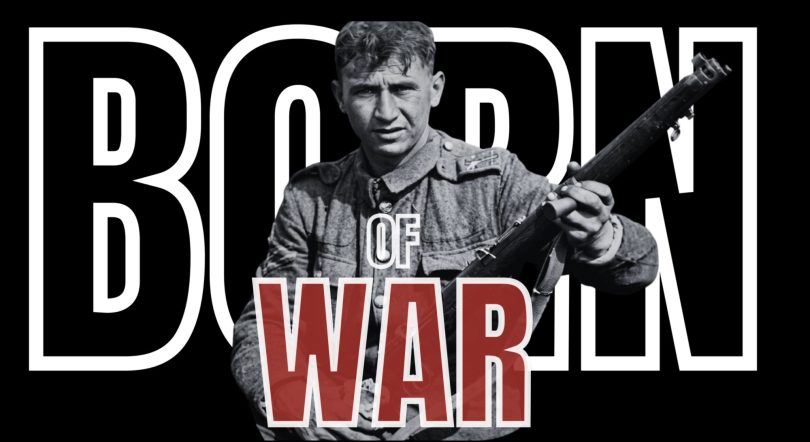

John in youth and old age: “You got nasty yourself when you had to”
The man who has answered the door stands straight, flawlessly dressed, metal grey hair accurately combed. The handshake’s firm, the gaze unwavering – so much so that the tyranny of first impressions tempts me to say that I’ve come to meet his father. But this is Gilbert all right, one of the centenarians we’re filming for BORN OF WAR, a cinema documentary chronicling the experiences of successive generations in battle and on operations.
First, though, Gilbert sketches in a little family history. His father joined the Grenadier Guards – and fought in the Boer War. Returning home to Bristol, he found that there was no work. ‘People were moving to Wales, to the mines. Rhondda Valley,’ says Gilbert. It was the route his father took, only to die when Gilbert was seven.
During the General Strike, Gilbert and his brother scrabbled over slag heaps looking for fragments of coal. At fourteen, he too went down the mine, like everyone else in Tonypandy.
Gilbert was in two minds about which was worse: war or the mines. Memories of one night on a mountain top in Italy swayed him: a wind-whipped night of snow and rain and repeated enemy attacks – repelled, each time, by bayonet charges, at brutal cost.
In the post-war years, words were superfluous, Gilbert’s generation being content to remain in silent communion with contemporaries who’d fought different battles in different campaigns. As another centenarian, Cyril, from Cromer, Norfolk, put it: ‘My brother never spoke of Dunkirk and I never spoke of [Monte] Cassino.’
Nor did Derrick until, finally, in failing health, he let his wife, Peggy, listen while he was interviewed. ‘I’ve heard more in the last hour about what Derrick did in the war,’ said Peggy afterwards, ‘than I have in the whole of our married life – and we got married in 1943.’
Only, perhaps, in the past decade has that generation – indisputably “all in it together” – begun to unshackle its memories, as individual and collective perspective are shifted by longevity and a consequent awareness that those remaining were, and are, marching towards a Harry Patch moment, when only one of them will be able to bear witness, as Patch, the last of the Great War survivors, did until his death, aged 111, in 2009.
That seemed to be what animated Sid and Jack, both 101. ‘I may be blind, I may be deaf, but I’ve still got my marbles,’ said Sid, proving the last point by recalling any number of details from a life which is now beyond emulation. His father, a miner, had died of Spanish Flu before Sid was born in 1918. By the time Sid reached adolescence, he’d successively been a paper-boy, barber’s lather-boy, errand-boy and kitchen porter, before lying about his age to enlist in 1936. He and Jack – who at 14 had followed his own father down the mine – were among the men from two infantry battalions ordered across the Channel at a few hours’ notice in May 1940. A Panzer division closed in on them within hours. They faced it unsupported by tanks and lacking anti-tank guns of their own. ‘A fiasco,’ said Sid. ‘A bloody cock-up,’ said Jack, who’d been called up months earlier.
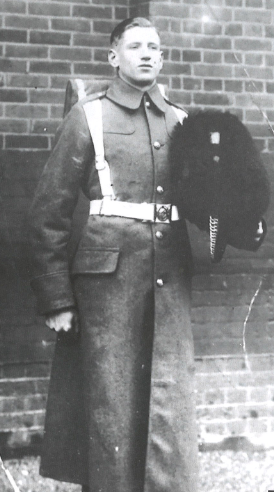
Sid: ‘A Life Beyond Emulation’
Sid in old age: ‘I may be blind, I may be deaf, but I’ve still got my marbles’
Sid and Jack and Alan – who’d enlisted as a drummer boy aged 15 – were three of the survivors of the rearguard action which followed. It was the sort of action replicated throughout the BEF: pockets of ill-equipped, overwhelmingly outnumbered men repeatedly displaying extraordinary bravery pitted against the Wehrmarcht, the disparity in forces being the baleful, inescapable legacy of the so-called 10-year rule, formulated by the Treasury in 1919. ‘It should be assumed,’ the rule stipulated, ‘that the British Empire will not be engaged in any great war during the next ten years, and that no Expeditionary Force is required for this purpose.’
The rule was ditched in 1932 – too short a time for Britain’s arms industry to recover before the outbreak of war, as David, who enlisted in 1938, recalled. ‘The chaps in bowler hats came down and gave us this anti-tank gun. Swore that it would penetrate any German tank. It couldn’t shoot its way out of a bloody council dustbin. We never saw it again.’
‘All we had was a bit of fighting strength. We didn’t have the weapons,’ added David, one of the last survivors from Dunkirk where he remembered the perverse beauty of the tide washing corpses and limbs littering the beaches. ‘I thought the sand was fluorescent but it wasn’t. It was oil from the ships.’
On the face of it, defeat was total – but not for the regulars. ‘Never thought for a second we’d lose,’ said Alan, mentioned in despatches in 1940. ‘Never at any time.’
It’s impossible to assess exactly what effect that belief had on those who in peacetime would never have put on uniform but were by then being wrenched from civilian life and into the forces. But Napoleon’s dictum – that, in war, the moral is to the physical as three is to one – is probably an accurate yardstick.
‘You knew full well when you were eighteen you were away,’ said Wilfred who left the family farm in Pembrokeshire for the Guards Depot. ‘We knew what we were fighting for.’
John had volunteered at the outbreak of war – to his father’s horror. ‘He said, “Were you called up?” I said: “No”. “Oh my God,” he said, “you’ve joined them.” His parents were from pre-partition Ireland. But John’s allegiance was never in doubt. A generation later, one of his sons became Roman Catholic padre to the SAS.
It is these men who are at the heart of BORN OF WAR, speaking shortly before fading away, thereby preserving their experiences from oblivion. There’s a recollection of a repeatedly decorated officer fighting hand-to-hand, to neutralise a threat to his men; a description of the escape of another officer, just weeks after capture – ‘you should hear this crowd…you should hear the cheers’; an encounter with a third, taking delivery of his tank before the Normandy Landings: ‘A lieutenant came out, shook us by the hand and wished us good luck. And that was Rex Whistler.’ And there’s Tom, producing a pre-war photograph of a Dutch family, its fate sealed by a war crime of the sort now routinely perpetrated by Hamas, and explaining that he remained in contact with one of the survivors for the rest of her life: ‘her name was Miel…Honey.’
The post-war years are in some ways just as sobering – if not in scale or consistent barbarity, then because they show how the armed forces have been allowed to shrivel into a caste remote from, and unknown to, most of the population – now unaware, for example, of the challenges faced in Northern Ireland in the 1970s. Soldiers were to open fire according to rigid rules of engagement – rules, they were told, which were enshrined in law. That fiction dissolved in subsequent decades as veterans became courtroom fodder for a political class which had no concern for those it hounded nor any comprehension of the debt it owed them. ‘A patrol had got into bother in the markets area,’ remembers Ray. ‘The company commander and I went round the corner and were engulfed.’ Spencer was in the nationalist Ardoyne area when ‘loyalists’ detonated a bomb. ‘If we hadn’t got out, we would have been beaten to death.’
If there is a consolation for the Northern Ireland generation, it is that, at the time of their deployment, there were wartime men in government who understood the realities of conflict as they summarised by John when, noting how ‘the Jerries [became] bitter…nasty’ as the war neared its end, acknowledged: ‘you got nasty yourself when you had to’.
Those deployed to Afghanistan were hard pressed to detect similar understanding in the governments which sent them.
Whereas American and Australian forces tackled the Talibans’ bombs – IEDs or Improvised Explosive Devices as the jargon had it – with ground penetrating radar, British forces were equipped with the Vallon – ‘a metal detector…great if the device contained metal’, and with Viking armoured vehicles – ‘coffins on wheels’.
There had been no ’10-year rule’ – just the smug assumption that there was an endless ‘peace dividend’, which could be enjoyed while simultaneously committing British troops to successive overseas conflicts whose precise objectives seemed susceptible to varying interpretations.
On return home, there could be no silent communion for them in places across the country, as there had been, for Gilbert and Cyril and Derrick, for decades afterwards. In a changed Britain, nor can there now be any presumption that many of its citizens would replicate an instinctive allegiance of the sort displayed by John, wounded three times and awarded the Military Medal for ‘personal courage, skill, and unwavering resolution’. That will not change until the governing class sheds the current delusions about the size and composition of the army, and accepts instead that, if an army is to prevail, it must, instead, transcend the limitations and deficiencies which now define contemporary Britain.
BORN OF WAR is a privately financed independent cinema documentary, being released next year. To offer support or simply to find out more, please visit: bornofwar.co.uk


