The material accompanying this British Museum exhibition didn’t suggest a particularly accurate and balanced presentation of history, and it lived down to expectations. The exhibition of Hew Locke’s work, entitled ‘What Have We Here?’, is a potpourri of interactions between (white) Europeans and (black/brown) Africans and Asians over (approximately) the last five hundred years.
To provide some context (which is sadly lacking in this show), by the 15th century the Ottomans controlled the eastern Mediterranean, taking Constantinople in 1453. They were expansionist and tried to take Vienna in 1529 (and also in 1683) and besieged Malta in 1565. The Portuguese, meanwhile, explored the west coast of Africa seeking an alternative route to India, and reached the Indian Ocean in 1487, some half-a-century after the Chinese had left. In 1492 Spain supported Columbus’s attempt to reach the “Indies” by sailing westwards, not knowing it was further than he believed and that the Americas were in the way. Subsequently, Europeans would dominate much of the world, to be succeeded by the United States, effectively an offshoot of Europe, which looks like being replaced by China this century.
This context is required because in this exhibition Locke “has chosen objects from Africa, the Caribbean, South Asia and Europe over a two-year collaboration with staff across the British Museum. He shows these alongside his own artworks to explore the legacies of British imperialism.” Without historical background, Locke’s choices and remarks on the labels often seem random.
We’re told that “exhibitions usually have a thread as the story unfolds. I’m purposely not doing that, to echo how you create an artwork – the gathering of objects, collage, layers.”
It’s a bit like throwing mud at a wall, however, and hoping some will stick. Visitors are challenged to ask “What story is being told about the past? How does it relate to the present? How can this telling be questioned or complicated?” But without context and a framework into which these artefacts can be placed, it’s difficult to know what questions to ask, let alone answer them.
There are many things in the exhibition to take issue with, but only a few lowlights can be discussed.
The charter granted to the Company of Royal Adventurers into Africa (later the Royal Africa Company) is displayed, and it’s claimed this is “a difficult, sometimes ignored piece of English history”. “Which history we remember depends upon what’s been made visible for you!” opines the label. Actually, there’s been rather a lot of discussion in recent years of the Company, its history of slave-trading, the role of Charles II in establishing it after the Restoration, and the responsibility for its actions 350 years later of his distant descendant Charles III. But you wouldn’t learn that here.
Charles II’s role in slave-trading isn’t balanced by any discussion of other aspects of his reign: his role in the Civil Wars of the 1640s, his father’s execution, his escape to the continent after the Battle of Worcester, his resumption of kingship in 1660 and the struggles with parliament over the terms of monarchy thereafter. To anyone unfamiliar with British history – which will be many, if not most, of the visitors – his life, and a vast slice of seventeenth century history, is narrowed and distorted in the concentration on slavery and the slave-trade, which to him then, more than a century before the existence of an abolition movement, would have counted for little, hard as it may be to accept that today.
The RAC receives further coverage: “Between 1672 and the early 1730s the Royal Africa Company transported more enslaved African people to the Caribbean than any other institution globally” and “as many as 160,000 Africans between 1672 and 1731, more than any other single institution during the history of the transatlantic trade.”
But there’s no context for these statements. The number is a little over 1% of the total of enslaved Africans transported to the Americas between the 15th and 19th centuries, and the Portuguese transported most of these, almost 4 million out of 11million. Indeed, 95% of slaves transported across the Atlantic before 1650 were taken by the Portuguese. British slave-trading accounts for 3 million of this total, largely during the eighteenth century.
The coverage of slave abolition is minimal. The famous print of the Brooks – “Description of a Slave Ship” – which was also exhibited at the Fitzwilliam Museum in Cambridge in their 2023-4 exhibition ‘Black Atlantic’ https://historyreclaimed.co.uk/slavery-at-the-fitzwilliam-empire-at-the-royal-academy-two-exhibitions-compared/ and which was used by the anti-slavery movement to dramatise conditions below deck on Atlantic slave ships, is supplemented by a “Print of a mother threatening to jump overboard with her child”. These anti-slavery prints “presented events in a theatrical manner to draw sympathy from European viewers and support for the abolitionist movement”. The print is British, about 1850, decades after the abolition of both the slave trade and slavery throughout the empire, and was presumably intended to put pressure on the United States where slavery was still legal. This could be better explained.
It wasn’t a surprise that there was no mention of the practice of human sacrifice as well as slave hunting and the slave trade in Benin and throughout West Africa. If the end of the Third Reich in 1945 was a good thing, then so was that of the Kingdom of Benin in 1897.
Unfortunately, some exhibits verge on the ludicrous. “There was a time when the relationship between Europe and Africa was very different”, we’re told, though when, precisely, and in what way it was different, is not made clear. The statement is illustrated by a medieval English jug, an African sculpture of a Portuguese soldier, and a Portuguese cannon. “Each illustrates connections that existed before British imperialism”, which is true enough, but the point is obscure. Apparently, “These objects tell a complicated story of what that relationship was at one point, and how it could have developed before it went off the rails.”
It’s difficult to know where and how to begin to discuss statements like this. Did it go off the rails when we stamped out slavery in West Africa, as in Benin? Or when Britain established colleges and universities in Sierra Leone, Nigeria and Ghana? Somehow, the exhibition has omitted to tell us that it was the Portuguese who pioneered links with West Africa and were the first to transport slaves across the Atlantic from 1526.
It would, however, be churlish not to commend the treatment of the complicated history of the Koh-i-Noor diamond which was given to Queen Victoria in 1849 under the terms of the Treaty of Lahore in that year: “It’s not as simple as saying ‘it should go back’ – where should it go back to?” It’s claimed by India, Pakistan, Iran and Afghanistan, which is why it might be better staying where it belongs, in the Crown Jewels in the Tower of London.
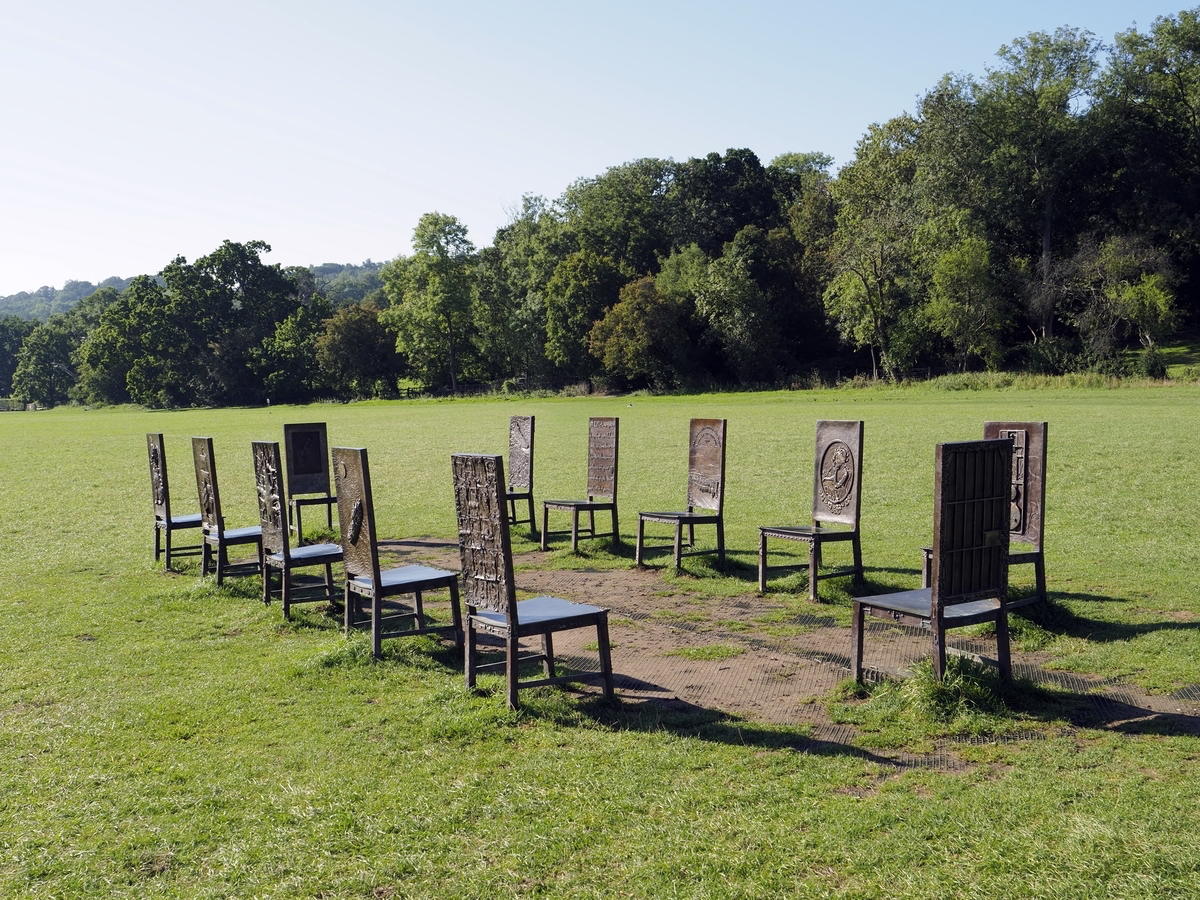
There is a potentially worthwhile exhibition here. But this isn’t it. It would need the help and expertise of historians who aren’t activists, and the provision of much more historical context. Hew Locke crafted a fine monument at Runnymede to mark the 800th anniversary of Magna Carta. Would it be churlish to encourage him to leave history to the experts and stick to what he’s good at?