


Readers may be aware that the Imperial War Museum has announced the closure of its Ashcroft Gallery as from this summer. https://www.telegraph.co.uk/news/2025/02/28/vc-winner-families-attack-imperial-war-museum-close-gallery/
Established in 2010 thanks to a benefaction to the museum by Lord Ashcroft, it displays the medals and stories of servicemen and civilians awarded the Victoria Cross and George Cross. Fascinated by heroism and self-sacrifice, Lord Ashcroft has been collecting these decorations for many years and he placed them on long-term loan to the IWM so that the wider public could see the medals, learn about their recipients, and share his admiration for them.
According to Lord Ashcroft himself and many press reports, he was only informed of the decision to close the gallery in February of this year, 2025, though the decision was taken by the Director-General of the IWM, Caro Howell, and the Trustees last July. https://www.telegraph.co.uk/opinion/2025/02/26/i-was-never-informed-of-the-iwms-plans/ Ms Howell is relatively new to the museum, having been appointed in 2023 after previous experience at the Foundling Museum, the Whitechapel Gallery and Tate Modern.
In an obscure corner of their website the IWM explains that it wishes to address more recent British conflicts in the museum and presumably requires the space now taken up by the Ashcroft Gallery. The museum wishes to create ‘new gallery spaces on upper floors at IWM London, which will allow us to share more stories of conflicts that are within many of our visitors’ living memory’. https://www.iwm.org.uk/events/lord-ashcroft-gallery
If that’s the case, perhaps the answer is not to close the Ashcroft Gallery or any other exhibits, but use the IWM’s worldwide reputation and many friends to raise funds for a gallery extension so that more things can be displayed. It surely shouldn’t be a zero-sum game in which exhibits of the greatest interest are removed.
In the absence of a clear rationale for this decision, there must be a suspicion that other factors are at play. One hopes these are not ideological: that someone objects to displays of military heroism in itself, or to medals won in imperial campaigns. Surely the point of the Ashcroft Gallery is to commemorate heroism? The campaigns themselves are almost secondary. It is the self-sacrifice, often in the support of colleagues and friends, that is being remembered. So far, the Museum’s officials and trustees have not commented. My message to one of the trustees asking that the IWM reconsiders has gone unanswered.
I must declare an interest in this because in 2009 my Oxford college, St. Peter’s, sold the medals of Noel Chavasse, one of only three ‘double VCs’ to Lord Ashcroft specifically so that they could form part of the new gallery and be displayed. Hitherto they were kept in a drawer. They had been left to the college by its founder, James Chavasse, Bishop of Liverpool, the father of Noel.
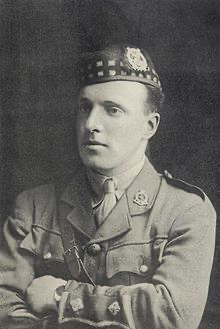
Captain Noel Chavasse (9 November 1884 – 4 August 1917)
One of twins (Noel’s brother Christopher was later awarded the MC), they both represented Great Britain in the 1908 Olympics in the 400 metres heats, though neither qualified for the final. Noel became a doctor and was a captain in the Royal Army Medical Corps attached to the 1/10th (Scottish) Battalion of the King’s Liverpool Regiment in the 55th (West Lancs) Division. He was awarded his first VC for his treatment of the wounded in no-man’s land during the Somme offensive at Guillemont on 9 August 1916. He was awarded his second posthumously for actions at the Third Battle of Ypres ( Passchendaele) the following year when, at Wieltje in Belgium, over two days at the beginning of August, he ‘went out repeatedly under heavy fire to search for and attend to the wounded who were lying out’. He died of his own wounds and is buried in Brandhoek New Military Cemetery.
St. Peter’s wanted Noel Chavasse’s life to be more widely recognised and his selfless acts appreciated. So did Lord Ashcroft. And so, it was thought, did the Imperial War Museum. Lord Ashcroft had always indicated that at his death it was his intention that his collection would pass to the Museum, and the college thought this was the perfect place and setting for the Chavasse medals in perpetuity.
It’s to be hoped that public scrutiny of this decision, and even government intervention, might sway the IWM to reverse their decision. There’s a possibility that the Ashcroft collection might go abroad to a Commonwealth country. This might be a very good outcome but it would deprive a British audience of the opportunity to appreciate the service of largely British recipients.
It hardly needs adding that a decision taken 9 months ago now looks out of time. Perhaps military heroism seemed unfashionable then and something of an embarrassment when all the other museums in London were ‘calling-out colonialism’ and so forth. But as we all know, the world is changing and the mood will change with it, probably very quickly. Self-sacrifice in military conflict may not be a thing of the past, to be consigned to the vaults or ‘returned to sender’.
Readers are encouraged to write to the Director of the Museum, Ms Caro Howell, and the Chairman of the Trustees, Sir Guy Weston, to ask them to reverse this decision at: The Imperial War Museum, Lambeth Road, London SE1 6HZ.


