

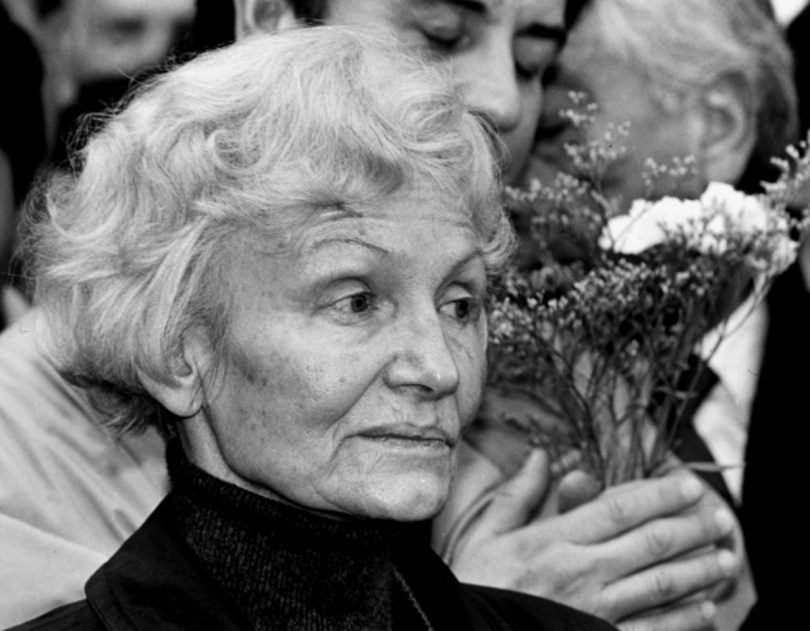

In 2012 and 2013, when I was British Ambassador to Chile, I had three long meetings with a still living dinosaur – Margot Honecker, third wife of longtime East German leader, Erich Honecker, and Minister of Education of the German Democratic Republik (GDR) in her own right all the way from 1963 to 1989. It was her job to produce new, suitably indoctrinated communist generations. Margot, née Feist, was in her mid-80s when we met and made it to 89 before passing in 2016.
I’d spent time in the GDR as a student on a rare UK university exchange in the early 1980s and remained fascinated by this joyless, sinister Marxist experiment thereafter, long after its demise. The Berlin Wall had been down for as long as it was ever up by 2017; by 2030, the GDR itself will have been gone for longer than it ever actually existed.
But look at the map of the recent German elections, where the AFD’s highest vote share almost exactly coincides with a map of former East Germany, and the division sometimes still feels real enough, though not in a way its former Communist masters would have dreamed of.
The GDR was a failed experiment in replacing one tyranny, Nazism, with another, Soviet Marxism. Both these German forms of totalitarianism eventually ceased to exist entirely, the former by losing an aggressive, genocidal war it sought and started, the latter overthrown by its own people, fed up with the fear, repression and drudgery of their daily existence. The horseshoe theory of politics on German soil.
Margot Honecker was amongst the true believers, all-in in her youth at the start of the East German experiment and a die-hard for its ideology long after emptied Stasi prisons became macabre tourist attractions.
She ended up in Chile in 1992, joined a year later by her husband for what turned out to be the last full year of his life, both effectively escaping justice for the crimes of the bleak dictatorship they ran uncontested for 18 years.
They were thereby repaid a favour by the then left-of-centre Chilean government who gratefully recalled the GDR’s acceptance as refugees of some 2,000 hardcore supporters of Marxist President, Salvador Allende (1970-73), turned fierce opponents of his military vanquisher, Augusto Pinochet. Those refugees included later two-time President Michelle Bachelet who has just ruled out a third run in Chile’s next elections later this year.
The Honecker’s daughter Sonja married one such Chilean, hence the more direct, family connection. And of course, the Honeckers weren’t exactly swimming in offers of a second home in the early 1990s, unwanted in Moscow, unloved in united Berlin, unwelcome elsewhere in the new Europe ‘whole and free’.
Twenty years later, it wasn’t easy to track Margot Honecker down. By then, she was living a near hermit’s life in Santiago’s eastern La Reina district, hard up against the Andean foothills, and she could still barely speak any Spanish. It took a year of tentative negotiations through contacts in the Chilean Communist Party to get her to talk, given her paralysing suspicions of anyone outside a tiny clique of ideologically aligned sympathisers.
When we finally met for the first time, at the British Embassy Residence, she asked repeatedly – in German throughout – why the UK Government was so interested in her views. I tried to find a diplomatic way of explaining that, in fact, they weren’t, and this was simply an inquiry of purely personal interest, a chance to discuss a chapter of history I’d experienced directly with a key, living witness. I don’t think she believed me.
During many hours of debate, including throughout a rare dinner with outsiders at her house, she didn’t give an inch. The political ideology of her whole adult life was, she told me, “objectively correct” as an inexorable reflection of the true human condition. Karl Marx had unlocked the deterministic path mankind must necessarily take. Capitalism had one day to collapse under the “weight of its inherent contradictions” – her exact cliched words. She had nothing to apologise for.
The GDR experiment had been honourable and successful, but its Western enemies constantly undermined it. However much communism was inevitably bound to win in the end, imperialism and capitalism had still been strong enough in the late 20th Century to fight back successfully. But “the seed survives and will blossom again one day”. Meanwhile, though, the demise of the GDR had been an “immense tragedy”: Germany had lost its “better half” (more accurately, a third) and millions of its former citizens were now clearly much worse off.
That was one of Margot’s many mindboggling inversions of the truth. The Stasi – “the sword and shield of our Republic” – had been necessary because “internal class enemies” sought to bring the system down in order to then enrich themselves through the exploitation of their fellow citizens under a renewed free market system. It took a long time to build socialism, as it included having to change a human mind-set which had evolved through centuries of capitalist conditioning. In the end, her comrades had not been allowed the time to finish the task.
There were of course far more enemies outside the GDR, particularly in West Germany, which is why the Wall had been necessary: “you wouldn’t leave a delicate seedling to be devoured by ravenous birds”.
GDR citizens knew the rules perfectly well, including what would happen to them, if they tried to climb over. Most of those who did had in any case been deliberately wound up to do so by West German agents or were simply the small number of deviants and criminals who made up any society. The western press had never reported the numerous cases she preposterously claimed of West Germans climbing over the Wall in the opposite direction to find peace of mind in a socialist paradise. Perhaps they never reported them because they never happened, I ventured back – a momentary stony silence.
Where Margot became truly animated was about Mikhail Gorbachev whose name she mentioned dozens of times with something approaching spitting rage. He was the ungrateful recipient of the greatest benefits of Soviet socialism only then to undermine and destroy them, deliberately sacrificing the GDR in the process, just to ingratiate himself with Helmut Kohl.
Gorby’s coming to power was, she colourfully put it, the equivalent of a Pope being elected who then told the Catholic Church that it had to allow abortion and accept homosexuality, thereby destroying its whole raison d’etre and internal structures. Gorbachev was simply a monstrous traitor to the cause that had raised him, as he sought to turn himself into a millionaire.
I batted most of this back, though to her credit the atmosphere never became too icy as a result. I explained to Margot that a formative experience for me had been lying in an East Berlin bed and hearing gunfire which I later discovered meant someone being shot while escaping westwards. She just shrugged.
I told her, too, that the film ‘The Lives of Others’ seemed to me a very accurate reflection of my own experience of what everyday life in the GDR was like. No, she retorted, that was organised, imperialist propaganda against us, perhaps financed by the CIA.
I then asked her, if it wasn’t obvious all around us in Chile that a free market, democracy and open society meant greater prosperity for the people than Salvador Allende’s Marxist experiment had managed?
No. Chile and all capitalist countries, especially the US, suffered from gross inequality, economic crime, corruption, unemployment, homelessness, mental illness and violence. She knew that from GDR Embassy reports from behind class enemy lines. But western governments ensured a tame press never reported that news. One of that day’s main Chilean newspapers lying next to us on a table, however, carried precisely several such stories.
Never for a moment did Margot Honecker give any ground or entertain any criticism, other than a brief recognition that the SED (the East German communist party) had had to make up some of its Marxist route map as it went along, so inevitably made some mistakes, though of management, not theory.
Otherwise, she was unrepentant and self-certain. Her vocabulary and diction sounded exactly as the most senior East German apparatchiks would have in the late 1970s. In fact, she never joined the highest echelon, the Politburo, but she was a hugely powerful First Lady – the GDR’s Lady McBeth.
Margot, nicknamed the ‘Purple Witch’ behind her back in her own communist utopia (for her Mrs Slocombe-like dyed hair); Margot who allegedly ordered the forced adoption of the children of jailed dissidents; Margot, overseer of a network of about 150 austere prison-like children’s homes where ‘politically difficult’ juveniles were harshly re-educated into good socialist citizens.

Margot the monster.
However, on a personal basis, she was somehow far from charmless: so much so that my Chilean wife struggled to associate “that sweet old lady” with the crimes and joylessness of the GDR portrayed in ‘The Lives of Others’ which we immediately re-watched after our last long conversation with her.
There was a post-script. At my farewell ambassadorial party in January 2014, many were visibly stunned to see a now frailer Margot Honecker appear amongst the guests. She was perhaps just as shocked briefly to meet Pinochet’s daughter, a fellow invitee as a serving local councillor in the Santiago city borough hosting the Embassy. I don’t know what passed between them, but not, I assume, a meeting of minds. Margot gave me a present that day, a small book of Goethe’s poems printed in the early years of the GDR by ‘The People’s Own Publishing House’ in the near indecipherable old German cursive script. I treasure it still.
My abiding impression well over a decade on is of having met a living embodiment of Hannah Arendt’s ‘the banality of evil’ who died without the merest hint of doubt about her lifelong ideological beliefs or remorse for the consequences of applying them so repressively in the GDR’s system of ‘real existing socialism’.
She was herself guilty of, and a very close accomplice to, grave offences against the most basic human rights of millions, but on our front room sofa she seemed like a humbled, reduced human being who it was hard to envision could have ever hurt a fly.
All in all, meeting Margot Honecker remains one of the most bizarre experiences of a 38-year diplomatic career. As I reflect on it now, it was also one of the most troubling. But there are still plenty of people left in Chile prepared implacably to defend either the same rigid political dogmas she believed in, as embodied in Allende’s government or, conversely, the crimes and injustices of his military regime nemesis, Pinochet, who ran a diametrically opposed type of ideologically-motivated dictatorship, which ironically finally left the historical stage in 1990, the same year the GDR did itself.
Jon Benjamin is CEO of Free Speech International (fsu.world) and was British Ambassador to Chile, Ghana and Mexico. He is @jonbenjamin19 on X and at jon@fsu.world


