

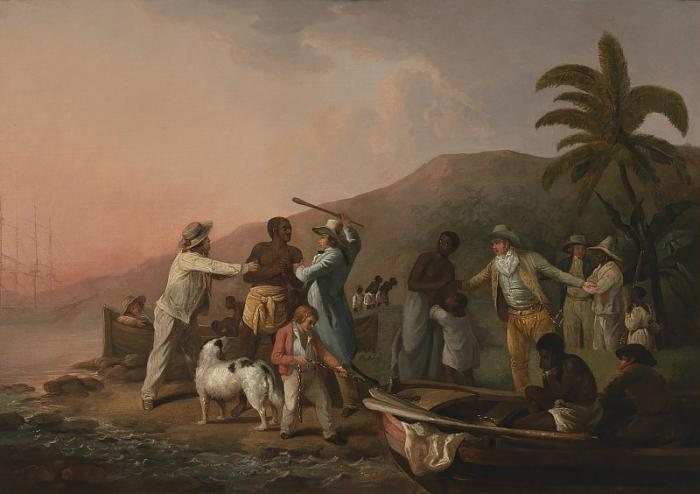

Featured Image: The Slave Trade (Execrable Human Traffick, or The Affectionate Slaves) by George Morland, 1788 (Smithsonian National Museum of African American History and Culture)
The Register of British Slave Traders was published in mid-September and publicised through The Guardian newspaper which devoted eight articles to it in the week beginning September 14th. The project involved three years of work by teams of historians from three universities – Lancaster, Manchester and University College, London – and was funded by £700,000 of public money granted by the Arts and Humanities Research Council.
History Reclaimed has already queried the absence of quantified data in the presentation of the Register by The Guardian. There is no way of knowing whether the numbers adduced by the researchers are large or small, even though they make claims for the enormous economic and social influence and legacy of the British slave trade. Using contemporary calculations from the early 19th century we have shown that the economic scale of the slave trade relative to the size of British overseas trade and the British economy as a whole was negligible and that the overall leader of the project, Professor Will Pettigrew, has exaggerated. See: https://historyreclaimed.co.uk/register-of-british-slave-traders/
Conducted over the past few days, an inevitably brief dive into the data presented in this Register throws up many issues of accuracy, definition and also omission. We apologise for the length but please read on to see how history is distorted.
Let’s begin with omission. The headline figure of a Register containing ‘13,000 slave-traders’ is being reported as the project’s preeminent finding. If so, where are they all? On the 28th September the public Register available online contained 6,373 profiles only. The Guardian reports that around 2.500 South Sea Company investors are not part of the published Register and that identifying information and records were found for about 6000 of the other 10,500 investors in the slave trade. So who and where are the rest? And what evidence supports their classification as slave traders? The 13,000 figure is already entering the public domain, yet much of the evidence concerning individuals is not publicly available. Who were the missing 4000-plus slave traders? (See The Guardian explainer here: https://www.theguardian.com/uk-news/2026/sep/14/register-british-slave-traders-africa-research )
Now let’s consider definition. The Guardian’s guide to the Register (see above) defines a slave trader as someone who ‘invested in directly financing a ship’s transportation of enslaved African people in expectation of a profit share.’ But the Register also includes children who inherited shares in companies involved in the slave trade, notably the Royal African Company which traded in slaves between 1672 and 1731; adults who inherited shares and quickly sold them; and executors merely handling estates. (Executors do not own the property of the dead, merely administer it. They will have had no control over the prior investment decisions of those on behalf of whom they execute testamentary bequests).
A child cannot be held responsible for investment decisions made by others, nor for profits gained. We’ll return to this with some examples from the Register in a moment.
There are also cases where so-called slave traders aren’t linked to any slave voyages at all, contradicting the definition of a slave trader as presented in the Register according to The Guardian.
The language used in the Register shifts between ‘investor’, ‘slave trader’ and ‘trafficker’. Penguin, the publisher of Professor Pettigrew’s accompanying book, Britain’s Slave Traders, declares that the project sought to identify ‘every known investor’ and then refers to the 13,000 people as ‘these traffickers’. The terms have different meanings and cannot be used interchangeably. To cite a recent example of the confusion of terms and the problems it leads to, in the Rustat case in 2022 involving a famous monument in the chapel of Jesus College, Cambridge, the students were told that Tobias Rustat was a slave trader. They evidently imagined he had a ship and a crew at his disposal. In fact, he was a dutiful courtier, sent by his king, Charles II, to serve as a Director of the Royal African Company. https://www.penguin.co.uk/books/460026/britains-slave-traders-by-pettigrew-william-a/9781847927903
Finally, let’s turn to accuracy and consider some examples drawn directly from the published Register.
Mary Delahay is linked in the Register to 65 slave voyages. She is one of the 13,000. She inherited shares from her mother which were placed in trust for her and managed by executors when she was a one-year-old. No further purchase of shares is recorded. Is a baby a slave-trader?
Rachel Bateman is linked to 57 voyages in the Register. Shares were placed in trust for her when she was about three or four years old and they were managed by adults. No later purchases were recorded. She is another of the 13,000 slave traders.
The identity of Anne Allicocke is unclear, but it seems likely that, as her brother and sister held shares in the Royal African Company (hereafter RAC), this Anne Allicocke held them also. But she only held them between the ages of 15 and 17. Is it sensible to describe a teenage girl, for whom financial decisions were being made by other people, as a ‘slave trader’?
Grace Barrow isn’t linked to any slave voyages at all (and so according to the definition in The Guardian isn’t a slave trader). She inherited shares and, according to the Register, she immediately sold them through her attorney. In what way was Grace a slave trader?
The cases of Sarah Wallis , Mary Harle and Elizabeth Franklin are all similar: none of them is linked to a slave voyage and in all three cases they held shares only by virtue of their respective roles administering estates. By what twisted logic can executors be included in a register of slave-traders?
Or take the case of Susannah Asselin who isn’t linked to any slave voyages either. In her case she inherited shares in May 1736 and sold them in July, two months later. She might have been an early, unsung heroine of anti-slavery. Under what research methodology is she defined as a slave trader?
Hannah Pepys is another of those who inherited shares ‘and sold them shortly after’. Isabella Hardinge inherited stock in the Royal African Company from her brother and sold it ‘shortly after’. Jane Tench Soresby inherited shares from her mother in 1738 and ‘sold them later in that year’. Anne Akerman inherited shares in the RAC in 1725 and passed them ‘in the same year’ to one of her sons-in-law. Dame Mary Everard inherited shares in the RAC from her husband in 1677 and ‘sold her shares back to his executor a short time later’ in 1678. Susanna Dashwood is not linked to any slave voyages. She inherited RAC stock from her husband’s estate, passed £500 worth to her daughter and sold the remaining shares. Ann Forward inherited her husband’s shares in the RAC in March 1732 and had disposed of them by September. Why are any of these people in the Register?
Elizabeth Collier inherited her husband’s holdings in the RAC on his death in 1733. The Register tells us that she didn’t have full ownership of the shares until 1740. But the Royal African Company ceased trading in slaves in 1731, the year of its last voyage. Why is she in the Register, therefore? The same goes for Arabella Brocas who inherited shares in the RAC in 1738, seven years after the Company’s last slave voyage.
Esther Crull inherited shares from her husband in 1733 and, according to the Register ’she sold them almost immediately’. Her entry continues: ‘The Company conducted one crossing trafficking an estimated 284 African women, men, and children on the Royal Caroline from West Africa to Veracruz in the year she invested.’ But this is a flat contradiction because she never invested herself, merely inherited and sold. You can sense their desperation in the following sentence: ‘As a companion and beneficiary of her husband’s estate, her indirect ties to investing in slavery lasted much longer.’ This is ridiculous, of course. Even in doing the right thing and selling the shares, Esther is convicted of guilt by association. It is all the evidence required to demonstrate the cock-eyed moral world of the researchers and the inaccuracy of their Register. This purports to be a Register of slave-traders, not of ‘indirect ties to investing in slavery’. Esther is entirely blameless.
We haven’t had time to dive deeper into the depths and murk. But note that all these cases concern women. None of them should be in this Register because none of them purchased shares personally or was in any sense directly involved in slave-trading. Why have the researchers picked on women in this way? The laws of property made them subordinate to their husbands throughout the era covered by this Register, circa 1550-1807. The first Married Women’s Property Act wasn’t passed until 1870. Not only were these women innocent; they were essentially helpless, lacking in agency. How very odd that a project about slave trading should come up smelling of misogyny. This is history as witch-hunting.
To inflate the numbers to a so-far unproven and undisclosed ’13,000’, children, women who inherited shares and quickly sold them, and executors handling estates have been labelled as slave traders. None of the people discussed above organised, directly financed, or chose to invest in slave trading. So what exactly does the Register of Slave Traders include, and why should we trust it?
Biographical research is sometimes difficult. Factual mistakes are understandable. But these aren’t errors of fact. People from the past without any responsibility for slave trading are being falsely branded as such.
History Reclaimed will be making a formal complaint about these matters to the Arts and Humanities Research Council. Public money is involved. Taxpayers have a right to expect that the research they fund achieves the highest standards of accuracy.
Professor Lawrence Goldman was the Editor of the Oxford Dictionary of National Biography from its publication in 2004 until 2014. He is an emeritus fellow of St. Peter’s College, Oxford


