

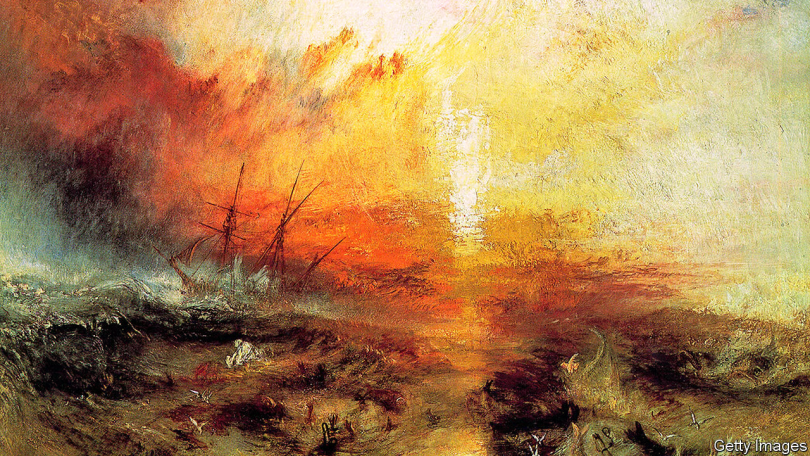

J. M. W. Turner, Slave Ship (Slavers Throwing Overboard the Dead and Dying, Typhoon Coming On) (1840).
In a speech in Wheeling, West Virginia, in February 1950, Joe McCarthy, US Senator for Wisconsin, claimed to have a list of 205 Communists employed in the US State Department. By the following day in a speech in Salt Lake City in Utah the number had dropped to 57. He later claimed there were 81 card-carrying subversives on his list (though the list contained 80 names only). When he came before a Senate committee the number had dropped to 10. By then, McCarthy’s credibility was in tatters.
Senator McCarthy and these episodes come to mind for several reasons when assessing the newRegister of British Slave Traders, compiled by Professor Will Pettigrew of King’s College, London with the help of teams of researchers from Lancaster and Manchester Universities and University College, London. https://britishslavetraders.org/
Like Senator McCarthy, the Register keeps changing its numbers and leaving us in suspense. According to The Guardian, which, in the absence of a published introduction to the Register explaining its methods, definitions and findings, is the only place we can go for information, the Register ‘lists 13,000 men and women’ (Guardian, 6th Oct). But a snapshot of the online public Register on 7th October contained only 6,374 individual profiles, of whom 5,493 were marked ‘in progress’ and only 881 as ‘complete’. What is going on?
Numbers:
The original Guardian explanatory article told us that around 2,500 South Sea Company investors from the early eighteenth century were not in the Register, although they were included in the 13,000 figure, and that identifying information had been found for about 6,000 of the remaining 10,500 https://www.theguardian.com/uk-news/ng-interactive/2026/sep/14/register-british-slave-traders .
The 13,000 figure risks becoming established as the total actually listed in the Register, even though approximately half that number only are currently available for public scrutiny, and most of these published profiles are marked ‘in progress’. Like Senator McCarthy’s list, when you test the numbers, they keep changing and the case being made dissolves before your eyes.
Not that the case is very strong: as we’ve explained already, if 13,000 people were involved in slave trading over a period of two and a half centuries, from 1555-1807, during which era between 25 and 30 million people lived in what became Britain, we are dealing with a tiny minority – and we are not the ‘enslaving nation’ that Pettigrew calls us.https://historyreclaimed.co.uk/register-of-british-slave-traders/
Definitions:
The second reason that McCarthyism comes to mind is the failure to sensibly define the meaning of the term ‘slave trader’. Just like Senator McCarthy, who had difficulty defining who, exactly, was a communist in the US government, this Register slips and slides across categories. As we have shown in a previous article, the Register includes as ‘slave traders’ widows and children who merely inherited shares in the Royal African Company and the South Sea Company from husbands and fathers, as well as executors who had legal responsibility for settling an estate. Executors sold the shares immediately; in many cases, the widows did the same. But in the spirit of McCarthyism, they are all tarred with the same very broad brush.https://historyreclaimed.co.uk/register-of-british-slave-traders-flaws/
Is a shareholder a slave trader? For many years the Universities Superannuation Scheme that provides pensions for lecturers invested our contributions in petrochemical companies. Does that make its current beneficiaries, and the researchers who have compiled this Register and will one day be USS beneficiaries also, ‘oil traders’? I think not.
Or ask this question of those national institutions which the Register also fingers: were Guy’s Hospital, Barts (St. Bartholomew’s) Hospital, and the Royal Society ’slave traders’?https://www.theguardian.com/uk-news/ng-interactive/2026/sep/14/london-hospital-st-barts-funded-donors-invested-slave-trade No, they and their founders were investors seeking a return to support their worthy purposes, albeit from what is now seen as an immoral investment.
The use of the word ‘trafficker’ in the Register only adds to the confusion. It is used as a synonym for ‘trader’, and thus also for a shareholder, but according to one definition ‘human trafficking’ is ‘the unlawful act of entrapping, transporting, transferring, harbouring, or buying human beings through force, fraud, or coercion for the purpose of exploiting them for profit’.https://en.wikipedia.org/wiki/Human_trafficking Traffickers were (and are) involved in overt acts of capture, transportation and sale. This term doesn’t describe thousands of people caught up in the 13,000 (if that figure really exists) in the Register.
The purpose of academic history:
The third connection with McCarthyism may be the most distressing of them all: is this what academic history has become? Is history now to be understood as the naming of names (however inaccurately) and the laying of allegations of guilt against people in the past who cannot reply and explain; who did nothing wrong under the laws that then applied; and who are being judged by our standards rather than theirs? Nothing is further from the real challenge of academic history which is to explain the past in its own terms.
There is a fourth connection, as well. Joe McCarthy spread fear and discord across America from the late 1940s until the mid-1950s. He stoked purges of employees in public service and in schools, and innocent officials and teachers lost their jobs because they thought and spoke differently from the majority. It wasn’t just in Hollywood that people were fired or lost the capacity to speak freely.
We’re enjoined daily to eschew ‘hate’ and practice social and racial inclusivity. We might legitimately ask of the Arts and Humanities Research Council, which provided £700,000 of public funds to support the research for this Register, whether it thought that a listing of slave traders, however defined, at this moment in time, would assist community cohesion? Would the AHRC also support, say, a listing of communist fellow-travellers in post-war Britain, starting from the 38 names that George Orwell compiled for the British Foreign Office in 1949?[i] It was Orwell, remember, who famously invented the ‘two minute hate’ in 1984. This Register offers the opportunity of hours and hours of hatefulness. Or would the AHRC favour a listing of all those people and families known to have supported the Mosley movements between the early 1930s and mid-1960s? What public good is served by listing such people and then implicating their descendants?
If you think the persecution of the living is far-fetched, think again. I’ve been involved in one case where someone who owns land in the Caribbean which was once part of a slave plantation has been ‘named and shamed’ in a doctoral thesis written at – wait for it – the University of Cambridge. (You just knew it would be Cambridge). I made the obvious point that academic research does not need to name the living to make its case: there are long-established conventions of referring to examples anonymously. Sadly, but unsurprisingly, when the person concerned complained about their treatment to the university, Cambridge did nothing.
Indeed, we might go further and ask why it was thought that a list of people in the 17th and 18th centuries, many with tangential associations to slavery, was the correct way to set about studying the slave trade as it was conducted by some Britons? There has been good work on the history of British slave trading, including a highly-regarded monograph by Professor Pettigrew himself.[ii]There are many things still to be learnt about where and how the odious trade was conducted. But judicious sampling can tell us all we need to know about the types of people who, at different stages, were directly involved in the trade. Lists of thousands of people, whether complete or in disarray, are simply beside the point. I have searched across the internet for a portrait of any one of about 60 women named in the Register whose entries I have accessed, but I cannot find a single image. Taken individually, these people are lost to history and should remain so.
History as Persecution:
Four decades ago the medieval historian R. I. Moore coined the phrase ‘persecuting society’ to describe the behaviour of West European polities between about 950 and 1250 that deliberately marginalised and persecuted groups like heretics (for example, the Cathars in southern France), Jews, homosexuals and prostitutes. In this way they reinforced the religious purity and solidarity of their own societies.[iii]
Today, it is only in a ‘persecuting society’ such as ours is becoming, that such a project as a Register of Slave Traders could attract support. It bodes ill for the future of academic history if this Register sets the tone, and becomes an example for others to follow. Slave traders, however ill-defined, must be persecuted in the past. Present-day historians who try to historicise their behaviour, ask for clearer definitions, or criticise the deliberate moralisation of history will also be persecuted by means of professional ostracism.
Biographical dictionaries and registers have usually celebrated achievement, notability and social and political influence. Nevertheless, the most famous of them all in Britain, the (Oxford) Dictionary of National Biography, which dates from 1882, always included criminals and malefactors, as well as benefactors of society. In all cases, good or bad, it has striven to achieve a balance, noting both the merits and demerits of the person.
This Register of British Slave Traders, on the other hand, makes no effort to tell us about the achievements, benefactions and public goods contributed by the many people it includes who were not directly involved in actual trading. It is one-sided history, always incomplete, because its aim is to persecute rather than explain. Thus Robert Aske, a city merchant, is included in the Register as an original subscriber to the Royal African Company in 1672https://britishslavetraders.org/individual/robert-aske/. Yet the Register fails to tell us that today, across the eight schools that grew from the foundation he established in the late 17th century, close to 9000 children are being educated at any one time, mostly in the maintained sector. I was one of them long ago.
Professor Lawrence Goldman was educated at Haberdashers’ Aske’s Boys’ School in Hertfordshire and was the General Editor of the Oxford Dictionary of National Biography 2004-14.
[iii] R. I. Moore, The Formation of a Persecuting Society. Authority and Deviance in Western Europe 950-1250 (Wiley-Blackwell, 1987)


