

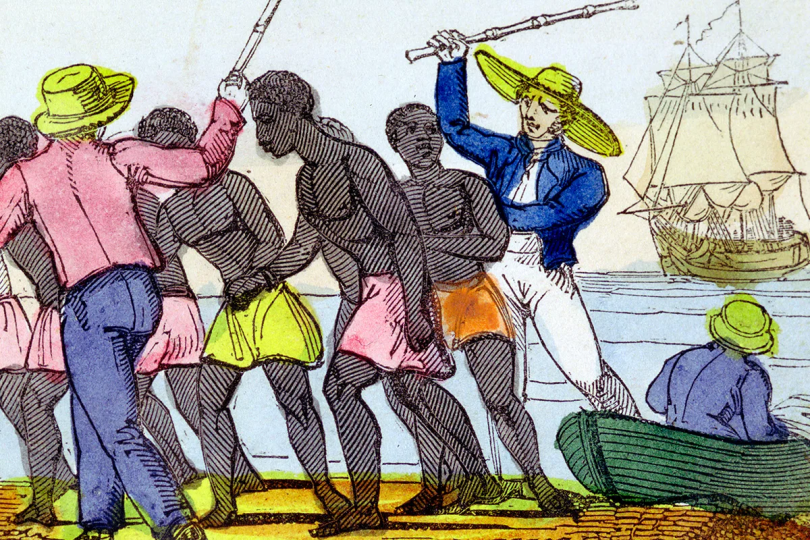

The Register of British Slave Traders (https://britishslavetraders.org/) has just been published. It’s the product of 3 years of research undertaken by teams from three universities, led by Professor Will Pettigrew, Professor of Global British History at King’s College, London. It has been trailed and excerpted in eight different articles published in The Guardian in the week beginning Monday 14th September. It is being used by David Olusoga in his new two-part BBC series on the history of the slave trade.[i]
History Reclaimed will write more generally about this new Register and the type of history it represents in due course. For the present, we want to concentrate on the numbers – or the lack of them. What strikes the reader is the absence of numerical data. In its place are wild accusations and exaggerations. It is possible, as we shall see, to present good estimates of the scale and economic importance of the slave trade, but the results would not suit the arguments being made by Will Pettigrew, his teams, The Guardian, and no doubt the BBC as well.
The Register traces 13,000 named people who financed the British slave trade over the period from 1550-1807, roughly two-and-a-half centuries. We take issue not with the identities of these men and women (and yes, there’s a separateGuardian article on women investors in the trade) but with the absence of a proper case for the economic significance of the slave trade, and with the consequent rhetoric and exaggerations. As one of our readers has commented ‘Nothing is presented in proportion or given statistical context’.
As an example of the problem, in the article in The Guardian on the Church of England and the slave trade we are told that 45 clergymen can be traced who invested in the slave trade.[ii] The author seems shocked. But is this a large number or a small one? Pettigrew and Co. do not say. But do the maths: in 1550 there were just shy of 9000 Anglican parishes across England and Wales, and about a 1000 more in Scotland. In 1800 the relative numbers were 11,000 in England and Wales and about 950 in Scotland. What’s surprising is not how many Anglican clerics invested in the slave trade across 250 years, but how few. But they won’t tell you that in The Guardian, probably because they haven’t thought to make the necessary calculations.
Pettigrew accepts that ‘slave traders were a tiny minority of the British population’ but gives them ‘outsized influence on this golden age of British development’.[iii] Yet the scale of that influence is never calibrated, merely asserted. ‘Interest in human trafficking’ apparently ‘cascaded down the social hierarchy’ but the 13,000 named individuals include no agricultural labourers or early industrial workers who made up the vast bulk of British society. This is hardly surprising as the Legacies of British Slavery project at University College, London – a much better example of scholarship than this Register – has estimated that somewhere between 5% and 15% of the British elite derived wealth from slavery, a group that might be numbered as a few thousand only, therefore.[iv]
Great play is made, as it always is in these cases, with the names of famous figures who invested in the slave trade – John Gay, Sir Godfrey Kneller, James Gibbs and Handel himself – but this still doesn’t help us understand the scale, value and economic significance of the slave trade.
There is the familiar tactic of guilt by association in Pettigrew’s careful prose: when he writes that ‘the register…highlights the conspicuous role of slave traders in the emergence of British science, via the Royal Society, and medicine (Dr. Richard Mead and Sir Hans Sloane)’ we are meant to feel uncomfortable, as if all the achievements of the British scientific revolution are mired by slave trading. Scientists beware: you too are guilty.
According to Pettigrew, these slave traders ‘were enmeshed in the processes that produced the nation we know today’. It sounds good, but what does it really mean? How many great cultural figures were NOT involved with slavery? How many of the Fellows of the Royal Society did not invest in the slave trade as compared with those who did? And in what sense does the action of an individual damn a whole nation?
Pettigrew gives the game away with a final cliched phrase: ‘we are all – in some way – connected to it [the history of the slave trade]’. Are we? What about the many millions of Britons today whose ancestors before 1807 were living elsewhere? What about the labourers and proletarians who earned a pittance and had no vote – no stake in society – until the late Victorian era? In the 18th century only 5% of the population – all men – had the franchise. In what sense were any of the rest of the people responsible for national policy, for monarchical monopolies like the Royal African Company, and for a joint stock venture like the South Sea Company?
In 1550 the population of England, Wales and Scotland was 4 million. In 1801 it was 10 million. AI tells me that between those two dates, somewhere between 25 and 30 million people lived and died in these three nations. Set that number against the 13,000 people Pettigrew and co. have found and we begin to get closer to an appreciation of the real scale of slave trading involvement in Britain.
But we can do better than this. We can tell Pettigrew and his teams the actual value of the slave trade relative to other British economic activity on the eve of the abolition of slave trading. Then we can make a judgment on the trade’s overall significance.
Let me set the scene.
On the 7th June 1804, the prime minister, William Pitt the Younger, rose to speak in a debate on the second reading of a bill introduced into the House of Commons by William Wilberforce for the abolition of the slave trade. Pitt held aloft a recently-published pamphlet entitled A Concise Statement of the Question Regarding the Abolition of the Slave Trade by Henry Brougham. In the previous year Brougham had sent him a copy of the two-volume work from which it was drawn, An Inquiry Into the Colonial Policy of the European Powers (1802). The pamphlet was distributed in advance to all MPs and peers and was judged so powerful a statement of the case for abolition that two spokesmen for the West Indian interest of slaveholders ‘wished the house to decline coming to any immediate decision upon this important bill’. Wilberforce brushed aside their objections: ‘Was the House to be supposed to be taken captive by that book so as to require another week to enable them to recover their judgment?’ He had read the pamphlet ‘with great pleasure and approbation, but he could not see what improper effect it could have’.[v] Pitt based his speech in support of abolition in that debate on arguments made by Brougham.
What did Brougham say about the scale and value of the slave trade?
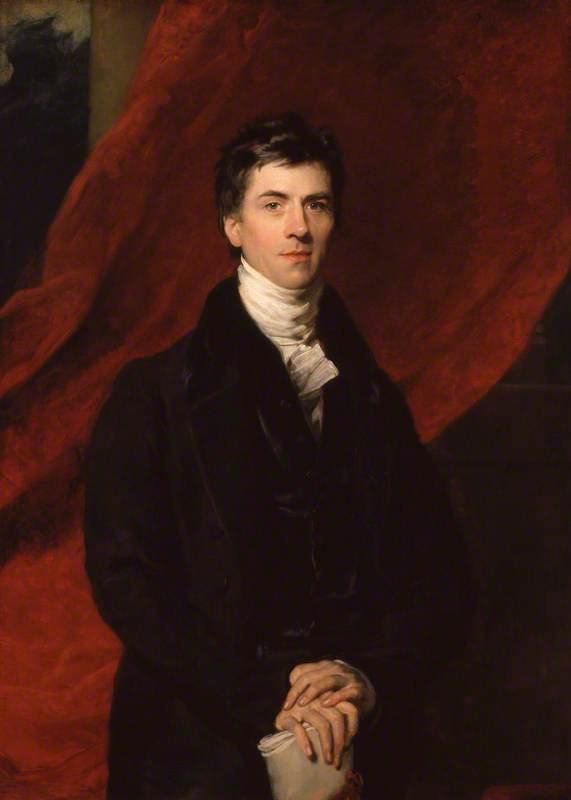
Henry Peter Brougham, 1st Baron Brougham and Vaux (1778-1868)
(Sir Thomas Lawrence, NPG)
Brougham demolished the argument that the slave trade was highly profitable and an important destination for British capital. On the contrary, it was ‘a gambling trade’, there were ‘numerous failures’, and because of this uncertainty, human cargo was an insignificant element of British overseas commerce. No one studying the history of the slave trade should be in any doubt of this: it was because slave trading only resulted in failure and loss that the South Sea Company readily gave it up at the end of the 1730s with the onset of war with the Spanish: shareholders had been critical about the losses for years.
Brougham calculated that the slave trade amounted, by value, to only 1/35th of British exports, or just 3%. It used only 1/63rd (or 1.6 %) of the total shipping tonnage in the empire, and 1/23rd (or 4.35%) of the number of imperial seamen – though trading in slaves had eight times the rate of mortality among sailors than other forms of maritime commerce. It was a dangerous, dirty, disease-ridden business and Brougham noted with what alacrity seamen on slave ships swapped for an easier billet on ships of the line in the Royal Navy.
The argument that a British withdrawal from the slave trade would simply see foreign traders take the place of Britain, was countered with the argument that British traders would then move into the legitimate and more lucrative markets that foreign traders had vacated.
It is evident, therefore, that the capital vested in the slave trade is extremely trifling; that no method of employing it could be devised less beneficial to the country; and that even if it were much more extensive, an easy and profitable opening would be found for it, were the trade instantly abolished.[vi]
In an argument that was to become more significant in later years, Brougham contended that legitimate trade in African products was growing and offered a more secure, lucrative and also a more moral future.
It was a feature of the Concise Statement that Brougham for the first time deployed numbers and calculations in making the case against slavery. Many others would do it later, most notably Zachary Macaulay, Thomas Babington’s father, who was the editor from 1823 of the Anti-Slavery Reporter, a mine of data and information on slavery. But Brougham has a claim to have been the first in debates on slavery to have grasped the advantages of arguing from statistics, something notably lacking in the material from the Register published by The Guardian.
This is not surprising. Brougham was already a Fellow of the Royal Society for his early mathematical work. He later founded of the Society for the Diffusion of Useful Knowledge. He was also the soul of Whig reform. From 1823 he led the forces of anti-slavery in the House of Commons. He was Lord Chancellor in the Whig government formed in November 1830, and, as such, was instrumental in framing the Great Reform bill and getting it through the House of Lords. He took the closest interest in cabinet in the bill to emancipate the slaves in 1833, for which he had worked for three decades.
One further point. The slave trade comprised 3% of the value of total British exports, not 3% of British GDP in 1800. Had the latter been the measure, slave trading would have been an even smaller proportion of the total British economy, of course. It used to be dinned into first-year undergraduates studying British economic and social history in Cambridge that the Industrial Revolution depended for a crucial period of the eighteenth century on home demand rather than foreign trade. A growing population with the affluence to consume the new products of British industry was the domestic bedrock market for British goods in this era.[vii] Foreign trade grew dramatically, of course, but entrepreneurs like Josiah Wedgwood depended on the home market for his ceramics and homewares: a growing foreign commerce was just the icing on the cake. Wedgwood also sold anti-slavery medallions and plates to hundreds of thousands of Britons, who together, over a much shorter period of time, vastly outnumbered the 13,000 slave traders and investors.
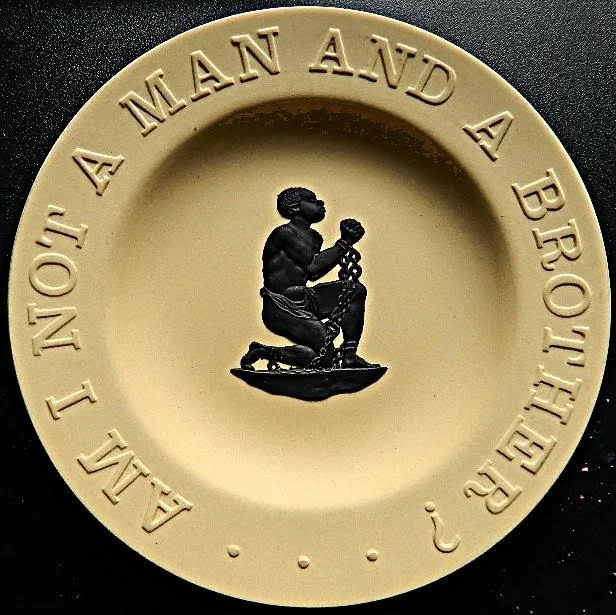
Wedgwood Yellow and Black Jasper Anti-Slavery Small Plate
Pettigrew’s Register is thus another example of distorting exaggeration in the history of slavery. We have come across this before, of course. Activist historians want slave-grown sugar to be fabulously valuable.[viii] They want it, and the slave labour that produced it, to be crucial to the financing of the Industrial Revolution.[ix] They want the slaves to have pioneered the new technologies of the Industrial Revolution, even when they didn’t.[x] They want all of British history since the late sixteenth century – and all Britons, it would be seem – to be complicit in slavery. But the numbers simply don’t add up.
If you don’t believe me, believe Professor Joel Mokyr of Northwestern University in Chicago, the 2025 Nobel prize winner in Economics who long ago in the 1990s showed that slavery, sugar, and the slave trade were never valuable enough to have provided the foundations of the Industrial Revolution.[xi] Or read Professor David Eltis, the greatest of the historians of the slave trade, who made the same points about slavery and the slave-trade in his most recent book published last year: they did not form the basis of British industrialisation. As he wrote there, it is ‘beyond credulity that slavery or the slave trade that supported it could have kick-started [British] economic growth’. Indeed he goes further: ‘the evolution of…all European economies could have been little different if slave colonies had never existed.’[xii]
We all agree that the slave trade was murderous, dehumanising, pernicious, destructive. But despite Pettigrew’s inflated claims, a biographical dictionary of slave traders cannot – and does not – tell us much about the relative economic and social significance of slave-trading. Indeed, the lack of data, whether of a relative or absolute type in these Guardian articles, gives the game away: slave trading was a small and insignificant part of the British economy with negligible impact on any of the processes that made modern Britain.
History Reclaimed will return to the true purposes of biographical registers and dictionaries in a subsequent article.
Professor Lawrence Goldman was the Editor of the Oxford Dictionary of National Biography between 2004 and 2014. His book, Victorians and Numbers. Statistics and Society in Nineteenth Century Britain was published by Oxford University Press in 2022. He, and his co-author, Dr. John Morewood, are at work on a book about Henry Brougham and the British anti-slavery movement.
[xii] David Eltis, Atlantic Cataclysm. Rethinking the Atlantic Slave Trades (Cambridge, 2025). See https://historyreclaimed.co.uk/review-atlantic-cataclysm-rethinking-the-atlantic-slave-trades-by-david-eltis/


