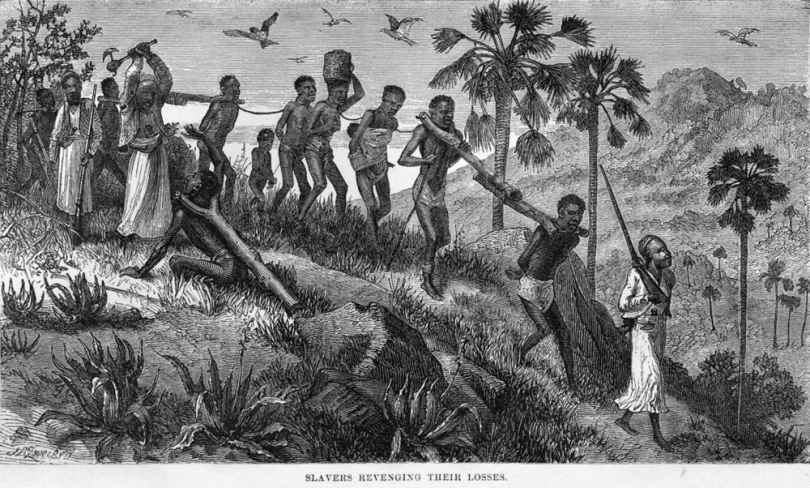

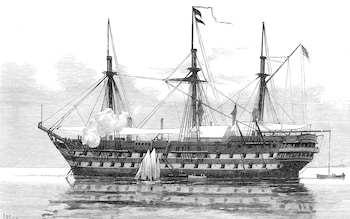
HMS London, a Royal Navy warship used to suppress the East African Indian Ocean slave trade from 1874 to 1884 Credit: The Print Collector/Heritage Images
Britain’s Prime Minister rose to address a packed House on the subject of Atlantic slavery. He was not a man to put his emotions on display, but this was a subject on which he felt deeply. The trade, he said, was “the curse of mankind … the greatest practical evil that ever has afflicted the human race … the most extensive calamity recorded in the history of the world”. He recognised Britain’s share in this “curse” and declared that the country should “atone” for this “long and cruel injustice.”
Those campaigners who complain that Britain has never officially apologised or recognised its part in the slave trade have probably never read this speech by William Pitt more than two centuries ago. Yet much of their own rhetoric echoes his. The phrase “crime against humanity” had not been coined, but that is what Pitt was talking about.
The King, on his recent tour of the Caribbean, acknowledged “the great suffering of the past”, but he will almost certainly not go as far as William Pitt. The issue has ceased to be about moral responsibility, expressions of regret or indeed about action to stop slavery today – when, according to the Global Slavery Index there are more people enslaved than ever in history. It now centres on attempts by campaigners to extract a certain form of words to provide a legal pretext for demanding hard cash.
Campaigners, including Commonwealth politicians who intend to be on the receiving end, demand “discussions”. Well, one could discuss this issue forever. In theory, there are circumstances in which reparations might be due. There is an American academic study that suggests that the indigenous people of England are still suffering from the effects of the Norman Conquest. Perhaps that is one explanation for the crowds queuing to see the Bayeux Tapestry at the British Museum. Perhaps President Macron could give it back as a belated reparation.
Reparations are simple when the perpetrators and the victims, or their immediate descendants, are still around. The many churches built by the Normans, including an altar on the very spot where King Harold was killed, may show that the conquerors realised they had sinned. But today? Perhaps my ancestors were enserfed by William of Normandy as were those of the homeless man on the street corner. Would we both be equally deserving of cash from the French treasury? Or equally undeserving?
The problem of reparations is less one of theory than of practice. Who exactly should receive them, and who exactly should pay them? Some conscience-stricken descendants of slave-owning families have made substantial donations to Caribbean charities. But this is not what is being demanded. Governments of several states are demanding trillions of pounds unconditionally from the British taxpayer for themselves, however undemocratic, incompetent and corrupt they may be.
Leading the international campaign – which is, in effect, being directed only against Britain – is Ghana. This in itself shows the cynicism of the whole operation. Ghana was one of the biggest slave-trading countries, and many of its people took part in the traffic. It is now demanding, in fact, to be compensated for its own crimes against humanity. It was West African countries that enslaved and sold people, and made big profits. This was the original act of violence, which made human beings into property.
As for those who exploited the people thus enslaved, the Muslim world was probably the biggest and arguably the cruellest: it made women into sex slaves and castrated men to be servants (many young boys died in agony from the effects). In the Atlantic world the biggest buyers were Brazil, France (in its colony of Saint-Domingue, later Haiti) and the United States. If reparations are due, all these should pay them.
Britain transported existing slaves from sellers to buyers – a nasty, cruel business. But Britain was far from being the leading slave owner. A recent estimate is that British people owned 1.7 per cent of the global enslaved population. The number of people in Britain identified as directly involved in the ownership or trafficking of slaves was – so a recent study claims – around 13,000 (including babies). This was out of a total number who lived and died in Britain during the slaving period of 20-30 million. In short, Britain was not the most guilty of involvement in slavery. Yet it seems to be the most targeted for reparations.
William Pitt believed that Britain had to “atone … for this long and cruel injustice”. I believe it did, to the best of its ability. One benefit of this otherwise depressing controversy is that we are getting to know our own history better. For reasons not fully understood, the British of Pitt’s generation suddenly turned en masse against the slave trade and slavery. No other people in the world did so. Even former slaves accepted slavery – at least, they were willing to own slaves themselves.
But Britain banned the slave trade – not just in words, like the Americans, but in deeds. It forced other states to agree in principle (very reluctantly) to phase out the trade. The Royal Navy made this mean something. Britain then emancipated all slaves in its empire, and the empire gradually stamped it out. (Reparations campaigners condemn both slavery and empire – they can’t have it both ways!)
British taxpayers, we are endlessly told, only paid compensation to slave owners, not to slaves. But they also paid compensation to other European and African slave-traders. Bribery was the quickest way to end the trade. When that did not work – for slave trading and slavery remained hugely profitable – British governments occasionally used force. In Lagos, for example, and in Rio de Janeiro. The diplomatic campaign against slavery continued for decades, well into the 20th century, and Britain today has some of the toughest laws against modern slavery.
Does this unique historic effort “atone”? Reparations campaigners will of course say no: they want money now. But when the King expresses our national regret, I hope he might also find a moment to recall publicly those who fought tirelessly to end “the curse of mankind”.