
(This article was first published in The Daily Telegraph on 4 November 2026)
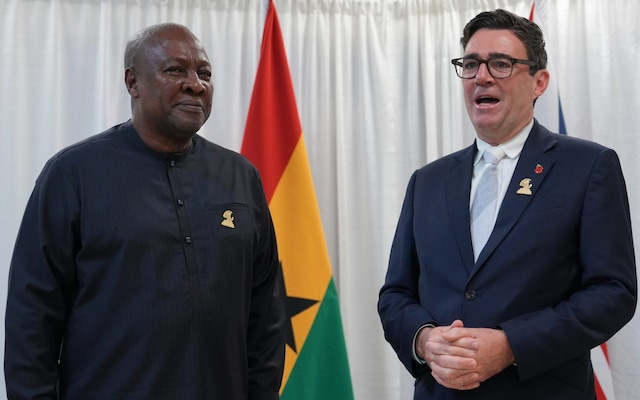
Andy Burnham meets Ghana’s president John Mahama at this week’s Commonwealth gathering in Antigua Credit: AP/Kin Cheung
The Prime Minister has blithely walked into the obvious trap laid by those Commonwealth governments who are hoping for large payouts as reparations for slavery. His waffly statements, rather than “drawing a line” under the issue, have announced open season on the British taxpayer. To talk about being “open” to an apology, and to link development aid to the issue of reparations implicitly concedes what successive Prime Ministers have consistently refused. Can Burnham really think that rebadging a few millions in aid payments will satisfy the reparations lobby?
The demand for a “formal apology” is not really about giving satisfaction for supposed psychological trauma dating back two centuries. Soothing words – whether pronounced by the monarch or prime minister – are only phase one. The real demand for massive amounts of money is based on economic theories that claim the slave trade and slavery were essential to Britain’s own development.
The godfather of these arguments was Eric Williams, an Oxford D.Phil student in the late 1930s. His thesis was published in 1944 entitled Capitalism and Slavery. He came from a middle-class Trinidadian family, went into politics, was influenced by the Black Power movement, and became the first Prime Minister of Trinidad and Tobago.
Williams’s arguments, much elaborated by later writers, were twofold. First, he aimed to demolish the idea that Britain had abolished slavery for moral reasons, and therefore deserved some credit, even gratitude. No, he said, the British only abolished the slave trade and slavery because they were no longer profitable. Second, he claimed that the slave economy was central in British economic history. The Industrial Revolution, and hence Britain’s later wealth, was founded on the inhuman exploitation of enslaved Africans.
These two ideas remain the basis of the reparations lobby: British abolitionism was mere opportunism, and Britain owes trillions of pounds to the descendants of slaves. There are some academic historians who try to support these arguments. One recently claimed, against all the evidence, that a technological breakthrough vital to the industrial revolution was invented by slaves in Jamaica and stolen by the British. Despite such ingenuity, both of Williams’s arguments defy basic common sense.
First, slavery was not unprofitable. Slave uprisings could not stop it: the price of slaves kept rising. It took a bloody civil war to end it in the United States. Sustained efforts by the Royal Navy and the Foreign Office – financial payments, diplomatic pressure, and gunboats – were required to throttle it in the Atlantic, the Indian Ocean and the Pacific. Not only did slavery last until the 1880s in parts of the Americas, it continues today. Britain could have monopolised this booming traffic. It chose to do the opposite.
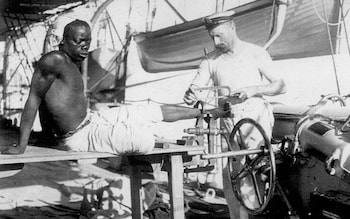
A slave having his shackles sawn off by a Royal Navy sailor aboard HMS Sphinx in 1907 Credit: PA
Second, ascribing Britain’s wealth today to 18th-century slavery ignores everything since: the internal combustion engine, electricity, the atom, computers and so on. Even more crucially, it ignores what went before. England was a wealthy country long before the age of slavery and the Industrial Revolution. England was three times as rich as Africa in 1500, and richer then than China and India would be until the 1990s. It was the high level of wages and consumption in Britain that sparked industrialisation, not the labour of enslaved Africans. Moreover – and this ought to clinch the argument – several countries were more involved with slave economies than Britain: France, Portugal, Spain, the Ottoman Empire. But none industrialised.
These are the common-sense arguments against the Williams thesis. In addition, generations of economic historians have disproved it in painstaking detail. They have calculated the relative importance of the slave trade and the slave economy within the broader story of British economic growth. The verdict has been the same over and over again. At the height of slavery, the Caribbean took only about 5 per cent of British exports. One estimate of total profits from the slave trade in 1770 is at most £342,000 out of total British GNP in that year of £166m.
Strikingly, even historians who try to talk up the importance of the slave economy seem to end up doing the opposite. The most recent example is an expensive inter-university project to track every British slave owner and trader. Press reports suggest it has found that only a fraction of 1 per cent of the population was involved. Yet we are being told that all of us owe reparations. https://historyreclaimed.co.uk/register-of-british-slave-traders/
The slave trade bequeathed many kinds of evil, tangible today in the United States, Africa and the Arab world. In the Caribbean, the trade created whole new societies of enslaved people and their descendants. That those societies today are in many ways successful and attractive testifies to their resilience and creativity over many generations. It also owes something to the efforts of British colonial rulers to repair the damage done by slavery and set up working democracies. Compare Barbados with Haiti.
Do Commonwealth countries now deserve apology and reparations? As I noted in an earlier article, William Pitt as Prime Minister made a very strong apology in 1792, and his successors worked hard to “atone” (his word) by combatting slavery. To repeat expressions of regret may be desirable and conciliatory, but not if they imply that Britain accepts the case for reparations. The idea that the Caribbean and Africa were somehow the creators of Britain’s present wealth, and that they therefore have a practically unlimited claim on it with no strings attached, is absurd.
Caribbean countries today can prosper by their own efforts, and many do. Most outstrip the African countries that enslaved their ancestors. The idea that they are still suffering from slavery nearly two centuries after emancipation is implausible. Where there are concrete problems – in health, or education – they would be candidates for aid based on friendship and goodwill, not on obligation.
A sensible prime minister would keep questions of aid and investment entirely separate from discussion of reparations, to which our response should be a polite but unambiguous no. A much wiser King maintained that separation in his opening speech on Tuesday. He also praised the anti-slavery efforts of the Royal Navy – a reminder that history (in his words) can “inspire” as well as “appal”.