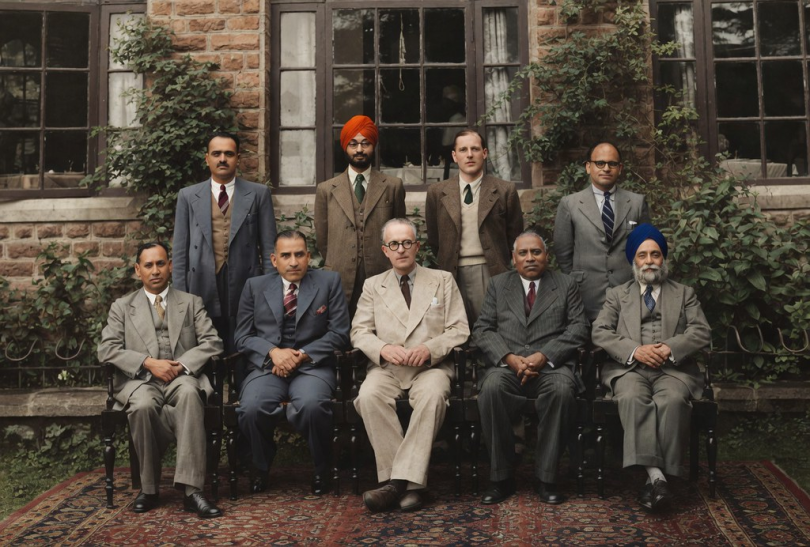

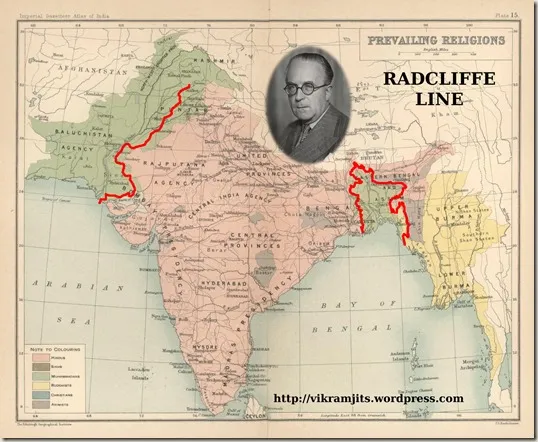
Sir Cyril Radcliffe was the British barrister who headed the Boundary Commissions which demarcated the borders between India and Pakistan at independence. There were three Boundary Commissions for Bengal, Punjab and Sylhet, all headed by Radcliffe. They also included Hindu, Muslim and Sikh judges. Public hearings were held which were chaired by one of the four local judges for each Commission. Radcliffe did not attend the public hearings but was given the transcripts of the evidence presented. At the close of the public hearings Radcliffe met with the other members of each Commission to determine the final awards. These were given to the Viceroy on the 13th August 1947.
Accounts of Indian independence by individuals who experienced the period directly seldom considered the actual date of Radcliffe’s departure from India of much importance, but in recent decades most accounts of Indian independence maintain that Radcliffe fled India on or about Indian Independence Day, 15th August, and was back in London by about the 17th. On this day the borders were publicly announced in India. It’s assumed that Radcliffe knew that his borders would be unpopular, and that, had he remained in India, he would have been murdered by one side or the other. It is also sometimes said that he was traumatised by the time he returned.
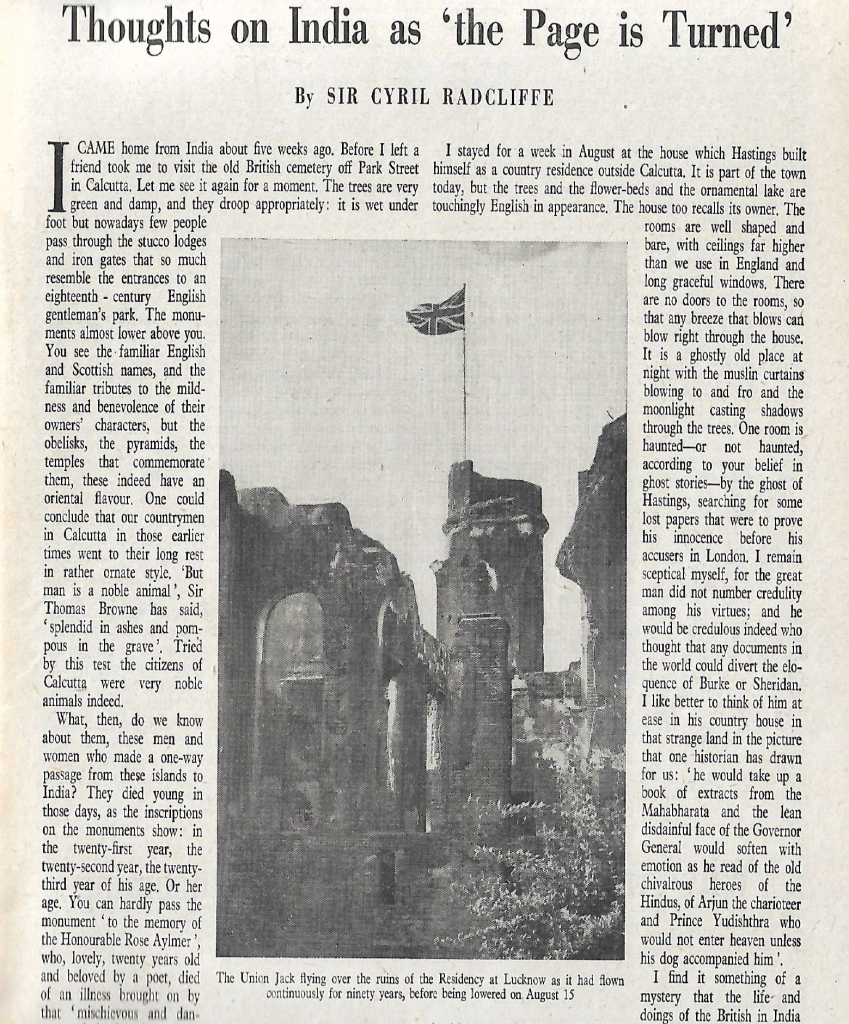
This version of events ridicules Radcliffe and the process by which the borders were determined. To many commentators, Radcliffe’s flight symbolises the failure of the British to manage the process of Indian independence in an orderly manner. This paper suggests, on the contrary, that far from fleeing India, having given his Boundary Commission Reports to the Viceroy, he remained in Calcutta for another week and then gave a talk to the BBC about his recent visit to the Park Street Cemetery on his return to Britain.
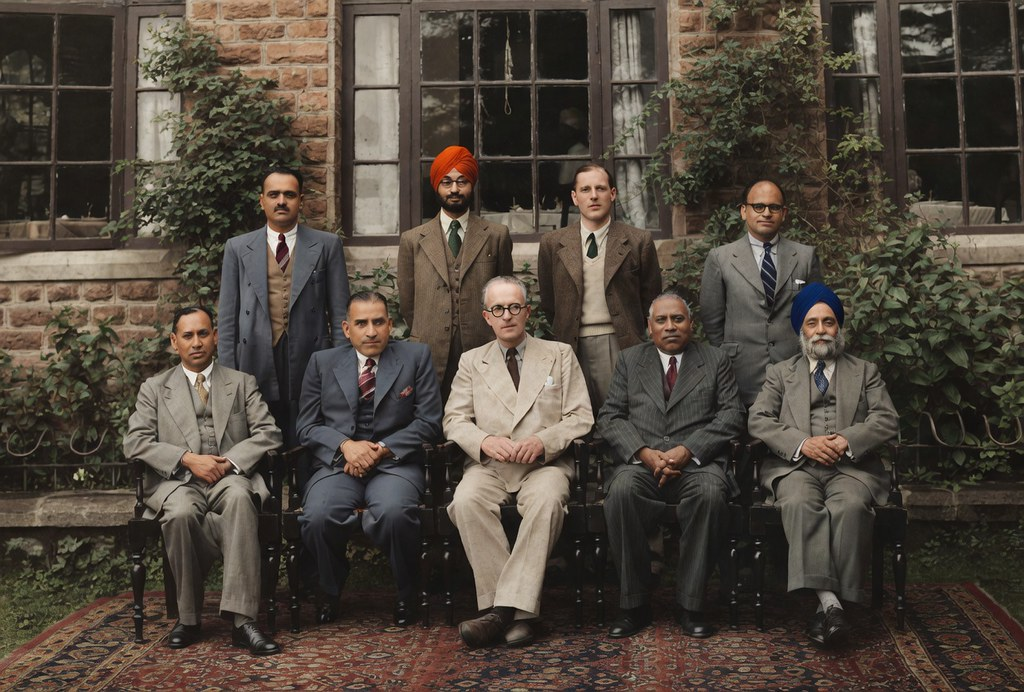
The Punjab Boundary Commission with Sir Cyril Radcliffe
The three Boundary Commission Reports contain the details of where and when the public hearings and Commission deliberations were held. In the Bengal Report, Radcliffe stated:
The public sittings took place at Calcutta, and extended from Wednesday 16th July 1947, to Thursday 24th July inclusive…After the close of the public sittings, the remainder of the time of the Commission was devoted to clarification and discussion of the issues involved. Our discussions took place in Calcutta.
The Punjab Report states:
The public sittings of the Commission took place at Lahore, and extended from Monday 21st July 1947, to Thursday 31st July inclusive…After the close of the public sittings, the Commission adjourned to Simla where I joined my colleagues.
The Sylhet Report states:
The Commission held open hearings at Calcutta on the 4th, 5th and 6th days of August… I was not present hearings at the open hearings as I was at the time engaged in the proceedings of the Punjab Boundary Commission … At the close of the open sittings, the members of the Commission entered into discussions with me…These discussions took place in New Delhi.
The above chronology would indicate that Radcliffe was in Calcutta from the 24th July till the 31st July and was in Simla or Delhi from the 1st till the 13th August when the Reports were finally ready to be given to Mountbatten. There was no need, nor was it possible, for Radcliffe to be in Calcutta for several days in August while working on the Commission Reports. The fact that the Sylhet Commission discussions, which determined borders in a region in the east of Bengal and would normally have been expected to meet in Calcutta, actually met in Delhi, emphasises this point.
A few weeks after he returned to London, on the 28th September, Radcliffe gave a talk on the BBC entitled Thoughts on India as the Page is Turned, which was published in The Listener (Vol XXXVIII, No. 975, pp 557-558) on the 2 October. It was also included in a collection of Radcliffe’s talks, Not in Feather Beds (1968). The text of the talk was also sent by Lady Radcliffe to the British Association for Cemeteries in South Asia and published by them (https://www.bacsa.org.uk/journal/volume-01-number-1/ ). This article mentioned that the talk was broadcast on 28 September.
The talk began; ‘I came from India about five weeks ago. Before I left, a friend took me to visit the old British cemetery off Park Street in Calcutta’. Radcliffe added: ‘I stayed for a week in August at the house which [Warren] Hastings built himself as a country residence outside Calcutta’. From the date of the talk it is apparent that he returned to London about the 24th August having left Calcutta on the 22nd.
Given that it was impossible for him to stay in Calcutta in August during the deliberations of the Boundary Commissions, he must have stayed there after the reports were completed. This would mean that he stayed in Calcutta from 15 August and left India on 22 August, arriving in London on the 24th. Calcutta was largely peaceful till the end of August and Radcliffe would not have had any difficulty travelling around the city. His opening remarks also suggest he left India from Calcutta.
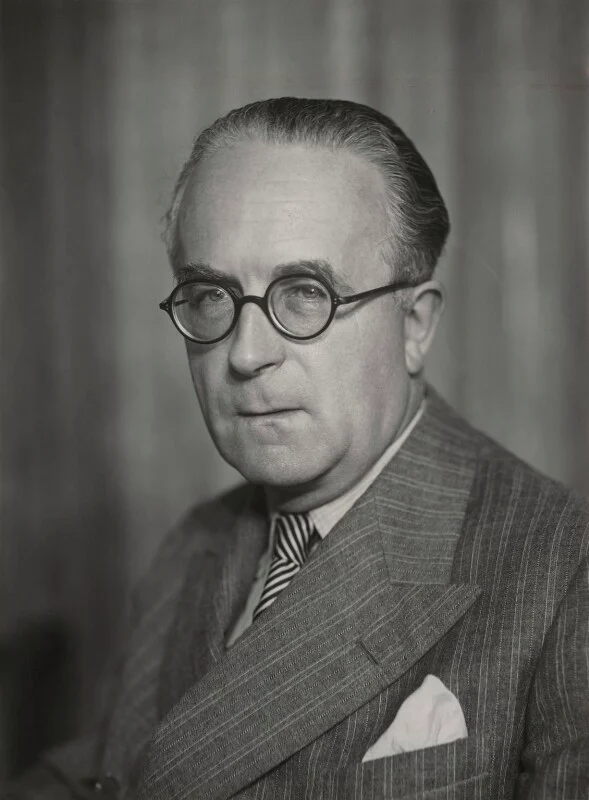
Cyril John Radcliffe, 1st Viscount Radcliffe (1949, National Portrait Gallery)
In his broadcast Radcliffe muses whimsically about the lives of the Britons, including Sir William Jones, who are buried in the Park Street Cemetery (See also https://historyreclaimed.co.uk/look-on-my-works-ye-mighty-and-despair-sir-william-jones-john-flaxman-and-university-college-oxford/) Radcliffe describes the interior of Hastings House and reflects on the life of Warren Hastings. He discusses British painters and writers who lived in India. He bemoans the fact that Britons in the UK knew little about the achievements of their ancestors in India and, far from being traumatised, delivers the following insightful analysis of the British legacy in India:
The gifts we brought were Roman: peace, order, justice and the fruits that those things bring. Men are apt to prize them less the longer they enjoy them. Like the Romans, we built our roads, bridges and canals and we have marked the land as engineers if we have not improved it as architects. Like the Romans, we brought and maintained a system of justice that we tried to make even-handed and a system of administration that we hoped was impartial.
Of course such gifts are not everything. They are the structure but not the heart or the brain in the life of the people. It may be that somewhere in our course, we mistook the means for the end and, absorbed in our practical task, we failed to penetrate the heart and soul of India. It may be that the government of one people by another can never be the best government in the long run, since benevolence and fairness are no substitute for national inspiration’.
Radcliffe concluded as follows:
I can think of one thing that we could say, at least, of ourselves: we certainly got about the world. We have been such wanderers that the mud of every country is on our shoes. It is quite an essay in geography to list the places in the five continents in which British soldiers lie buried: and we would need a new list for the British civilian cemeteries overseas. In all recorded history up to the present no people have ever so mixed its dust with the dust of the wide world. Eccentric, tiresome, interfering, if you like, but surely too, adventurous, ingenious, courageous and enduring. And yes, for better or worse, very remarkable’.
This broadcast, and his subsequent Reith Lecture on British Rule in India in 1951 (https://www.bbc.co.uk/programmes/p00hhj7p) demonstrate that Radcliffe was interested in, and knowledgeable about, the careers of British officials and intellectuals in India. It is understandable that Radcliffe would want to spend a few days in Calcutta after he had completed his work for the Boundary Commissions. It is surprising that the Park Street Cemetery broadcast has largely been ignored over the years, given that it was his first public talk since returning from India.
The evidence presented in this paper is not conclusive, but makes it highly likely that Radcliffe stayed on in India for a week in Calcutta after independence and did not leave in haste and shame – and as a symbol of British imperial failings – as is sometimes imputed. Other commonly held assumptions about Indian independence should also be re-examined as we approach its 80th anniversary next year.