

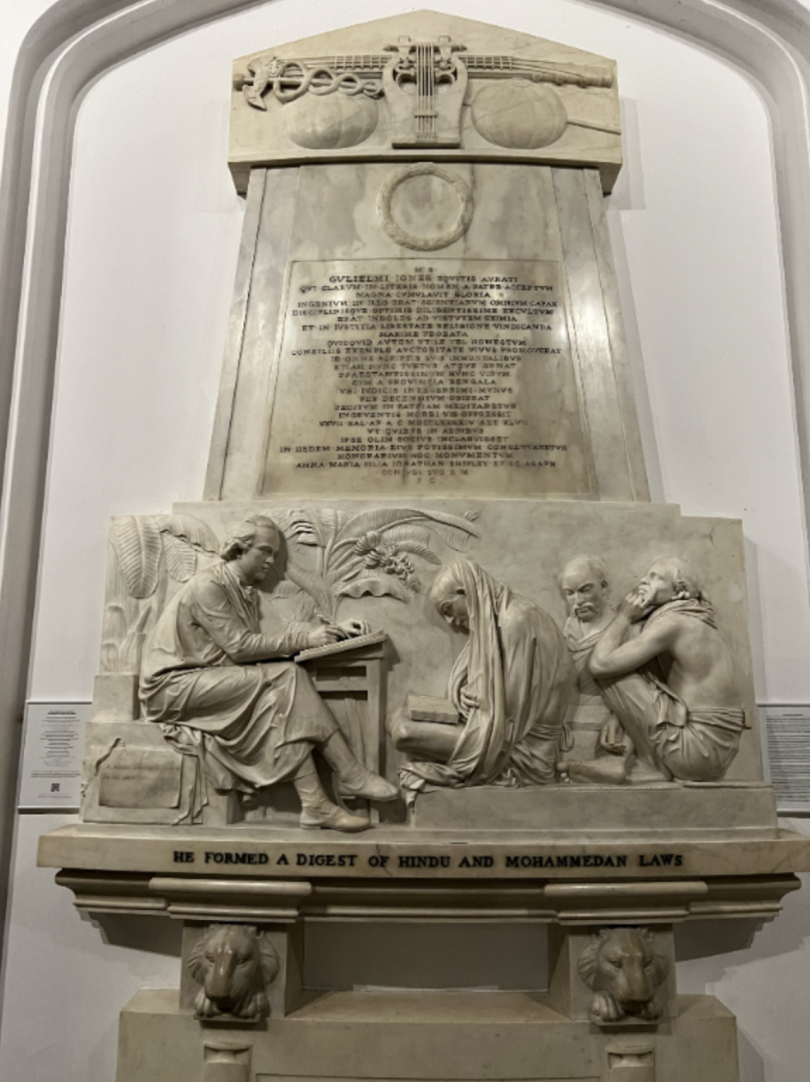

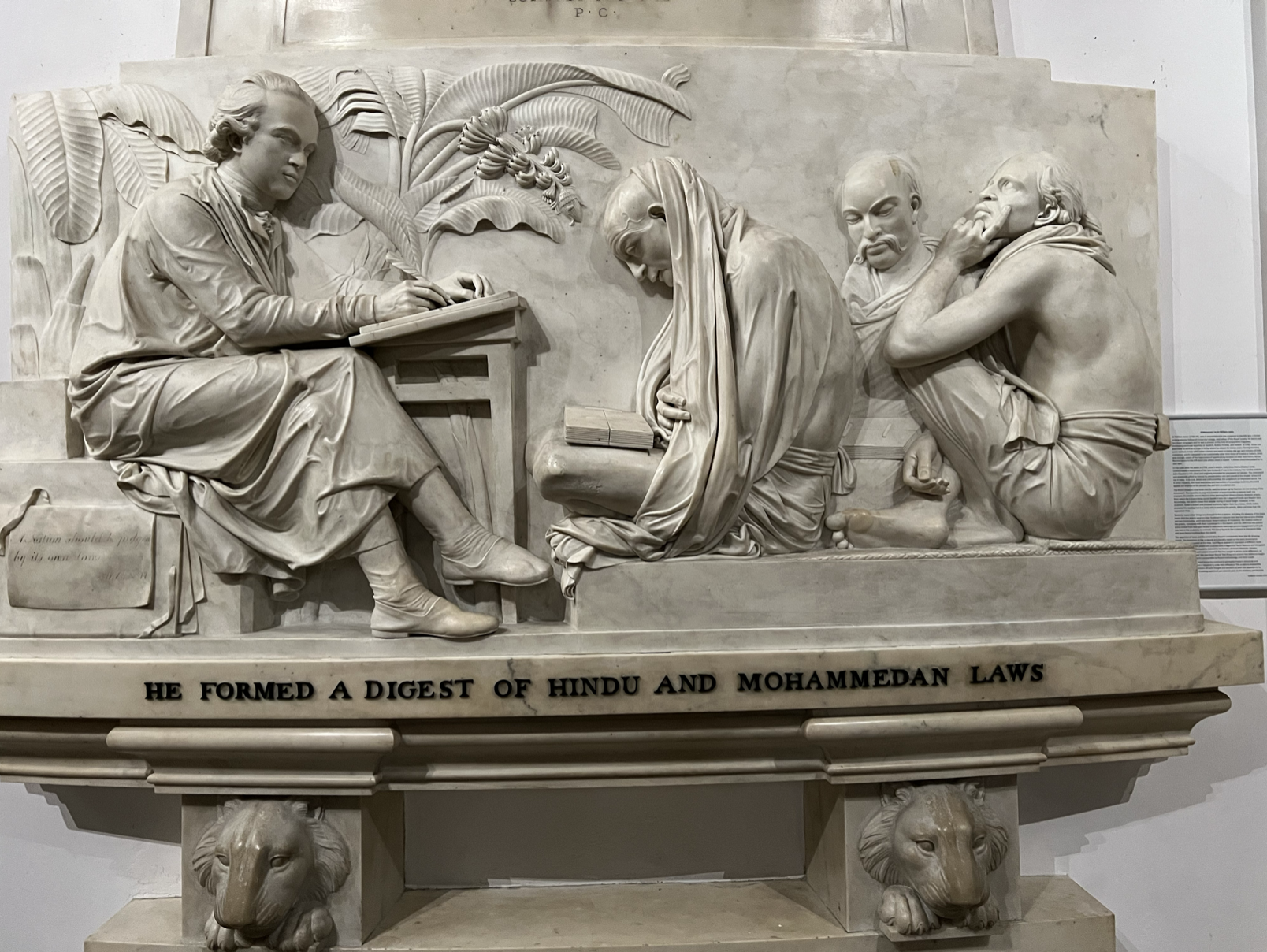
In the chapel of University College, Oxford, there is a monument to one of the college’s most famous members, Sir William Jones (1746-94), which was designed and executed by John Flaxman (1755-1826). It shows Jones sitting under a palm tree at a desk, at work on his famous codes of native Indian law, both Muslim and Hindu. Beside him sit three wise men, pandits, who are assisting him. Jones seems to be writing down what one of them, evidently a Hindu sage, appears to be reading from his book. Jones is slightly higher and larger than the three sages – it’s a monument to him, after all. But the presence of the trio tells of collaboration and shared endeavour between these men, and by implication, between west and east. We are told that ‘Intense collaboration with his team of legal informants, many of whom were Brahmans, led to a real and reciprocated respect’.[i] The inscription underneath tells us that ‘He formed a digest of Hindu and Mohammedan Laws’, and the monument itself makes evident that it was with the help of native scholars.
Beside the monument there is now a notice, set up in 2020, interpreting it for those who enter the college’s chapel. This interpretation requires reinterpretation.
A Welshman, Jones was educated at University College, Oxford, became a fellow there, and then forged a career as a lawyer in London and a judge in India. He was also one of the greatest of all philologists, in whose work the links between Sanskrit and European classical languages were first explored in detail, and who first posited the existence of a family of Indo-European languages, many of which he could speak and read himself. On arrival in India in late 1783 he founded the Asiatick Society of Bengal in Calcutta to further ‘oriental research’. It still exists, an enduring example of the British foundations of contemporary Indian academic and cultural institutions, a theme explored in History Reclaimed by Rohan Fernando.[ii] A pioneer also of archaeology and anthropology in India, Jones was among the first and most influential of all Orientalists, which explains why his monument in Oxford has attracted unwarranted attention.
John Flaxman, meanwhile, was of humble birth, but his skills at illustration, design and the plastic arts, taught to him by his father, made him one of the most famous sculptors of his or any age in Britain. Indeed, he is one of the few British sculptors to have been influential and widely admired in Europe. His monument to Jones has ‘great feeling and immediacy’ according to one of his biographers.[iii] A. L. Rowse considered it ‘one of the finest’ of Oxford’s college monuments.[iv] But the combination of ‘a man of genius’ – as Jones was described by Gibbon[v] – and an artist of the greatest skill, has not deterred the Fellows of University College from an act of iconoclasm and scholarly patricide.
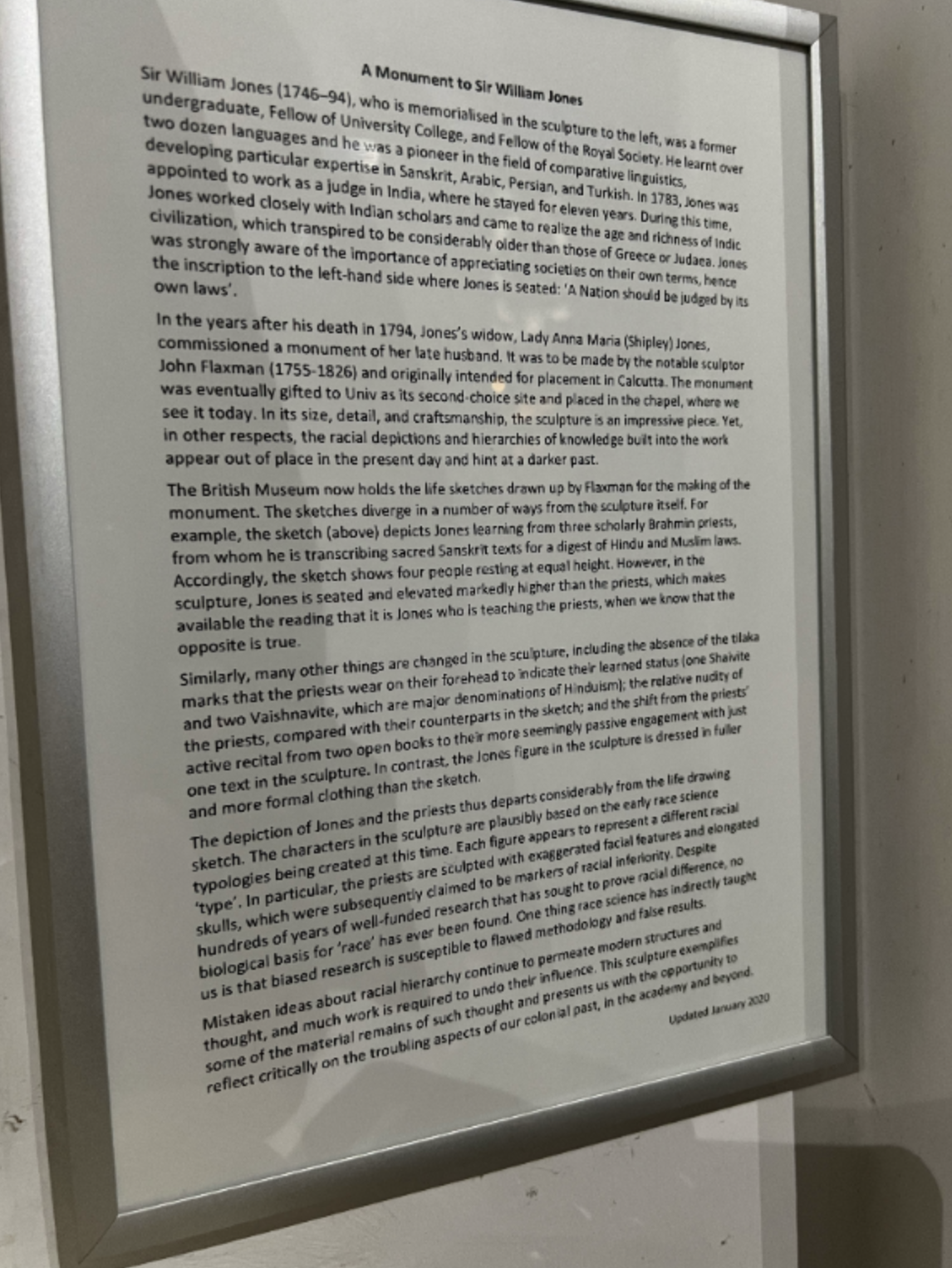
The board at least explains who Jones was, though it fails to tell the full story, as we shall see. But it then begins a litany of grievances about the monument. The text complains of ‘racial depictions and hierarchies of knowledge built into the work’ and goes on to tell us that these ‘appear out of place in the present day’. One might write that of any and every monument from the past: by definition, the values and assumptions they embody differ from our own. It’s an admission that this is yet another exercise in seeing the past through the present, an invalid academic approach that no Oxford college should entertain or sanction.
Apparently, Flaxman’s sketches for the monument, which are held in the British Library (whoever wrote the text, which says ‘British Museum’, doesn’t seem to know the difference) vary from the sculpture we see. In the sketches the priests wear more clothing, recite from two open books rather than one, and carry the tilaka marks on their foreheads ‘to indicate their learned status’. Also, in the sculpture Jones ‘is dressed in fuller and more formal clothing than the sketch’. Readers may legitimately question the significance of these changes. Whoever wrote this text seems not to have asked if there might have been technical reasons for them, nor how a sculpture can convey tilaka marks. The process of turning designs on paper into marble is not straightforward and a working sketch may change.
We’re then told that ‘the characters in the sculpture are plausibly based on the early race science typologies being created at this time…the priests are sculpted with exaggerated facial features and elongated skulls, which were subsequently claimed to be markers of racial inferiority’. I cannot see this myself and I doubt if anyone of good faith can. But the give-away clue is in the word ‘subsequently’ because this monument dates from 1798, and the kind of racial pseudo-science based on the measurement of heads and facial features, which is being referred to, dates from much later. Samuel Morton in America and Paul Broca in France were the progenitors of this. Morton’s first such work, Crania Americana, was published in 1839, forty years after the memorial to Jones was created. Broca’s publications on ‘craniometry’ date from the 1860s.[vi]
We’re invited to believe that the monument deliberately presents Indians as physiologically inferior – which I cannot see – two generations before such ideas were in wide circulation (which is different from being universally accepted, which they certainly weren’t). We’re also invited to believe, at least by implication, that John Flaxman is responsible for all of this, but the text is curiously coy – silent, indeed – about his role, largely, I suspect (and I’m no expert on him or his work), because there is no evidence linking him to racism and deliberate denigration in the execution of this work. He was a modest and shy man and a brilliant craftsman. In any case whoever wrote this text evidently wishes to generalise the blame across English society as a whole: the message being conveyed is that they (and we) are all responsible for the depiction of Indians in this manner.
The text then ends in homiletics. It has told the visitor what he or she should see, even if the evidence of their eyes is different. Now it tells them what they should think. ‘Mistaken ideas about racial hierarchy continue to permeate modern structures (sic) and thought, and much work is required to undo their influence’. By implication, this is the self-appointed task of this text. It ends thus: ‘This sculpture exemplifies some of the material remains of such thought and presents us with the opportunity to reflect critically on the troubling aspects of our colonial past, in the academy and beyond.’ Actually, it presents us with the wonderful opportunity of reflecting on the achievements and genius of Sir William Jones, one of the greatest scholars that Oxford, or any other university, has ever produced and a brilliant role model for students of University College today.
The word ‘colonial’ is both ill-chosen and revealing in a text relating to William Jones. He was a radical whig – in our terms an advanced, ‘progressive’ liberal – who sympathised with the American colonists in the 1770s and who was deeply critical of George III and his ministers. Jones aligned himself with John Wilkes and the Wilkesites, critics of aristocratic and monarchical corruption. His pamphlet, The Principles of Government, in a Dialogue between a Scholar and a Peasant, published in 1782, was ‘an attack on authoritarian monarchical government and a strong plea for liberal constitutionalism’.[vii] In a famous legal case, Jones’s brother-in-law was tried for seditious libel after he republished it in 1784.[viii] Spending time in Paris in the 1780s, Jones’s close friend there was Benjamin Franklin himself, then the American minister to France. Jones published widely in the early 1780s, opposing government policy in India, the continuation of the slave trade, and calling for parliamentary reform and popular education. Appalled by the anti-Catholic Gordon Riots in London in 1780, his own position was one of ‘tolerant deism and a syncretic approach to world religions’.[ix]
This adds to the shame of University College, Oxford. In their haste to signal their virtue, and in a text that strains at gnats in its efforts to confect a bogus case against the past, they dishonour their greatest son. They could and should have erected a notice beside the monument that acclaimed Jones, truthfully and accurately, as an early anti-colonialist, a political and religious liberal, a ‘friend of liberty’, and a friend also to foreign cultures which he treated with the greatest dignity and respect. But why let the truth get in the way of anti-colonial posturing? He was an ‘Orientalist’ after all, and all such people are fair game in this distorted view of the past.
It is sad that a text of this nature, sowing discord between the present and the past, should be placed in a chapel, a sacred place supposedly designed to bring people together. It is also risible that the Master and Fellows of University College should take it upon themselves to tell us how to see and think, while simultaneously denigrating two men, Flaxman directly and Jones indirectly, whose achievements so far outweigh anything they will attain. Arrogance manifests itself in the loss of judgment and self-awareness.
They should reflect on a poem by another student from University College, Shelley, who left the college before graduating. Published twenty years after the monument to Jones was made, Ozymandias is the most famous warning about transience and impermanence in the language. ‘No thing beside remains’, wrote Shelley in his sonnet. I await the day when wiser counsel prevails in chapel and college and the current words beside Flaxman’s great monument are removed, to be replaced with a full and true account of Jones’s great life.
[i] Michael J. Franklin, ‘Sir William Jones (1746-94)’, Oxford Dictionary of National Biography, https://doi.org/10.1093/ref:odnb/15105
[ii] On this theme, see the articles by Rohan Fernando in History Reclaimed. For example: ‘Colonial Museums in India’, https://historyreclaimed.co.uk/colonial-museums-in-india/ and ‘Indian Commemorations of British Legacies’, https://historyreclaimed.co.uk/indian-commemorations-of-british-legacies/
[iii] Sarah Symmons, ‘John Flaxman (1755-1826)’, ODNB, https://doi.org/10.1093/ref:odnb/9679
[iv] A. L. Rowse, ‘Welsh Orientalist: Sir William Jones’, History Today, vol. 21, 1, Jan. 1971
[v] ibid
[vi] Stephen Jay Gould, The Mismeasure of Man (1981)
[vii] Rowse, ‘Welsh Orientalist’.
[viii] Jones’s brother-in-law, William Shipley, was Dean of St Asaph in Wales, and it is known as The Case of the Dean of St. Asaph.
[ix] Franklin, ‘Sir William Jones’.


