

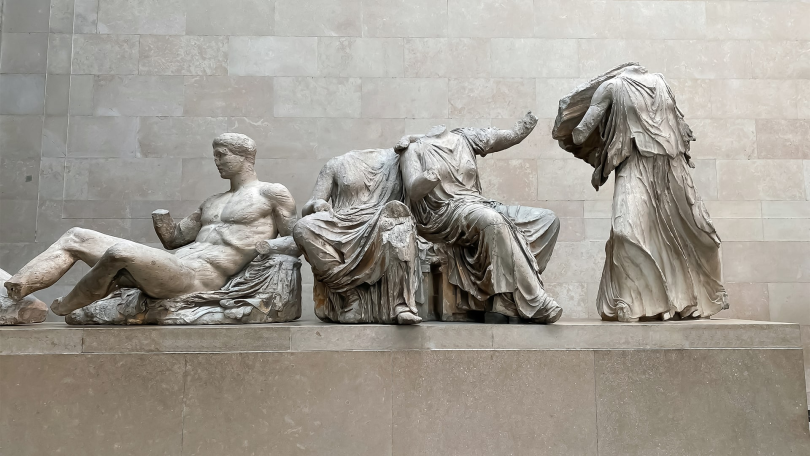

In the History Reclaimed newsletter of Summer 2026 (‘The British Museum: Less Cullinan, more Pius VII’) Dr Mario Trabucco della Torretta makes a forthright—indeed belligerent—case for the retention of the Elgin Marbles at the British Museum. I wonder if an opposing position can be put, depending not on ‘decolonisation’ or ‘inclusivism’—let alone ‘emotional drivel on a substratum of propaganda from a foreign power’—but on more reliable ethical foundations.
Many of the legal and historical arguments surrounding the Marbles seem to me to be basically academic. The Director of the British Museum is forbidden by Act of Parliament to divest the institution of items in its collection, but presumably Parliament could order or sanction a particular restitution without necessarily miring itself or the Museum in legal precedent. The extent of the permission granted to Elgin by the occupying powers in Greece has been debated by some, but the Turks were indeed the ‘internationally recognised authority’ in the region and took no steps to prevent or circumscribe his activities. Whether Elgin’s motives were ‘selfless and noble’ is also debatable. The justification he offered on his return was the aim of fostering and encouraging the arts in the United Kingdom—but perhaps you would say that if you were trying to sell your acquisitions to the British Museum. No doubt by his actions he did protect the Marbles from further intermittent and piecemeal depredation, and possibly from damage they might have suffered in the Greek War of Independence. But it is also true that the Marbles were damaged by well-intentioned acts of ‘restoration’ in the Victorian era.
The case for retention has also rested on other principles. First, that such treasures are more easily visited and seen by the public in cities such as London, Paris, and New York that are hubs for international travel. Second, that in such metropolitan collections the works of art of different cultures and eras can be more readily compared with each other: Greek antiquities with Roman, Egyptian, Persian, or Byzantine ones, and so forth. I shall return to the Louvre in a moment, but the leftist Romantic intellectual, William Hazlitt, in his Life of Napoleon Bonaparte, made similar points about that museum: that it had ‘shortened the road to Italy’ and that the stolen items there had found ‘their adopted country’. ‘These works,’ he argued, ‘instead of being taken from their respective countries, were given to the world’. ‘School called unto school; one great name answered to another, swelling the chorus of universal praise.’
Tourist numbers are hard to estimate, but Athens welcomes around seven million visitors per year, compared to London’s twenty million or so. The Greek capital is clearly not an inaccessible backwater, nor does the road to it need shortening in our day and age. School does indeed ‘call unto school’ in institutions like the Louvre, the Metropolitan, and the British Museum, and that is a significant reason for their eminence and importance, but the British Museum holds something like 100,000 items of Greek antiquity, only a tiny proportion of which can be displayed at any given time. Would the ability of the everyday visitor to compare Greek art with other traditions be radically retarded if the Marbles were not there? The Duveen Gallery is a somewhat gloomy and subaqueous environment; it is not impossible to imagine a renovated and re-lit space that could be devoted to the Classical Greek inheritance in more of its diversity. It is also easy to imagine that, were the Marbles to be returned to Greece, a truly collegiate relationship would be established not only with the Archaeological Museum in Athens but also with collections such as those in Thessaloniki and Iraklion, allowing visitors to Great Russell Street to see many new things in light shed on them by the collection as a whole.
The relevant questions, I think, are ethical rather than historical or legalistic. That ethical questions are involved with such collections is made clear by the retention and/or return of anthropological samples held in the West from the Age of Discovery. These items are rarely of any aesthetic value and—in so far as the discipline of physical anthropology still concerns itself with ancient topics such as craniometry—their significance can surely be established via measurement, photographic record, and DNA recovery before being returned to the peoples from whom they were taken and who still regard them with spiritual reverence.
The ethical issue as regards the Marbles is not as clear-cut, but it is not invisible; modern Greeks may not worship Zeus, but their relation to the Parthenon as a symbolic entity is profound. Analogies are always imperfect—as Dr Trabucco della Torretta’s one between the Director of the British Museum and Pope Pius VII demonstrates, since the pontiff was under ‘immediate existential threat’ from an occupying foreign power, which is certainly not the case as regards Nicholas Cullinan. But imagine if Rembrandt’s Night Watch had, during the eighteenth century, been cut into four pieces and sold by its legal owner, with one section remaining in the Rijksmuseum and others ultimately and legally acquired by (say) the Met, the Louvre, and Kunsthistorisches Museum in Vienna. If a famous Turner moves from an English country house to the Getty it retains its artistic integrity nonetheless; but the urge to return the orphaned parts of the Rembrandt to the city which it celebrates, and thus restore the painting as what it was intended to be, would surely be hard to resist. That seems to me to be the key ethical question here. Long ago Ruskin exploded the delusory distinction between a building’s ‘structure’ and its ‘decoration’: the Parthenon was designed for the Marbles quite as much as the Marbles were designed for the Parthenon, and to return them would enable the reintegration of a single work of art.
Of course, that work of art could not be completely reintegrated. No one would propose that the Marbles be returned to the Parthenon as such and exposed to Athenian air pollution. But the Acropolis Museum is a perfectly safe, purpose-built and handsome institution at the foot of the Acropolis, maintained by a (nowadays) stable and safe Western democracy, which could house the Marbles as close to their old home as possible. The administrators of the British Museum are not the sole possessors of ‘a legacy they are there to steward and transmit not just intact but even…augmented’ as Trabucco della Torretta argues. The Athenians have a legacy, too, despite not being inhabitants of Trabucco della Torretta’s ‘sceptred islands’. The Museum’s claim to stewardship goes back 200 years; the Athenian one goes back 2,500 years, interrupted for 400 of them, it is true, by a colonial occupier acting without regard for the local population and its inheritance. The contrast with the Benin Bronzes is sharp. In the first place, we have reason to be anxious about their safety in conflict-ridden Nigeria, which (as its citizens rightly complain) also suffers a pronounced degree of political corruption—and is a long way off the international tourist itinerary, too. In the second, those statues do not form a composite as the Marbles and the Parthenon together do, the restoration of which is an aesthetic duty.
Lastly: this ethical issue is not unique to the British Museum. Galleries and museums across the English Channel have a similar load to bear but are subject to far less scrutiny. During the French-Revolutionary and Napoleonic Wars that Pius VII witnessed European nations were routinely stripped of their cultural treasures by their invaders. ‘French art plunder was stunning’, Wayne Sandholtz concludes in Prohibiting Plunder: How Norms Change (Oxford University Press, 2007), ‘not just for the vast quantity of masterpieces it netted, but also for the systematic and informed nature of its execution.’ In Trophy of Conquest: The Musée Napoléon and the Creation of the Louvre (Faber and Faber, 1965) Cecil Gould estimated that of the 500 paintings stolen from Italy, for example, half have never been returned and remain in the Louvre and numerous provincial galleries to this day. (Hazlitt had his thoughts about this, too: ‘Instead of robbery and sacrilege,’ he wrote, such plunder ‘was the crowning and consecration of art….’ After all, ‘what is subject to barter and sale in time of peace, may be reckoned among the spoils of war.’ And so on, and so forth.)
At the second Treaty of Paris after Waterloo the French argued with brazen hypocrisy that ‘public establishments and monuments, museums and libraries and all institutions of the kind be respected’, when they had paid no respect to such institutions whatever—and I am glad to record that Wellington treated such claims with the scepticism they deserved. The Louvre records that Tintoretto’s modello for the Paradise—to take one example from dozens—was taken from Verona in 1797 by ‘conquête militaire’. It now hangs in the gallery named after Napoleon’s plunderer-in-chief, Dominique Vivant Denon. Other such items, most famously the Veronese Marriage at Cana from San Giorgio Maggiore, were covered by the legal fig leaf of treaties such as Campoformio—a fig leaf that ethically speaking can and should be removed, as a work of art should never be reconfigured as either a casus belli or a ‘reparation’, not least because the Venetian Republic put up almost no resistance to Napoleon in the first place. Such works are safe and sound in French museums, no doubt, though the Marriage at Cana was cut in half and stitched back together before being hung in the Louvre, and Bellini’s San Zaccaria altarpiece of the Madonna enthroned was lopped top and bottom before it was repatriated. But the fact remains that France is in possession of hundreds of works, from Italy, the Lowlands, Germany, and Austria that it has not even the tiniest legal right to retain. Nicholas Cullinan is not the only museum director who should be under the spotlight: what is sauce for the goose is sauce for the gander.
Richard Lansdown is Adjunct Professor of English at the University of Tasmania


