

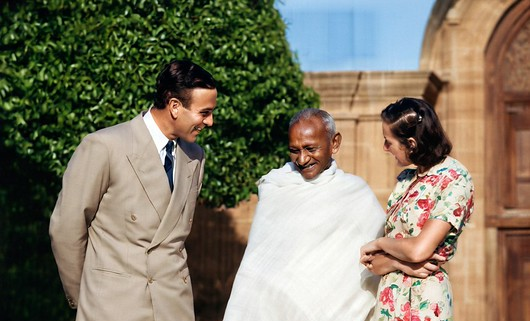

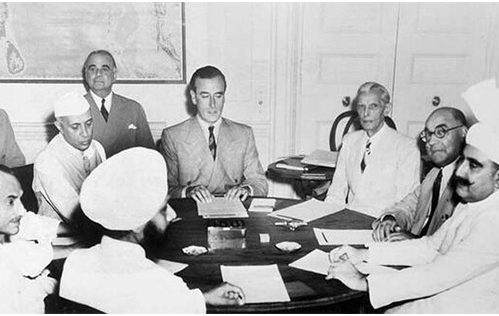
Mountbatten flanked by Nehru (left) and Jinnah (right) negotiating partition in 1947
Lady Pamela Hicks (9 April 1929 -5 June 2026), the younger daughter of Earl Mountbatten of Burma and his wife Edwina Ashley, who died recently, was probably the last living person to witness directly the events leading to Indian independence and to meet the individuals who negotiated with her father, the last Viceroy of India. Her passing is an appropriate moment to reassess Lord Mountbatten’s actions during this controversial period of history.
Many commentators in Britain today blame Britain, and Mountbatten in particular, for the partition of India and the ensuing bloodshed. A common feature of these critical assessments is to cite modern academics, who are frequently deeply antagonistic towards Mountbatten, rather than consider the views of the leading Indian and Pakistani politicians and officials of the period who were far more knowledgeable about what actually took place. This paper redresses the balance by quoting senior Indians and Pakistanis who had direct knowledge of the events in 1947/8.
The critics seldom mention V P Menon, who, as Mountbatten’s Constitutional Adviser, was present at most of the important meetings and was the Indian best placed to judge Mountbatten’s actions. He later wrote three of the most authoritative books on Indian independence: The Integration of Indian States (1956), The Transfer of Power in India (1957) and An Outline of the Constitutional History of India (1965). In the third book he gives his considered judgment on Mountbatten:
It is hardly necessary to emphasise what we owe to him for steering us through the maze of conflicting interests and policies and personalities in Delhi in 1947. In fact, I think it is no exaggeration to say that without him the transfer of power would not have taken place. I must also pay tribute to his help and guidance in dealing with the communal situation after partition, and the mass migration between India and Pakistan. He organised the government’s forces to deal with it and the situation was brought under control in three or four months’ time. No praise would be too high for these contributions.
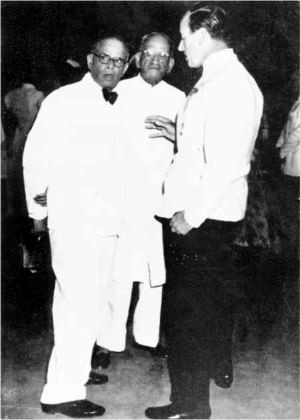
V.P Menon (left) and Mountbatten at a party in 1948
Regarding Mountbatten’s role in integrating the Indian States, in his book on the subject Menon wrote:
Another factor that went a long way in winning over the rulers was, of course, the infectious charm and inborn tact of Lord Mountbatten. It was because of his abundant love for India, and not merely because he was obliged to do so, that he had taken upon himself the task of negotiating with the rulers on the question of accession. And once he undertook any task, he invariably put the whole weight of his personality into what he was doing and spared himself no effort. Half-hearted methods and half-hearted measures are alien to him. India can never forget the magnificent service he rendered at a critical juncture in her history.
Menon’s views on whether power was transferred too soon and whether an exchange of population was possible are given in the following paper: (http://www.forgotten-raj.org/doc/menon.htm).
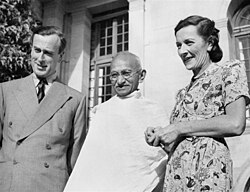
The Mountbattens and Gandhi
The ‘June 3rd Plan’ of 1947, also known as the Mountbatten Plan, set out the processes by which India and Pakistan would achieve separate statehood from the Raj. Mahatma Gandhi expressed his views on Mountbatten’s role in facilitating independence and also partition at a prayer meeting a few days after it was published:
The British government is not responsible for partition. The Viceroy has no hand in it. In fact he is as opposed to division as Congress itself but if both of us – Hindus and Moslems – cannot agree on anything else, then the Viceroy is left with no choice. The Viceroy has worked very hard and tried his utmost to bring about a compromise. This Plan was the only basis on which agreement could be reached. The Viceroy did not want to leave the country in chaos; hence all his efforts.
Muhammad Ali Jinnah, leader of the All-India Muslim League, referred to Mountbatten in his radio broadcast on June 3rd:
I must say that I feel that the Viceroy has battled against various forces very bravely – and the impression that he has left on my mind is that he was actuated by the highest sense of fairness and impartiality. And that it is up to us to make his task less difficult, and help him, as far as lies in our power, in order that he may fulfil his mission of the transfer of power to the peoples of India in a peaceful and orderly manner.
Jinnah also paid the following fulsome tribute to Mountbatten at the state banquet to celebrate Pakistan’s independence on the 13th August 1947:
Here I would like to say, Your Excellency, Lord Mountbatten, how much we appreciate your having carried out wholeheartedly the policy and the principle that was laid down by the plan of the 3rd June and the Indian Independence Act which was passed by the British Parliament and received the assent of His Majesty the King on 10th July with grace, dignity and great ability. You are the last Viceroy of India, but Pakistan and Hindustan will always remember you, and your name will remain cherished not only in the history of these two Dominions but will find a place In the history of the world, as one who performed his task and duties magnificently.
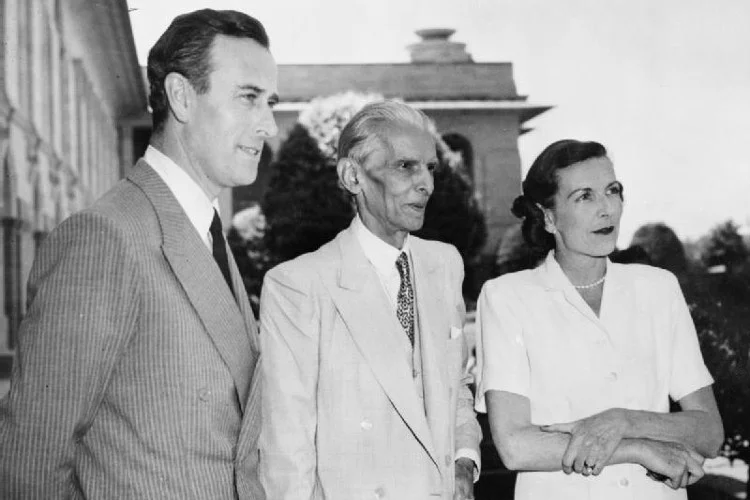
The Mountbattens and Jinnah
At a function shortly before Mountbatten’s departure from India in June 1948, Jawaharlal Nehru, subsequently India’s first prime minister, paid the following tribute to Mountbatten: ‘His period of office has been memorable in the history of India and he will be remembered by the people of India with affection as one who cooperated in the great task of building a free India and who applied his great abilities and energy to this end’.
Chakravarti Rajagopalachari, the Congress politician who took over as Governor-General following Mountbatten’s departure, said in his first address in Durbar Hall:
The work of my predecessor during his memorable term of office was a marvellous instance of detachment, devotion and energy on the part of one who, though not belonging to India, worked as one belonging to her, and did his work in the spirit that is laid down in our scriptures with regard to the task that falls on anyone.
Sardar Patel, Home Minister and Deputy Prime Minister after independence, wrote to Mountbatten on the eve of his departure:
Your sympathetic imagination and realistic approach to India’s problems enabled you to win popular support for one of the boldest plans that were ever conceived in history. All of us can, I think, have the satisfaction that on the whole that plan has justified itself and has settled one of the most difficult and taxing problems which has ever faced statesmen in any country.
Hirubhai M. Patel, a senior Indian civil servant, later the Indian Finance Minister, who negotiated the division of assets between the two countries with Chaudri Muhammad Ali, the senior Muslim civil servant who later became Pakistan’s fourth prime minister, wrote of this period in the book Rites of Passage. A Civil Servant Remembers (2005):
All these various steps, measures and arrangements and many more had to be accomplished within a matter of seventy-odd days. It would have been impossible to achieve all this, but one has to accept it because all this was, in fact, accomplished. For this, credit must go to only one fact, the fixing of 15 August as the date for the transfer of power. Mountbatten was clearly moved by one consideration, and that was that the transfer must take place as early as possible, if trouble was to be averted. He received maximum possible cooperation because everyone was, for one reason or another, anxious to see the end of uncertainly and violence… Mountbatten therefore, managed to ensure that practically everything necessary to be done to facilitate the transfer of power by the British was completed on time.
Chaudri Muhammad Ali was generally critical of Mountbatten for, in his view, always favouring the Indians, but even he valued the June 3rd plan, as he stated in his book,Emergence of Pakistan (1967):
The immediate effect of the announcement of the plan and its acceptance by the main political parties was to still the controversy and bring about a semblance of calm. At last the great issues that had dominated the Indian political scene for decades and had aroused such strong passions were settled. Among Muslims there was a sense of fulfilment at having achieved Pakistan.
Maulana Azad, former president of Congress and a Moslem who decided to remain in India where he was Minister of Education between 1947 and 1958, criticised Mountbatten for partitioning the country. But in his book India Wins Freedom (1958) he nevertheless praised Mountbatten’s role in ending the violence:
I have blamed Mountbatten for the way in which he helped to bring about partition. I must now pay him a tribute for the manner in which he handled the crisis which faced us. I have already referred to the energy and vigour with which he carried out the intricate and difficult task of partitioning India. He now acted with even greater energy and vigour to restore law and order in the country. His military training now stood us in very good stead. Without his leadership and experience of military tactics, it is doubtful if we could have got over the difficulties with such expedition and efficiency.
The most heartfelt tribute, however, was paid by the 200,000 ordinary Indians who at Mountbatten’s departure from India in June 1948 came out to cheer him. Nehru referred to the vast crowds that had attended the Mountbattens’ last appearances and wondered ‘how it was that an Englishman and Englishwoman could become so popular in India during this brief period’ (Philip Ziegler, Mountbatten.The Official Biography (1985), 478-9.)
It is evident that most senior Indian politicians and officials at the time of independence had nothing but praise for Mountbatten and admired him greatly. Pakistani politicians and officials criticised some of his decisions but praised others. More weight should be placed on the views of these individuals who had direct knowledge of events and of Mountbatten’s actions, than those recent commentators who demonstrate a lack of awareness of the realities in India in 1947.
Following his violent death on 27 August 1979 at the hands of the Provisional IRA, India observed a week of national mourning.


