


In my last job, before being restructured into redundancy, oblivion and senility, I was Curator of Historical International Art at the Museum of New Zealand Te Papa Tongarewa. I was a latecomer, having previously been an academic, but during my five or six years there, I formed firm views about the do’s and don’ts of the job and will share these here.
1. Thou shalt have a good knowledge of thy section of the collection.
If you haven’t got such knowledge, learn it up, and fast, on the job. It’s fun and it makes you a professional. My portfolio was vast – any non-New Zealand art before 1900. But I had the massive advantage of being that old-fashioned thing as an academic, an all-rounder, not a narrow specialist: a bit of a Kenneth Clark, but maybe I’m deluding myself. In some ways I was a better fit in a museum than I was in a university and slightly regretted not going to one earlier, though the pay packet shrank.
2. Thou shalt be passionate about thy section of the collection.
As Gombrich famously said, ‘You see what you know’. And then you should, ideally, love what you know. If you’re still bored with the art work or object at the end of the day, that’s your right, but if a large part of your portfolio bores you, then you probably shouldn’t be in the job. It’s easy to love Dürer prints and cigarette cards, harder perhaps with Victorian butter churners but – certainly in a larger museum – somebody else has the latter in their remit and could well be passionate about churning.
3. Thou shalt share that passion with the wider world.
Once you feel confident about an object, write a description of it in your museum catalogue. If this is accessible to the public, that’s even better, but make sure what you say is fairly snappy as they’re likely to read it on their phones. Try to make your description interesting, literate, informed and above all jargon-free. As a curator I wrote nearly 1800 web summaries on individual art works for Collections Online. Here’s an example, a lovely print of modest commercial value by a dead, white British male, Francis Dodd:
https://collections.tepapa.govt.nz/object/42504?page=1&rtp=1&ros=1&asr=1&assoc=all&mb=c
4. Remember thou art a humble curator, not a preacher or politician.
Tragically, saying this wouldn’t have been necessary until quite recently. By all means have political convictions. But as far as possible, do not let them influence, still less compromise, your web summaries or – still worse – exhibition labels. If someone wants to know about Francis Dodd, he or she won’t want to know where you stand on the restitution of the Parthenon Marbles (or whether you’re a Manchester United supporter). If you’re curating an exhibition, inform visitors about the object in front of them. Say little or nothing about yourself: explain and don’t preach. Frankly, you’re probably far less interesting, and you owe your job to the exhibit. Equally important, don’t bang on about colonialism, heteronormativity or intersectionality: these are not, or should not be, issues for curators but for failed humanities academics (certainly the last two). Obviously if the exhibition is specifically political, e.g. ‘David and the French Revolution’, then you must necessarily engage, but here I favour lightness of touch and even-handedness, allowing viewers to draw their own conclusions. David and Corday matter: you don’t.
5. Thou shalt be careful and circumspect about deaccessioning objects.
One gets the impression these days that some curators, particularly a well-known one in Oxford, would give away a skull or an African bronze at the drop of a hat to anyone remotely plausible. If in doubt, don’t move. Do proper research on the ‘contested’ object, on a case-by-case basis. Find out as much as you can about the circumstances and motives behind the initial acquisition. Look at the intrinsic qualities of the object. Consider the interest it creates if exhibited to visitors of all political views and ethnicities where it currently is. If you’re wavering, ask yourself whether it would be in better hands in a Nigerian or New Zealand museum of international credibility and conservation standards. Look at your own museum’s constitution and collection policy. Then and only then…
6. Thou shalt not waffle.
If you’re lucky enough to be curating an exhibition (my museum was a bureaucratic monster, I was forever being thwarted here, but it’s boring to grumble), think carefully about how you’re going to label each exhibit. Write about the object, and keep to the point. Don’t overwhelm visitors: remember their normal attention span is about 10 seconds, which can extend to 30 or more if they’re interested. Therefore, and I repeat myself, don’t bang on about heteronormativity. Here’s a label that I wrote for an exhibition I curated, ‘Seriously Valuable Art’, which is currently touring the South Island of New Zealand:
Clarice Cliff was nothing if not versatile, and here she is in a highly untypical, modernist yet playful mood. Had she been looking at her Bauhaus women counterparts? Or even the Surrealist, Miró? Her fans underrate this style: but isn’t the honey-coloured glaze of ‘Goldstone’ rather gorgeous?
7. Thou shalt work with and learn from others.
At the museum, I found the other curators, and those unsung heroes and heroines, collection managers, were often terrific, able people, generally far nicer than my often self-centred academic colleagues of the previous 28 years. Work with them: support them if they want to acquire something interesting for the collection, and get their support in turn. Think about how they can potentially help you with your own exhibitions and collection related research. My happiest example of cross-disciplinary understanding was when I collaborated with two fine invertebrates specialists from the Natural History team, to look at an enchanting set of prints of assorted butterflies, moths and bugs by Wenceslaus Hollar (1607–77). As art historians had devised the prints’ titles, and rightly suspecting their limited knowledge of invertebrates, I got my colleagues to identify them accurately and we retitled the prints accordingly. One amusing moment was trying to persuade another curator (in the British Museum, incidentally), to retitle her set too, but oh no, she was very grand, and determined to stick to art historical erroneousness. The collaboration culminated in an article, published in Print Quarterly: https://www.jstor.org/stable/48780271 which, perhaps, got her to rethink: I must check!
8. Thou shalt covet thy neighbour’s house, but preferably draw the line at the wife, servant, ox and donkey.
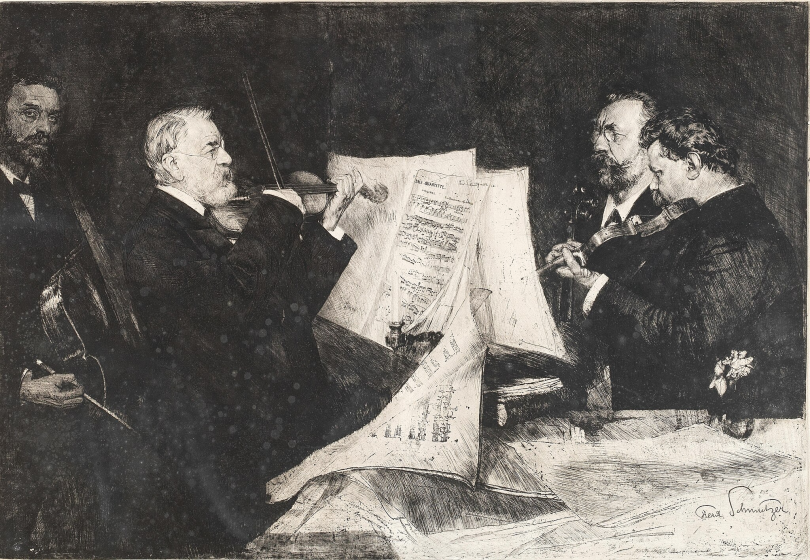
One of the joys of the curator’s job – if you’re fortunate enough to have an acquisitions budget – is to visit people who are interested in selling or donating their treasures. I only wish this had happened more often. Look at what they’ve got, do some instant homework on your phone, chat to the owners about them, admire the quality of the art work, and if it fills a gap in the collection and is remotely attractive and in good condition, then consider writing an acquisition proposal. This can culminate in a purchase at a fair price or a gift, an enhancement to the collection, and smiles all around. But note one thing, which I learnt early on: avoid being too enthusiastic – or even too erudite – when you first set eyes on the object of your desires. If you gush too much, the owner may well start liking it themselves and change their mind about letting it go. My mistake applied to one of the largest etchings in western art, by Ferdinand Schmutzer, of the Joachim Quartet (1904). I was a Veruka Salt (‘I want it now!’) and this was my Achilles heel. It still hurts, but at least the owner continues to enjoy it.
9. Thou shalt treat all people equally.
As taxpayers, they fund the museum, and as foreign visitors, they may well spend in the store and drop a banknote or two into the donations box. If someone wishes to see an object that isn’t on display, make an appointment to see it with them. Do your homework, and hear what they have to say in turn. They may be a party of primary school kids: if so, great, listen to their responses and you could well learn from them. If it’s the world expert on the brilliant but mad Wyndham Lewis, as one visitor was, learn from him and write – or rewrite – your web summary of the relevant museum holdings. Like the coveting (see commandment 8), I only wish this kind of thing had happened more often.
10. Remember, thine occupation is a calling, rather than a mercenary means unto an end.
While I feel really sorry for my British curatorial counterparts, whose average salary is less than an army corporal’s, you should never be a curator for the money. But what you do is immensely valuable, it is work that shouldn’t feel like work, and you’re being paid for caring for treasures that people pay to visit, or else pay far, far more to own. The curator with an interesting collection is like the proverbial kid in a candy store, and should enjoy that privilege.


