Empires Featured India

On the William Jones memorial in University College, Oxford

image 2025 01 24 120810756

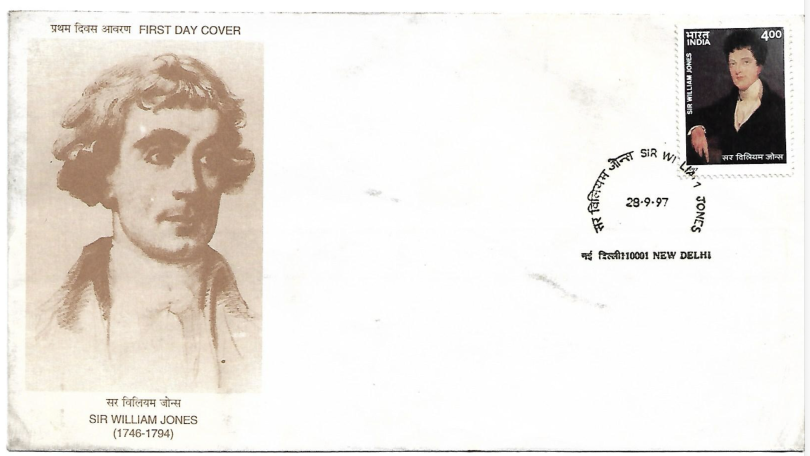
Mark Stocker and Rohan Fernando add further evidence to contradict the ‘anticolonialism’ of University College, Oxford, manifested in their commentary on John Flaxman’s monument to Sir William Jones in the college’s chapel. Dr Stocker demonstrates Flaxman’s credentials as a humanitarian and Mr Fernando provides visual evidence of the high regard in which Indians hold Sir William Jones: a first day cover of an Indian stamp issued in 1997, following the 250th anniversary of his birth, bearing Jones’s portrait.

Dear History Reclaimed,
 
As an art historian and a (short) biographer of John Flaxman, I can confirm Professor Lawrence Goldman’s point (’Sir William Jones, John Flaxman and University College, Oxford’, 15 January 2025, https://historyreclaimed.co.uk/look-on-my-works-ye-mighty-and-despair-sir-william-jones-john-flaxman-and-university-college-oxford/) that there is precisely zero evidence linking John Flaxman to racism or the support of slavery.
 
As a close associate of both the famous abolitionist Josiah Wedgwood, and of William Hackwood, artist of the very
‘Flaxmanesque’ relief Am I Not a Man and a Brother?, this suggests personal sympathies very much at odds with this. The case is strengthened by Flaxman’s authorship of his famous and moving monument to Lord Mansfield in Westminster Abbey. Mansfield’s judgement in Somerset v Stewart (1772) ruled that it was illegal to enforce an enslaved person out of England and was a landmark in the abolitionist cause.
There is no tangible proof, however, that Flaxman himself was an abolitionist, and though I’d love it if he were, if I implied it I would fall into a similar trap as University College – and risk Professor Goldman’s justifiable ridicule!
 
Yours sincerely,
 
(Dr) Mark Stocker

About the author

Mark Stocker

Mark Stocker

Mark Stocker, FSA, is former Curator, Historical International Art, at the Museum of New Zealand Te Papa Tongarewa. He has taught at the universities of Canterbury and Otago. His publications include numerous contributions to The Burlington Magazine and When Britain Went Decimal: The Coinage of 1971 (2021).

About the author

R P Fernando

R P Fernando

The author was born in Sri Lanka and is a scientist with a first degree and doctorate from Cambridge. Extensive correspondence and some articles of his have been published in the national press in the UK and in Sri Lanka. He has published Selected Writings – W A de Silva (2009) and Buddhist Heritage in India and Sri Lanka – Rediscovery and Restoration (2017).