‘The National Trust is committed to promoting and preserving those places of natural beauty and historic interest for which it has the privilege to be responsible for the benefit of the nation, for everyone for ever.’
This appears on the National Trust’s website under the heading ‘For everyone, for ever: our strategy to 2025’. If it were true, most of NT’s 5.37 million members would be happy. So why does the National Trust collaborate with Leicester University on the Colonial Countryside Project which aims ‘‘to transform the heritage sector’s approach to its colonial links’? This mission is the polar opposite of ‘promoting and preserving . . . for the benefit of the nation,’ The NT says new narratives must include ignored or lost knowledge. But such narratives, do not enrich or expand knowledge of our heritage. They select information on the basis of the political prejudices of identity politics and exploit it to present a corrupted narrative about British history and our cultural heritage.
One pleasure of summer in England is a visit to a great country house, often nestled in artfully landscaped parkland dotted with woods and the occasional folly, and rounded off with tea and a scone. Sadly, such visits are in danger of being ruined if the National Trust continues with deplorably misguided initiatives like the Colonial Countryside Project or those promoted in Radio 4’s programme The Grand House: Boom or Blight? https://www.bbc.co.uk/programmes/m0022c3h
Both share a cavalier disregard for the complexities of history, and a lack of historical imagination that prevent today’s cultural curators and directors doing what their forebears did spontaneously: truly adore the houses and collections in their care.
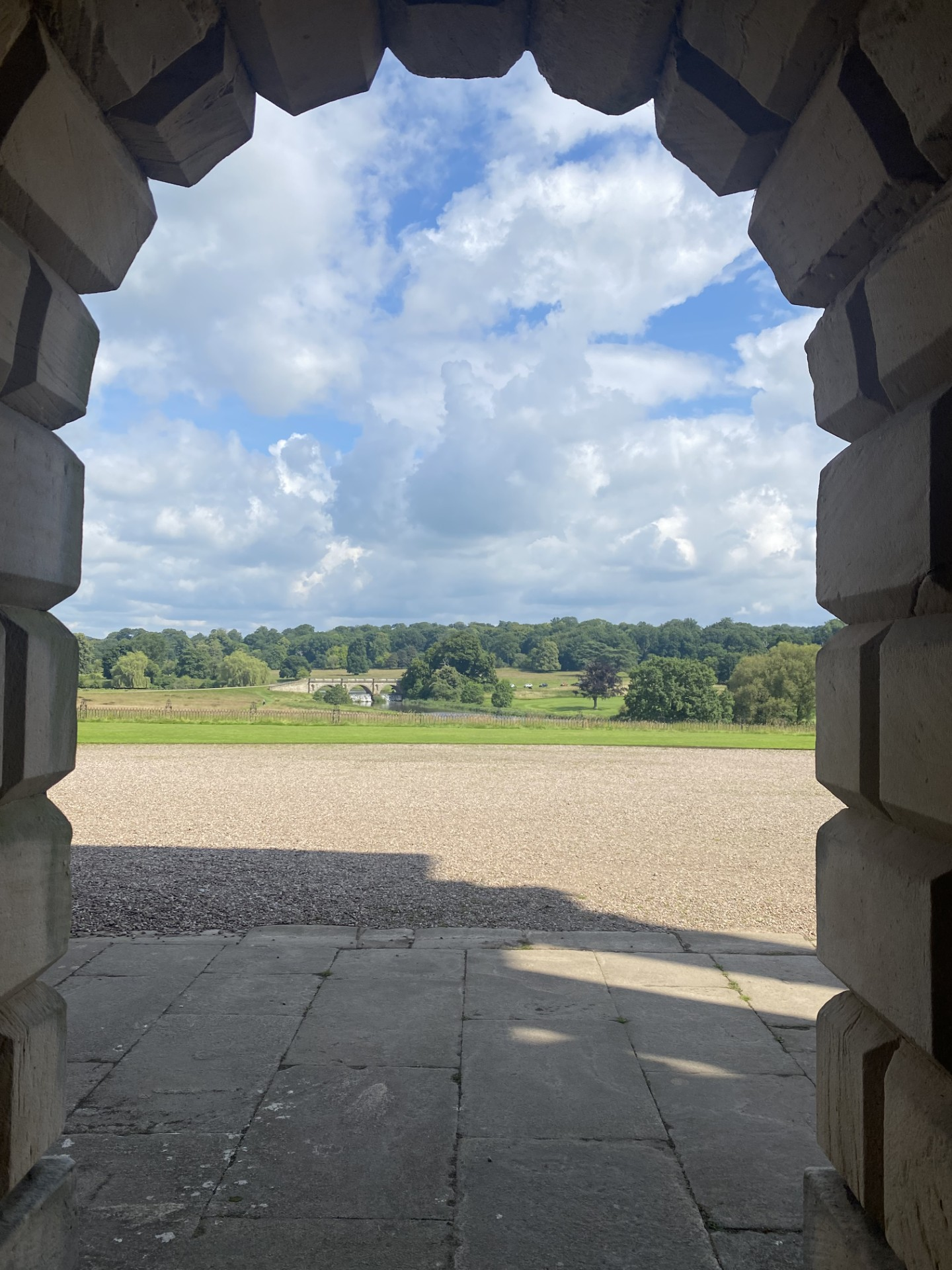
A typical English beauty like Kedleston Hall in Derbyshire offers the opportunity to experience a sense of England’s history during a particularly important and creative era. Approached with good faith, an open mind and curiosity, a visit to Kedleston Hall illuminates how at certain times in history, technical, cultural, political and social progress combine to create things of lasting beauty and shape individuals who are committed to such creation. In doing so, both creator and creation stamp their mark in time.
Connections between the land on which Kedleston Hall stands and the Curzon family began in the 12th century. The lineage can be seen in the impressive family tree that hangs in the Family Corridor. The original Robert de Courson arrived in England with William the Conqueror. Around 1198, Richard de Curzun made a grant to Thomas de Curzum of ‘all the vill of Ketelestune with the advowson of the church . . .’ When, in 1758, Nathaniel Curzon, later the first Lord Scarsdale, inherited the much extended house and gardens built by his grandfather, he chose to do much more than simply maintain the house and gardens bequeathed him. Nathaniel Curzon was an educated man, schooled at Westminster and Christ Church, Oxford. He was enthused by Mediterranean culture, particularly the architecture of Palladio, to which he decided to pay his respects. He had his grandfather’s property demolished and rebuilt drawing on aspects of Palladian and Picturesque architecture. The architect and designer, Robert Adam, used local as well as international sources of art and decoration.
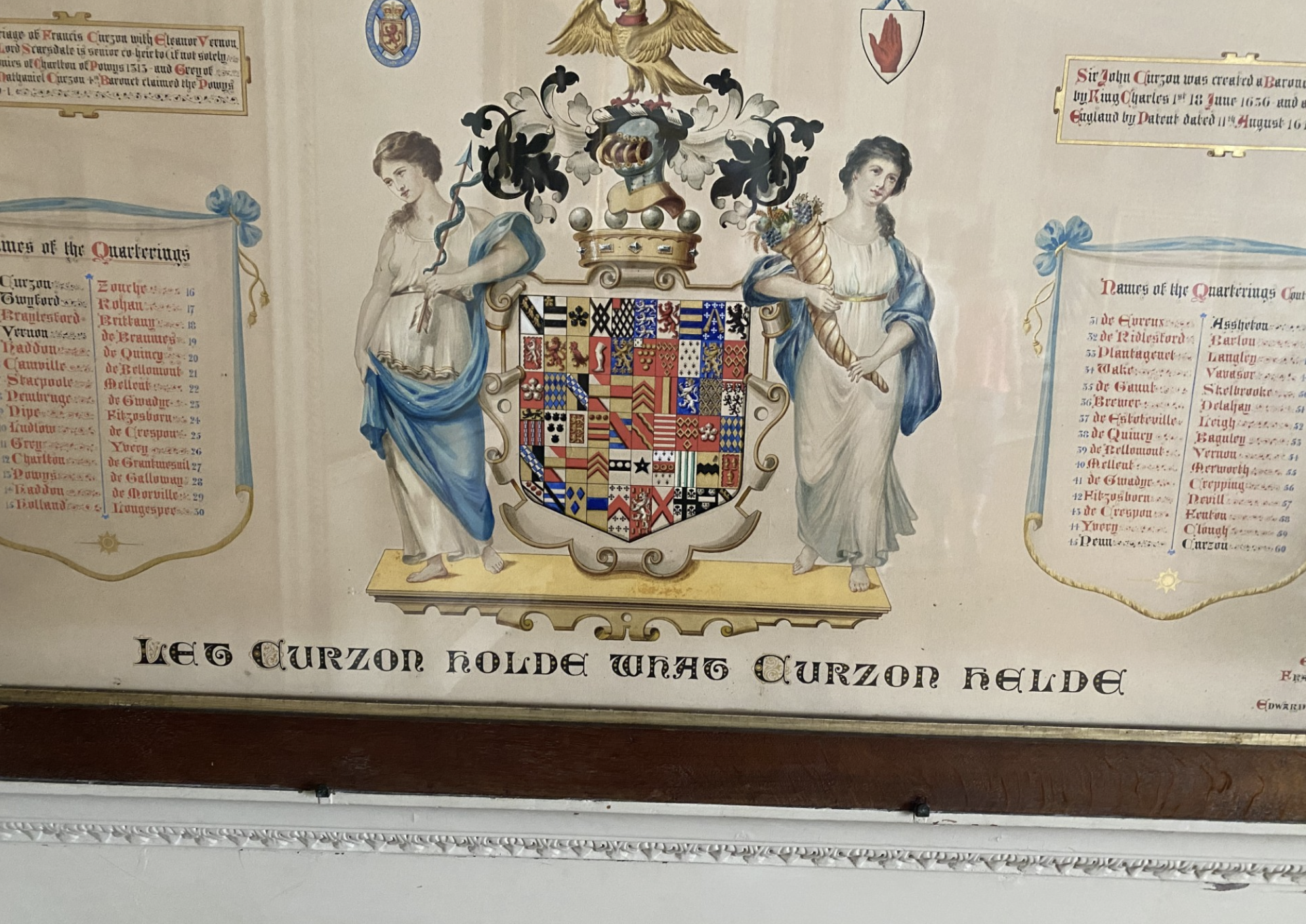
Image from the Pedigree of the Curzon Family, Kedleston Hall)
A more recent addition is the Indian Collection which houses the eclectic collections of George Nathaniel Curzon, who served as under-secretary for India. He had travelled and written extensively about Asia and Russia. In 1899, was appointed Viceroy of India. As such, he oversaw the partition of Bengal, preserved the Taj Mahal which he found in dire physical disrepair, and restored its gardens. He was an imperialist and a champion of western civilization. However, he recognised the civilizational value of the cultural heritage of the other. Curzon was determined to restore and preserve the Palace of Mandalay although it meant evicting the British residents. This historical legacy should be celebrated. Did he have outdated views of Indians, or use bigoted language? Quite probably. But today, though these are regarded as anachronistic and morally reprehensible by most British people, nevertheless the opportunity for so many from several generations to enjoy the beauty of the Taj Mahal endures, in no small part thanks to the efforts of colonialists like Curzon.
However, today’s decolonisation advocates are unable or unwilling to celebrate a past containing colonialism and Empire which they see not as political or social eras, but as unique moral sins with consequences that reach directly into the present day. Hence new narratives are needed. The Colonial Countryside Project is an ill-conceived collaboration between the National Trust and the University of Leicester. In 2018, the National Lottery Heritage Fund and the Arts Council England awarded £160,000 from the public purse to fund the project, ‘Colonial Countryside: Reinterpreting English Country Houses’. Its aim was to ‘inspire a new generation of young people to advocate talking about colonial history’. It assembled sixteen historians and 10 writers commissioned from Peepal Tree Press which declares on its website that it has been ‘Decolonising Bookshelves Since 1985’. The writers were paid £1,200 each plus £400 for research expenses. They were also invited to attend social media training events, writing and public speaking workshops, literary festivals and Black History Month meetings. Branded as innovative, child-centred pedagogy, to many it looks like indoctrination. The researchers on the project represent a new type of academic, dedicated to using scholarship in the service of social justice activism.
The University of Leicester’s Museum and Galleries Department also hosts the Research Centre for Museums and Galleries (RCMG) which received a Special Recognition Award for outstanding contributions to the sector at last year’s Museums and Heritage Awards. Among its valued contributions are:
. . . multiple projects that have had a transformative impact, supporting organisations across the culture sector to advance trans inclusion, challenge embedded whiteness, tackle ableism, advance human rights and play an active role in engaging audiences around pressing contemporary issues.
This represents the rejection of the heritage sectors’ role of stewardship of our past heritage for the future: for everyone for ever. Using the National Trust leadership ‘to transform the heritage sector’s approach to its colonial links’ bypasses established internal institutional democratic process, which is something the campaign group Restore Trust is highlighting. Democracy, and a basic respect for the public, is something for which contemporary decolonisers have little time. There is something quite patrician in their assumption that the public cannot engage with our historical heritage without its ethical sanitisation via the work of self-appointed experts in race and decolonisation. Ironically, the decolonising lens seems more than a little Eurocentric itself. Maybe our decolonisers are not the morally enlightened bearers of ‘new knowledge’, or as politically radical, as they think they are?