

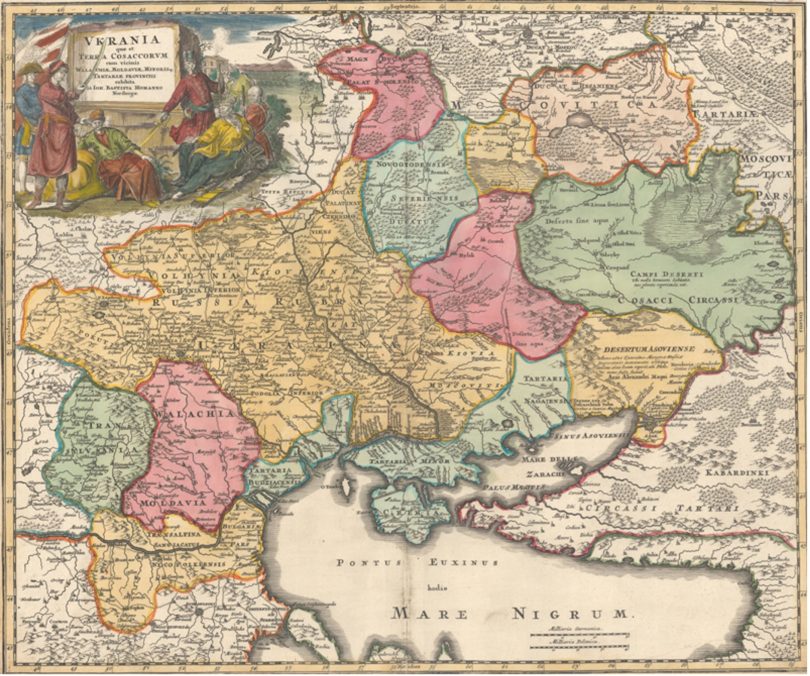

The struggle for independent statehood which Ukraine now wages – the deadliest, most ruinous, in its short history as an independent state – is one which, among much else, it fights for the right to reclaim its own history. More exactly, since it has, unusually for a post-Soviet state, a robust democracy where free speech and publication has been in the main preserved, it has many histories, differing in detail or fundamentally, many dealing with the more tortured periods of its past. In that past, it had been part of the Roman, Ottoman, Hapsburg, Romanov and most recently Soviet empires: its present independence, now fatally threatened, is little more than three decades old.
The briefest of histories shows that Ancient or Kievan Rus – the major population of which were descendants of the Scandinavian warriors (the ‘Rus’) who seized power in the region and merged with the local inhabitants – fragmented under successive invasions and was wholly destroyed in the 13th century by the all-conquering Mongols. Moscow gained in importance in the East, forming the region of Muscovy: in the West, the Poles and Lithuanians developed a Commonwealth.
Settlers on the steppes, known as Cossacks, rose against the Commonwealth and managed to establish a state – the Hetmanate. Pressed by the Poles, they appealed to the Muscovy tsar for aid, largely on grounds of a common religion and ethnicity. Brought into the conflict, the Russians saw off the Poles and Lithuanians, and created a vast empire, – much of this due to Catherine the Great (1729-96). By the early 20th century, the Russian empire was at maximum stretch – from Central Europe in the west to the Bering straits in the east, its coast only some 50 miles west of the American state of Alaska.
Situated at the western end of the Russian steppe lands, and the eastern end of states which were part of Europe, Ukraine acted as a buffer against invasion, and was also buffeted by invasions. The Soviet Union was the last empire to claim it as its own, and under Stalin’s fanatically cruel rule, Ukraine seemed to bring out the worst in him. The famine of the 1930s is seen by many scholars as the result of a deliberate war on the peasantry’s resistance to collectivisation, together with huge grain exports to obtain hard currency. Some historians believe that the Soviet leader used the famine to crush nationalism. Stalin’s death brought to power Nikita Krushchev (1953-64) followed by Leonid Brezhnev (1964-82), both of whom, though ethnically Russian, had risen through the party in Ukraine: they championed it within the party leadership, while continuing to wage war on the strong current of nationalism, which neither could eradicate.
The USSR’s collapse was Ukraine’s opening to statehood. As it became ever clearer that Mikhail Gorbachev’s attempt to construct a less rigid form of communism through the restructuring of the economy (perestroika) and freer speech and publication (glasnost), the bottled -up civic energy in Ukraine emerged, with ever greater confidence. Elections to the parliament in 1990, as Gorbachev’s authority reached its nadir, saw democrats take a quarter of the seats: a new president, Leonid Kravchuk, got a declaration of independence through, and when, in December 1991, it was supported in a referendum with a majority for independence of 90 per cent on an 84 per cent turnout, the Soviet Union was over. Its 15 states were formally independent; Gorbachev resigned on the 25th of that month, Christmas day in the west. In Russia, Boris Yeltsin became President of Russia.
Ukraine had a cruel time of it, coming into statehood. Its industry, largely based on heavy manufacturing, had the rest of the former USSR, especially Russia, as its main market: that market more than halved. As in Russia, younger men took over from the Soviet era managers, stripped the economy down to its market essentials and became billionaires. These were the oligarchs. One of them, Igor Kolomoisky, had a TV channel which developed a show called Servant of the People, about a history teacher who, through none of his own doing, becomes President of Ukraine. Playing the teacher was a young actor-comedian, Jewish and a Russian speaker, Volodymyr Zelensky. In the presidential election of 2019, at the age of 41, his role became his life.
He was a leader unsullied by the deals, corruption and authoritarian leanings of previous presidents: a schoolboy when the USSR disintegrated, enthusiastically pro-European and democratic, and successful in his profession which had made him relatively rich. In him, Ukrainians who valued their country’s sovereignty – the large majority – saw one whose instincts and background placed him firmly on the liberal-democratic side of politics. More than that: when the Russian army invaded on February 24, 2022, he was offered sanctuary and escape by several foreign embassies from what was assumed to be the capture of Kiev and likely murder. He unhesitatingly refused: it made him, as a leader, untouchable.
In the near three years of war, he and his closest aides – several from the media world in which he had lived – have become more closed, even authoritarian; corruption remains high throughout politics and the economy; criticism of his presidency grows louder. But basic freedoms remain: debates in the parliament are uninhibited and the media retain, if less surely than before, the ability to be critical.
He now faces a more urgent matter than his popularity (lessened, but still higher than any other political figure): will the west continue with financial and weaponry support sufficient for Ukraine to halt the Russian advance? Will it force, or leave no option but a negotiated peace deal? And would that lead, quite quickly, to a country enclosed in a political straitjacket: forbidden to join either Nato or the European Union, constrained to be part of a revived Russian imperium, its open politics ended.
No question that President Vladimir Putin has this as the legacy he wishes to leave his successors: no question that his view of its history leaves no room for an alternative. While sheltering from Covid in 2020–2021, Putin wrote an essay On the Historical Unity of Russians and Ukrainians, published on July 12, 2021. Much of it sought to prove that Ukraine and Russia had grown together—linguistically, religiously, culturally—throughout the centuries, until, in the 2000s, malign actors (who included radicals and neo-Nazis, encouraged by Western forces which turned the new leadership into “willing hostages”) began to tear Ukraine away from Russia, discriminating against the many Russians living in Ukraine, forcing them into a narrow Ukrainian nationalism in which Russian speakers were suspect. Putin wrote, “It would not be an exaggeration to say that the path of forced assimilation, the formation of an ethnically pure Ukrainian state, aggressive towards Russia, is comparable in its consequences to the use of mass destruction against us” (my italics).
This was a huge inflation of the danger the Russian President claimed to see in Ukraine’s efforts to deal with him as one sovereign state to another. His description of the threat in such a manner makes it clear that he posed this as the most extreme danger—and thus raised the need to defend Russia militarily against it, to the point of invading the errant state in a preemptive strike. The invasion, when it came a little over eight months from the essay’s publication, could thus be framed as a necessary defense against a regime led by Nazis (their leader in the cunning disguise of a Jewish comedian) which had committed itself to a war against Russia, one which threatened its extinction. The attack against such a foe was, his essay ‘proved’, a necessary defence.
Putin’s essay was written to be the authoritative word on the status of Ukraine. He opened by writing that he had been asked, in one of his yearly phone-ins with ordinary citizens, about Russian-Ukrainian relations. He had replied “Russians and Ukrainians were one people …It is what I have said on numerous occasions and what I firmly believe.”
He ended it in the same vein: “I am confident that the true sovereignty of Ukraine is possible only in partnership with Russia. Our spiritual, human and civilizational ties formed for centuries have their origins in the same sources, they have been hardened by common trials, achievements and victories. Our kinship has been transmitted from generation to generation. It is in the hearts and the memory of people living in modern Russia and Ukraine, in the blood ties that unite millions of our families. Together we have always been and will be many times stronger and more successful. For we are one people.”
One people: like it or not. A Russian triumph, whenever and however it comes, will be the victory of Putin’s view. The “blood ties” and “kinship” are icing on a cake unchanged since Soviet, pre-Gorbachev times. “The sovereignty of Ukraine is only possible in partnership with Russia”: that, for the Kremlin, is the end of history – and will be for a Ukraine brought again under its dominion.


