

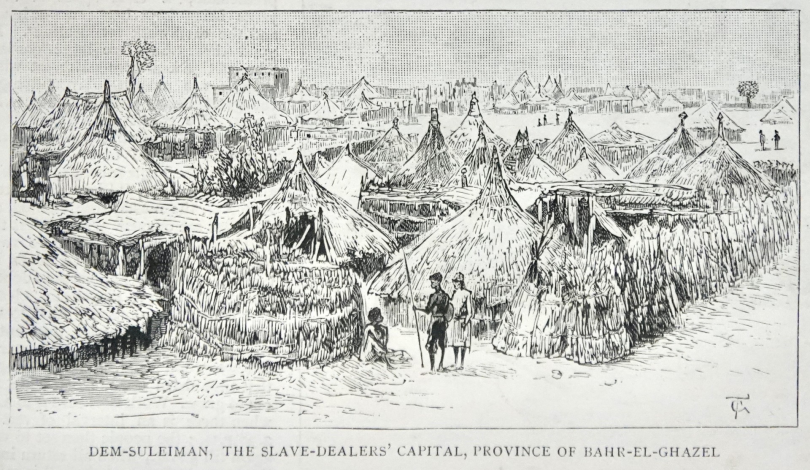

The great humanitarian cause of the 19th century was the abolition of slavery. It is simply impossible to exaggerate the effect it had on the whole country as Britons basked in the glow of a moral crusade successfully achieved, and it came to epitomise the very definition of what it was to be British:
The Lord Mayor, in opening the proceedings said that they were met that afternoon in regard to a question which for a long course of years had appealed, and he hoped always would appeal, to the hearts of Englishmen, namely, the question of slavery. That was a question of doing all that lay in their power to promote the abolition of slavery in all parts of the world. (Cheers)… By that great deed our beloved country washed her hands of the sin and the guilt of slavery, and from that day forward, whatever they had to deplore in other respects, they at all events had the satisfaction of feeling that our gracious Sovereign ruled over no slaves in the whole of her dominions… They all felt pride in the fact that half a century ago their fathers paid down 20 millions to get rid of the curse of slavery. (Cheers) [1]
Anti-slavery also kick-started a fascination with tropical Africa. Nobody knew much about the interior of the continent before the Royal Geographic Society began sponsoring expeditions,[2] but when their explorers reported back that man-capture was thriving in the forests and villages, it was clear that slavery was unfinished business. Naturally enough, the British assumed that their past success with abolition gave them both the experience and the moral obligation to continue the work, although the circumstances of the trade were different. African tribes continued to enslave their neighbours much as they had always done, but Europeans were no longer their primary market.
Expressed simply, slavery is the practice of treating people as property, but the issues it raises are more complicated and we may need to view the practice in terms of outcomes rather than simple ownership.[3] In the absence of an internationally recognised set of human rights, tensions existed between cultures and religions in different parts of the world which help explain why, despite the bold universality of the Declaration of Independence in 1776, the United States took until 1865 to abolish slavery and Saudi Arabia and Yemen only did so in 1962, after a century of prevarication and pressure from the West. The last known child captured by slavers in the central lakes region of Africa died in 1974, well within the lifetime of many readers of this article[4] and in the less accessible, war-torn regions of central Africa, sex trafficking and the practice of forcing child to be soldiers, both within the definition of modern slavery, still torment the villages.
As for any commodity, the market was driven by the needs of the purchasers. On the Atlantic, this was for manual labour on plantations in the West Indies and Americas, while a different market existed in the Sudan not just to fill labour shortages, but to supply domestic markets and harems across the Ottoman Empire. This was the slavery encountered by Samuel Baker in 1862 when he was exploring the Nile with his indomitable wife – herself purchased in a
Hungarian slave market – having undertaken the task of bringing order to the region on behalf of the Egyptian ruler. As he explained in 1883
As I had the honour to command the first expedition that was ever organised for the suppression of the slave trade in Central Africa [by the Khedive of Egypt], I can testify that no conquest was either attempted or effected of any country that was not already over-run by bands of slave hunters; those brigands were beyond the reach of Egyptian law, and it became necessary to establish the Government in order to bring them within the power of the Khedive and thereby relieve the natives from the enslavers.[5]
To the south of Lake Victoria another slave dependent economy, also controlled by Arab traders, was responsible for even more extremes of misery.[6] It has been argued that the effects of this slave trade were exaggerated by abolitionists determined to sustain an Islamophobic anti-slavery campaign to “clear the decks” for a more mature form of Western capitalism post abolition[7], but it must be doubted that a native African wrenched from his village (more likely “her”, as the general practice was to kill the men who were not being used as human mules[8]) appreciated the commercial distinction between being captured for export or to work on domestic clove plantations (the valuable commodity in this case being clove oil rather than the slave).
If the Atlantic slave trade serviced a booming demand for sugar, the East African market was driven by an explosion in world demand for ivory. For years Arab traders had been moving inland, following the vast herds of elephants and setting up trading posts along the way, but these were not centres of regional government. The merchants did no hunting themselves, preferring to barter, steal or ransom captured local tribesmen for elephant tusks that could only be transported down to the coast economically on the heads of yet more natives enslaved for the purpose. The carnage was appalling – tens of thousands of Africans were ripped from their small communities or died along the road. Once they reached the coast, the survivors, estimated to have been fewer than 20% of those originally captured, were sold at market.[9]
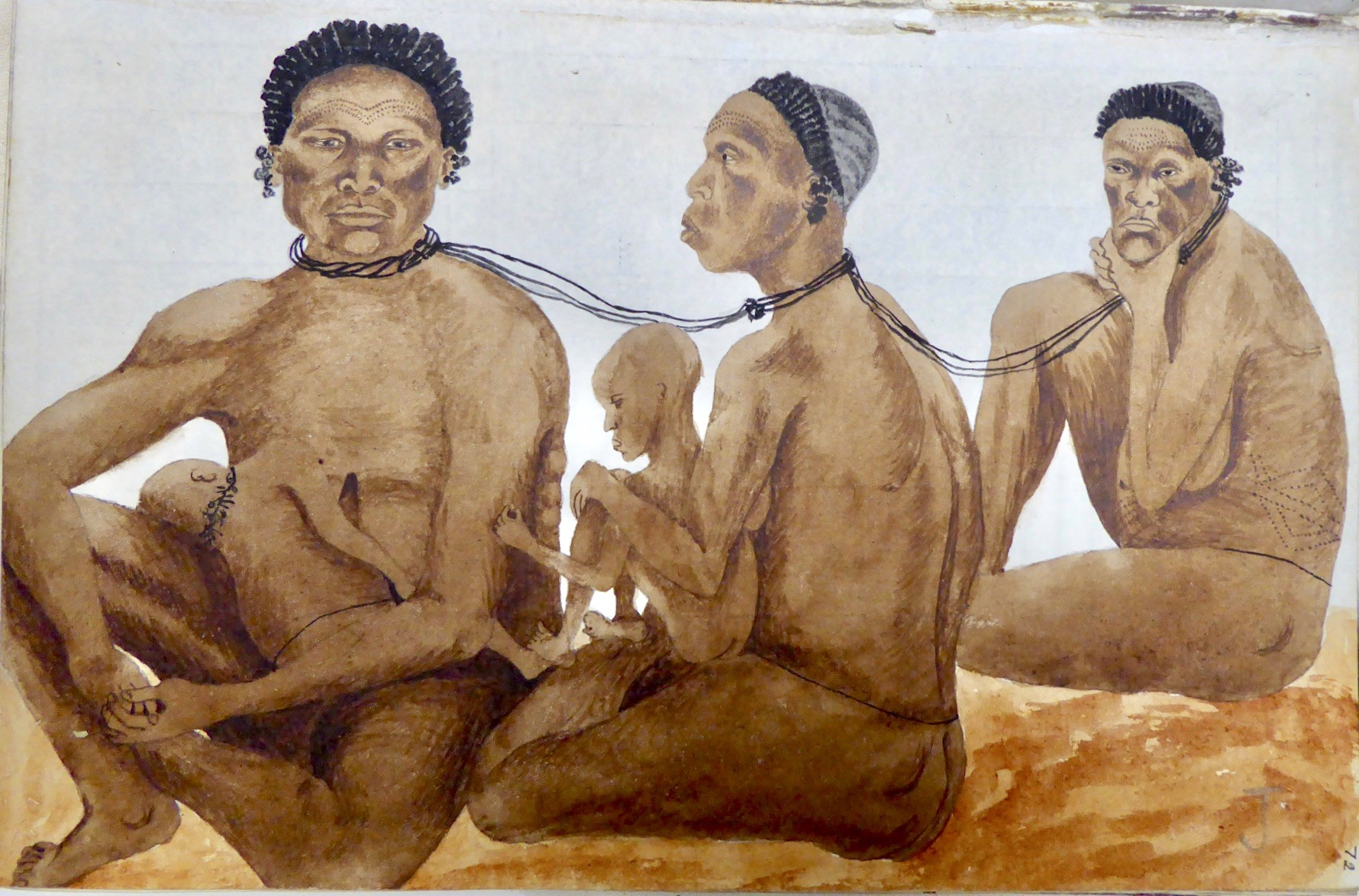
Captured natives being ransomed for food, 1888, by James Jameson (1856-88) naturalist and traveller, who participated in the Emin Pasha relief expedition. The image is taken from Jameson’s notebooks held in the Pitt Rivers Museum, Oxford
Everybody accepted that slavery in all its evil manifestations had to end and the only real debate was how best this could be achieved. British slave owners might have been persuaded to accept compensation for loss of their property rights, but nobody ever contemplated paying off Islamic slavers. The Anti-Slavery Society wanted all nations to step up to their responsibilities:
Fifty years ago England was all ablaze with an anti-slavery enthusiasm…it would be well for the cause of humanity if a similar enthusiasm could be kindled among the nations of the civilised world, in order to compel by the force of an irresistible moral pressure the putting down of slavery in Egypt and other Oriental countries.[10]
However, the solution was to come from a principled man with on-the-ground experience of the issues.
During Dr David Livingstone’s years in Africa he had developed a passionate loathing for the slave trade and his proposal for its eradication chimed perfectly with spirit of the age. As a somewhat ineffectual missionary himself, he knew that missionary work, teaching by example and shining the light of Christian values into the darker corners of the continent, was not enough. He argued that it was essential to bring commerce to the region and convince the natives that there was more value to be had in trading goods than trading people. It was an argument that resonated with men like the Scottish industrialist William Mackinnon, who passionately believed it was his Christian duty to use his great wealth to improve lives in Africa. Yet the big problem for everybody with humanitarian, commercial or military interests in central Africa, was how to get there. Henry Morton Stanley’s solution of using the Congo River had by 1890 proved to be a non-starter and equivalent rivers did not exist in East Africa. Mackinnon had the idea of building a railway across Kenya from Mombasa to Lake Victoria, but the project was too big for private initiative and he died before seeing his poorly conceived vision brought to fruition.
Since there was no system of government capable of ending the traffic in human life in central Africa itself, successive British Governments found themselves under pressure to intervene and impose anti-slavery. But despite popular calls to support Livingstone’s commercial solution, politicians remained sceptical because the region had so little to offer – or so it seemed at that time – to offset the huge costs involved. Liberal Gladstone was adamantly opposed to any sort of military intervention and Conservative Salisbury dismissed all talk about humanity and the rights of mankind as so much cant. The only consideration that mattered to him was whether action or intervention was in Britain’s best interests.
As it happened, one argument for strategic access to Uganda did gain ground. India was crucial to British commercial interests and since its completion in 1869, the Suez Canal was the quickest way to get there. Egypt controlled Suez and was in turn dependent on the waters of the Nile. With the French and Italians up to their own machinations in the Sudan it was obvious that Britain had to act and retain control the Nile right up to its source at Lake Victoria. MacKinnon’s railway idea triumphed, despite being absurdly uneconomic.
In the meantime, King Leopold II of the Belgians, who had delusions of Empire, was also using an anti-slavery rhetoric to bolster his own territorial ambitions by pretending that his interest in the Congo basin was motivated by pure altruism. The Congo held no strategic importance. but under the cloak of applying Livingstone’s benign commercialism, he proceeded to rip out the riches of the territory much as the Arabs had done, and when he went to war with them, it was not so much to suppress their inhuman trade as to eliminate a commercial rival.[11]
Whatever motivated other nations, the notion that British interests in East Africa were solely driven by profit is very wide of the mark. Humanitarian and commercial arguments were initially the most compelling, though for late-Victorian governments these were less persuasive than strategic concerns over the passage to India.
Marcus Rutherford was born in East Africa and is a former International Disputes lawyer working in the City of London (now retired). He is currently writing an account of the Emin Pasha Relief Expedition [1887- 1890] sourced from the original diaries, notebooks and and letters of the men involved.
[1] The Times 23 July 1885
[2] Burton/Speke expedition 1857-59; Livingstone Zambezi expedition 1858-64; Speke/Grant expedition 1860/1862; Johnston/Thomson expedition 1878/80. Stanley’s expeditions were all commercially sponsored.
[3] The ancient practice of capturing women from rival tribes – one specific manifestation of slavery – can be seen as a useful way of enlarging the gene pool of isolated tribes.
[4] Maria Ernestina died at the age of about 85 in Bagamoyo, Tanzania.
[5] The Times 27 November 1885
[6] Although attention is rightly paid to the terrible cruelty perpetrated on slaves sent to work on plantations, too little attention has been given to the effect slavery would have had on the communities from where the slaves were captured.
[7] Slaves, Spices & Ivory in Zanzibar [1987] Abdul Sherriff.
[8] “The Arabs attack and capture a village, kill all the grown up men and make prisoners of all the boys, girls and women they can. These they can carry on with them on their marches, selling the women where they can for ivory and bringing up all the boys for raiders and girls for their harems. Their system is a good one, though one which destroys the country they pass through…” Stairs’ diary entry for 18 October 1887 [Public Archive, Nova Scotia]
[9] Numbers are contentious. Some estimates of slaves captured over the millenia exceed those during the period of the Atlantic trade, but the calculations are dubious. Millions may be right, tens of millions perhaps not, but the 80% attrition rate may be close to the truth. Stanley’s “humanitarian” expedition of 1887 – 1890 saw an attrition rate of about 70%.
[10] Charles Allen in The Times 24 December 1883.
[11] King Leopold’s Ghost [1999] by Adam Hochschild remains the best account.


