

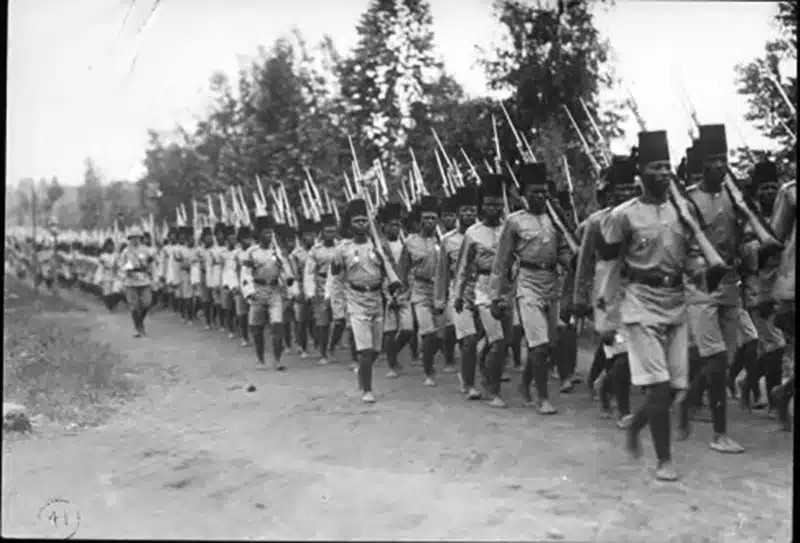

In August 2025, several reports[1] contended that, in June 1905, the British lined up 1,850 Kenyan men, women and children in Sotik in western Kenya and slaughtered them with a Maxim machine gun. It was also suggested that this act generated an enormous profit: ‘The expedition had been allocated £20,000, yet the [20,000] seized cattle, each sold at £3, brought in £60,000 yielding a £40,000 profit for the colonial treasury’.[2]
The origin of this claim appears to be a 2020 Nairobi webinar supported by the Kenyan Historical Injustice Campaign, Kenya Diaspora Alliance, the Society of Black Lawyers and the Pan African Lawyers Union, all of them campaigning for systemic reparations and for British corporations to give up their Kenyan land. The session was chaired by Peter Herbert and contributors included the late Paul Chepkwony and Claudia Webbe. Herbert, a former UK employment tribunal judge, founded the UK’s Society of Black Lawyers and controversially claimed racism in the British judicial system before retiring to Kenya in 2020. Paul Chepkwony was then Governor of Kericho County, the subject region, and a former chemistry professor. Claudia Webbe is the former Leicester East MP (2019-24) and Islington councillor (2010-2018). They claimed that
“The Sotik massacre has been erased from the history books, not just of the United Kingdom but from Kenya as well. The slaughter of some 1850 men, women and children would today be classified as genocide and a crime against humanity. In 1905, Colonel Hennessey, used a Maxine (sic) machine gun to conduct this slaughter. This massacre was used to terrorise the Kipsigi people and evict them illegally from their ancestral homeland … The Nandi Chief, Koitalel Samoei, who had successfully rebelled against the British, was assassinated a few weeks after the Sotik massacre using the same Maxine (sic) machine gun. The Sotik massacre and the assassination were directly linked to the colonial system of forced labour, hut tax, the apartheid segregation, and racism that was used to impose the colonial exploitation of Kenyans”.[3]
In the following month, Claudia Webbe wrote[4] to the Education Minister about ‘one of the most appalling massacres in the sordid history of the British Empire’, suggesting it had been air-brushed from British history, noting that no apology or reparations had been made, and urging this true history be taught in British schools. Her letter mentioned that the Kericho County Government had lodged a human rights violation complaint with the UN in 2018 and noted that the Kenyan National Lands Commission had ruled in 2019 that the Kipsigis[5] had unjustly lost their property, a ruling subsequently quashed in the High Court.6
Two years later, the human rights issue was also noted in a UK Parliamentary early day motion.[6] The next month, the ‘Sotik Massacre’ interpretation was added to Wikipedia (July 2022) referencing the London Gazette report (13 March 1908) that 14,711 rounds of rifle ammunition and 614 rounds of Maxim ammunition were expended. Other details of the Sotik Massacre were circulated that year,[7] reflecting local oral history and referring to how, four months after the ‘Sotik Massacre’, ‘Colonel’ RichardMeinertzhagen tricked the Nandi’s leader, Koitalel Samoei, into what was effectively an ambush and shot him at point-blank range, killing him and the rest of his entourage on the spot. Inevitably, the World Council of Churches also released the handy ‘Massacres in Africa’ booklet with a section on the ‘Sotik Massacre 1905’ which faithfully repeated Paul Chepkwony’s history, even down to the ‘Maxine’ misspelling of the Maxim machine gun[8].
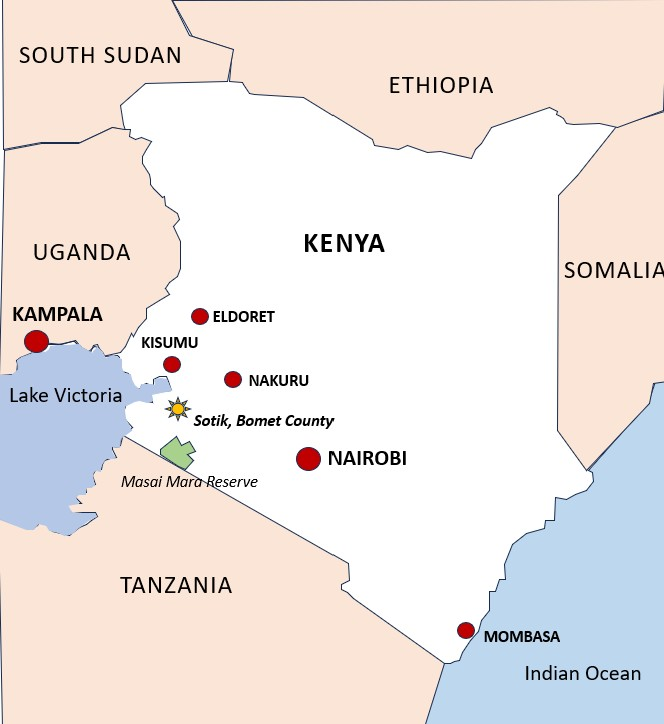
This tale of the ‘Sotik Massacre’ and Meinertzhagen’s murders has now spread far and wide with some additions. For example, the reputable Orders and Medals Research Society did have a section on the British medal clasps ‘East Africa 1905’ for the Sotik and Kisii[9] Punitive Expeditions and the clasp ‘Nandi 1905-06’ for the Nandi Punitive Expeditions with the latter noting
‘In this campaign, the Nandi Liabon (Chief) Koitalel was gunned down by the maxim of Lieut. S.S. Butler when meeting Lt. R. Meinertzhagen to discuss peace terms. This was covered up at the time but is now believed to be what happened.’[10]
None appeared to have recognised that Lieut. S.S. Butler of 1 King’s African Rifles (1905-08) became Maj-Gen. Stephen Seymour ‘Sammy’ Butler CB, CMG, DSO, South Staffs Regiment (1880-1964) whose personal notebooks covering the expedition are in the Bodleian Library archives in Oxford.[11]
Claudia Webbe, in her letter to the minister, had been anxious to distinguish the Sotik Massacre from the Mau Mau Rebellion where the UK Government had paid £19.9 million in 2013 in settlement of 5,228 former rebel claims, a liability subsequently limited by the Overseas Operations Act 2021. The Mau Mau settlement was largely influenced by spurious data, as documented by David Elstein in ‘How Kenyan History is Being Rewritten.’[12] As Staffan Lunden has pointed out in his review of Dan Hicks’ work, zealous representations of history can lead to its fabrication so that ‘an incomplete understanding of the past impairs efforts to repair past wrongs.’[13] What evidence is there of the Sotik Massacre, or of the Sotik Punitive Expedition of 7 May -12 July 1905?
By way of context, this region, then of about 4 million people[14] was at that time governed by the East African Protectorate which had been established in July 1895 to block the French and Germans and to stop slavery. It was organised ‘with no firm or clear purpose of Colonial development in mind, but mainly for strategic reasons in Egypt and on the Nile. For this purpose, a railway was commenced. After Fashoda, the strategic necessity vanished, but there was now a financial need to find means of covering the cost of administration and making the railway pay’.[15] The Mombasa to Lake Victoria railway, or Uganda Railway, was constructed over 1896-1901 by over 30,000 indentured Indians, at great expense but to no present purpose, and consequently was derided as the Lunatic Express.
At the northern end in the Great Rift valley and close to Lake Victoria, the railway passed close to the Nandi, Kipsigis and Maasai pastoralist tribes, originally from southern Sudan, and ‘between the tribes, raids and barter trade were common. So also was a process of conquest and migration. Few peoples had long inhabited their locations. … This was no static society with fixed tribal boundaries’.16
In securing their ‘ancestral homeland’, the Kipsigis had forcibly dislodged the Maasai, Luo and Abagusii in the early 19th century and they, in turn, had dislodged the Sirikwa and Gusii. Both the Nandi and the Kipsigis opposed the railway construction with raids, thefts and murders. Two punitive expeditions were consequently carried out against the Nandi (1895-97) and the Third in 1905-06.[16] The tribes were subsequently forcibly restricted to reserves away from the railway and, it has been suggested, away from the fertile land. ‘Recognising from the outset that the future of the country lay in the development of the thinly-peopled highlands’ it was argued that
‘We must assist Europeans to develop the fine land which the Protectorate contains, and must not allow nomadic tribes to monopolise huge areas of which they can make no real use. We must, of course, secure for natives the possession of the space which they require, but their present wasteful methods of abandoning land after they have cultivated it for a few years, and moving on to another place, cannot be allowed to continue’.[17]
The Kipsigis tribe were divided into several clans including the ‘Lumbwa’,[18] Tailai, Buret and those around the Sotik Post (now Bomet) referred to as the Sotik people. In the spring of 1905, the Sotik people raided the Maasai and refused to release their captives or to restore the cattle. According to the then Commissioner of the East African Protectorate, Sir Donald William Stewart (1860-1905),[19] ‘This raid was successful owing to the Maasai warriors being away removing stock to the new Reserve on Laikipia’[20]. The matter was reported extensively in the British press.
“Reuter’s Agency learns that repeated attempts on the part of Sir Donald Stewart to obtain reparation by peaceful means for their raid on a friendly Masai tribe having failed, a force of 400 troops and 900 native allies, with three Maxims, has been dispatched against them. The raid committed by them was of a particularly daring character. They descended on a friendly Masai tribe, burnt two of their villages, killed twenty of the old men, and carried off twenty-two women, capturing at the same time 300 head of cattle, and some thousands of sheep and goats. The Masai warriors, who were away at the time of the raid, then arranged a counter-raid, which was stopped on the assurance that the Government would exact reparation from the Sotik. The British Commissioner sent an officer to get in touch with the raiders, but their attitude was so threatening that he had to leave the country. A native emissary was then dispatched, but to no good effect, and, accordingly the expedition had been sent. The troops have been dispatched in two columns, the first consisting of 285 men of 3rd Battalion King’s African Rifles with two Maxims and 600 Maasai spearmen. The second column numbers 120 men 3rd Battalion King’s African Rifles, with one Maxim and 300 Lumbwa spearmen. It is expected that the operations will last a month”.[21]
The Punitive Expedition force was commanded by Brevet Major and Capt. Richard Pope-Hennessy of 3rd Battalion (Uganda), King’s African Rifles (KAR) who led the first column, and by Capt. Charles Barlow of 1st Battalion (Nyasaland), KAR, who led the second. The first column comprised three companies with one from 3rd KAR, one from the 3rd KAR Maxim Battery (2 guns) and a 1st KAR detachment plus Maasai levies. The second column comprised one company from 3rd KAR, 30 Rifles Police and Lumbwa/ Kipsigis levies. The force was accompanied by Hugh Partington,[22] the senior political officer, and Herbert McClure, the Maasai-speaking assistant political officer[23].
That probably equated to a force, excluding porters, of 1,344 men with 14 European officers (1%), 210 Kenyan Askaris,[24] 210 Sudanese Askaris, 615 Maasai native levies, and 295 Lumbwa native levies.[25] Approximately 83% of the force was made up of local tribes, therefore, under the command of British officers, typically temporarily seconded from British regiments. Richard Pope-Hennessy (1875-1942) of the Oxfordshire Light Infantry, for example, ended up as Maj. Gen. Pope-Hennessy CB DSO,[26] whilst Lt. Col. Charles Barlow DSO (1877-1918) of the West Yorkshires was killed in action at Ypres.
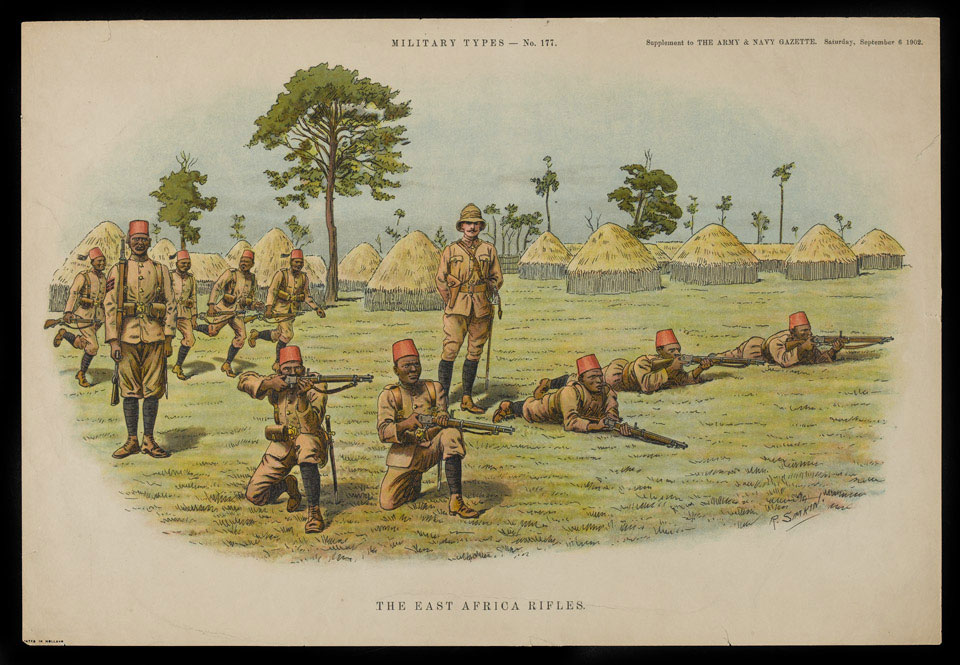
‘The East African Rifles’, Illustration from the Army and Navy Gazette, September 1902.
According to the KAR history, the two columns met up at the Sotik Post on the 9th June operating then as a single force sending out flying columns into the surrounding countryside searching for the stolen cattle and the abducted Maasai. By the close of operations on 13 July, the Force had recovered “over 5,000 head of stock”[27] rather than the alleged 20,000 head of cattle. Similarly, the press reported 1,000 cattle and 4,000 goats recovered and that “the captures will, it is said, pay expenses and compensate the friendly Maasais for their losses at the hands of the chiefs.”[28] The Commissioner reported that ‘The Sotik… proved somewhat refractory, and a small column had to be sent into their country. They were, however, quickly reduced to submission without any serious fighting, and are now quite peaceably disposed to the Government.’[29]
A more detailed account of the Expedition is in a packet of records[30] containing the handwritten notes of Brig. Gen. Manning[31] et al; the Commissioner’s Report to the Secretary of State; Major Pope-Hennessy’s Report; Prisoner Statements; the Staff Diary of the Force; copies of the Column daily orders by Major Pope-Hennessy; Report by the Collector, Hugh Partington, to the Kisuma Sub-Commissioner; Henry Bedeker’s Medical Report; and John Leveson-Gower’s Topography report.
These records detail conflicts, locations, casualties and enemy deaths including 12 Sotik on the 8th June, 4 on the 11th June, 9 on the 27th June, 3 on the 30th June, etc. The records also refer to occasions the Maxim machine guns were used: ‘A few shots from the Maxim at the enemy who were not in any strength … at 9pm a few shots were fired from the Maxim at a light some 700 yds off on the hill side’, (8th June, p.18). Given the Maxim machine gun rate of fire of about 500 rounds per minute, usually fired in 250 rpm bursts, the expended 614 Maxim rounds would normally represent only two or three bursts of fire over about 75 seconds in the 43 days of the Expedition.
Pope-Hennessy’s report states that
‘estimates of the enemy’s strength varied from 6,000 to 1,400 fighting men, his actual strength I believe to have been about 1,200. Similarly, the amount of stock held by the Sotik was greatly exaggerated – I doubt if they owned more than 6,000 to 8,000 head of cattle in all…’ (p.8).
The Force’s casualties were one KAR askari and two Masai levies killed by poisonous arrows. Of ‘the enemy’, it was estimated that
‘98 were killed, mostly by rifle fire. I am unable to estimate the number wounded … the enemy resistance was slight … their principal chief was killed by one of our patrols, about 8 June (p.11).
The Officer was clearly unimpressed with the Lumbwa levies, “probably owing to their kinship with the Sotik” (p.13).
The Maasai women and children and the majority of the stolen cattle, largely hidden with neighbouring clans, were recovered. Of the Maasai people abducted, “those left were 3 women and 3 children, that 5 men and 10 women were killed in the raid, 3 children died in captivity” (p.42). All Sotik prisoners taken were released, on the advice of the political officer, to aid a peace settlement.
Press reports of the time broadly bear this out; as per, for example:
‘Sir Claude de Crespigny of Champion Lodge, Essex, who is with the Sotik Field Force, states in a letter home that the duties of the force are nearly at an end. Major Pope Hennessy, of the King’s African Rifles, has captured 1,000 cattle and 4,000 goats and sheep. Fifty Sotiks have been killed. The captures will pay the expenses of the expedition, and compensate the friendly Masais for their losses in killed, captives, and cattle’.[32]
The next Punitive Expedition against two clans of the Nandi (18 Oct 1905 – 6 Jul 1906[33]) was a more substantial affair,[34] and this is when, on the 19 October 1906, ‘Colonel (sic) Richard Meinertzhagen’ is alleged to have murdered the Laibon (Nandi spiritual man and healer) having lured him “into what was effectively an ambush and shot him at point-blank range, killing him on the spot and the rest of his entourage’.[35] Moyse-Barlett’s regiment history[36] notes;
‘An officer of the 3 K.A.R., who had been ordered if possible to capture the Laibon Koitalel; arranged through his interpreter a meeting at Ket Parak Hill. The fact that the Laibon consented to appear at all was in itself suspicious, as he always refused to meet Europeans. The officer was accompanied by 80 rifles from Nandi Fort, but in accordance with the Laibon’s wishes went forward to meet him with an escort of one native officer and four askaris only. The Laibon, however, was accompanied by about a dozen warriors, and many more could be seen lurking in the bush behind him. He refused to approach and shake hands, making the curious excuse that the sun was too hot for him to leave the shade of the tree under which he stood. At that moment the interpreter turned with his spear levelled, and the officer, now sure that treachery was intended, shot him dead. Spears and arrows at once flew at close range; the native officer shot the Laibon, the troops rushed to the rescue and altogether 23 Nandi were killed. Afterwards the tribe complained bitterly to Walter Mayes that their intentions had been honourable and that the treachery lay on the British side. Evidence taken at subsequent Courts of Inquiry did not wholly disprove these accusations, and Manning recorded his opinion that ‘the reputation for fair-dealing and honesty of the British Government had been called into question’ (C.O. 534, 3.)’
Lt. Richard Meinertzhagen (1878-1967) of the Royal Fusiliers had been seconded to 3rd KAR in April 1902 and wrote a diary of his experiences.[37] He subsequently became a controversial figure but he noted in his diary that, during the 1904 Irryeni Expedition (Kikuyu and Embu tribes) which led to 1,047 tribal deaths and 11,000 stock captured, he shot two of his askari and three of the Masai levies for spearing a woman and child, having warned them beforehand of their conduct, because “my men are mere savages in the laws and customs of war and the Masai are bloodthirsty villains to whom the killing of women and children means nothing …’ (p.143).
His account of the Nandi affair is broadly similar to Moyse-Barlett’s but with much greater detail. Apparently Meinertzhagen, by then a Captain, knew his interpreter was a spy and suggested that the Nandi Laibon was keen to ambush and kill him, partly because his body parts would provide fetish invulnerability to bullets (p. 222). Lt. Sammy Butler had been left behind with the Maxim machine gun and 75 men to cover his retreat, if necessary (p. 233). Incidentally, it could not have been the same machine gun used in Sotik as Butler’s company of the 3 KAR had not been part of the Sotik Expedition force.
In the meeting, the interpreter reportedly turned and tried unsuccessfully to spear Capt. Meinertzhagen but was shot by the KAR corporal. Meinertzhagen was slightly wounded by an arrow.[38] He and five askaris killed a number of the 23 warriors accompanying the Laibon and several that were hiding in the bush. (pp. 232-238). His native officer askari was later judged to have shot the Laibon. There were three Courts of Inquiry into the matter,[39] all of which cleared him. He explained that the Inquiries were pushed by Collector Walter Hayes, an administrator, whom Meinertzhagen had previously reported for corruption. One Provincial Commissioner at the time recalled:
‘That old stirrer of trouble, the Laibon, was shot, and curiously enough this incident led to much recrimination between the officers of various sections, some considering that the officer concerned had not behaved according to service conditions. An inquiry was held which acquitted him; so the agitation, which at one time caused heated discussion, gradually died away’.[40]
Meinertzhagen was later ordered home because, in his belief, despite the War Office’s conclusion that he had acted in good faith and had been commended, the Colonial Office considered him an embarrassment.[41] Evidence for the contrary view has yet to be identified.
After the campaign, Meinertzhagen noted
Now that the Nandi have been driven out of their country it has been thrown open to European settlement. I often wonder whether it was this idea which lurked at the back of the minds of the Colonial Service and the civil authorities out here when they not only sanctioned the Nandi expedition but defined the reserve. If this was the case, it was a most immoral excuse for dispossessing the Nandi.” (p.291).
He had suggested to the Commissioner, Sir Charles Eliot[42], that ‘East Africa belonged to Africans and that we had no right to occupy any land which is tribal land’ (p.157). In reporting on Pope-Hennessy’s Sotik Expedition, Eliot noted ‘the severe lesson which he gave the Sotik…has resulted in a valuable and fertile country being opened to settlement’.[43]
This forceable dispossession and eviction of some Kipsigis in 1902 to the Sotik Reserve and further land confiscation in 1919 was the human rights case raised by Governor Paul Chepkwony with the UN in 2017-18, advised by Karim Khan KC who became an International Criminal Court prosecutor in 2021, the year when Fabian Salvioli, the UN Special Rapporteur on the promotion of truth, justice and reparations, issued reports (May-July 2021) that backed Kipsigis’ demands to rectify their historical claims of land dispossession of some 115,000 acres.[44]
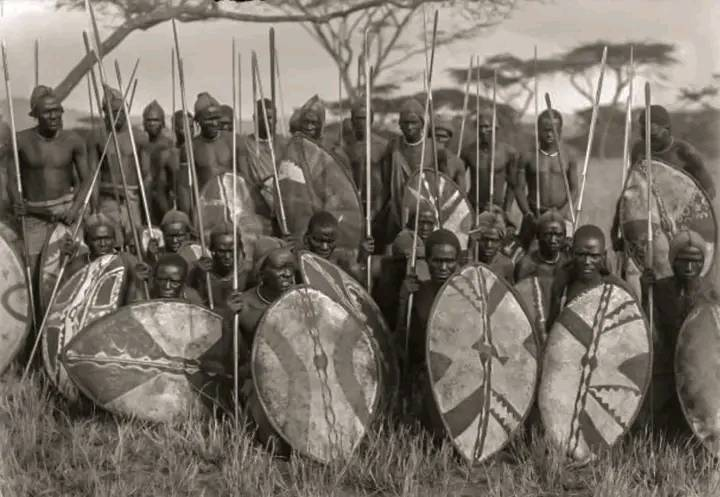
Kipsigis Warriors 1926 (Photo by Martin Johnson)
After no UK Government response, the Kipsigis filed a case in August 2022 against the U.K. at the European Court of Human Rights seeking an extraordinary £168 billion in reparations concerning 115,000 identified victims[45] – presumably for the 1902 breach of the 1950 European Convention of Human Rights.[46] The Kipsigis also filed a petition with the Senate Human Rights Committee of the Kenyan Parliament in March 2023 who then noted that the Kipsigis land claim appeal was still under consideration in the Kenyan High Court and resolved that the National Land Commission relook at the matter, that the large scale tea producers in the area come up with ways their activities may better benefit local people, and that an accurate land title database be created. The alleged Sotik Massacre of June 1905 does not feature in any of these claims or petitions although some may then have concluded it might assist a legal case.
The evidence that the massacre did not take place could all be a co-ordinated and elaborately constructed coverup between the local military, the Protectorate Government, the press, personal diaries, the War Office and the Colonial Office in Whitehall, but such seems unlikely. The Crown land seizures of the ‘thinly-populated’ territory used by nomadic pastoralists are matters of record. However, it is difficult to envisage how such a subsistence economy could generate sufficient capital to bring forward the necessary 20th century social and economic infrastructure.
Part of the process by which intensive agriculture was introduced was undoubtedly deeply flawed, but Kenya’s colonial history has sufficient violence, from both the colonial authorities and the tribes, without the need to fabricate yet more violent incidents for ideological purposes. The 2013 Kenyan Truth, Justice and Reconciliation Commission[47], recorded a number of colonial punitive expeditions using ‘violence on a locally unprecedented scale and with unprecedented singleness of mind and purpose.’ Sadly, the Commission also recorded that these have been exceeded in quantum by the post-colonial violence and massacres perpetrated by security troops in Northern Kenya over the period 1964-84.
Footnotes:
[1] Uzonna Anele, 12 Aug 2025 ‘Sotik Massacre of 1905: The Little-Known British Massacre in Kenya That Claimed 1,850 Lives’ in Talk Africana, on-line African blog; https://talkafricana.com/sotik-massacre-of-1905 and Julius Kones, Thread by @Konesjk on Thread Reader App, 30 Apr 2025.2 Wikipedia’s citation for this is p.6 of Starr, F., 1907. The Truth About Congo Free State, Forbes & Co: Chicago, but this journalist’s book contains no reference to the region and is a curious apologist’s account of Belgian colonialisation, slavery, polygamy, etc. https://en.wikipedia.org/wiki/Sotik_Massacre.
3 International Pan African Webinar on ‘Historical Injustices, The Sotik Massacre, Blood Tea and Land Alienation” in Nairobi, 23 Jul 2020. https://societyofblacklawyers.co.uk/press-release-historical-injustices-the-sotik-massacre-blood-tea-and-land-alienation/
4 Claudia Webbe Letter to Rt Hon Gavin Williamson MP, 7 Aug 2020.
5 Technically should be ‘Kipsigisiek’ being the people and ‘Kipsigis’ being the homeland or language.
6 Quashed in 2023 by the Kenyan High Court: Republic v National Land Commission & 6 others; Tuei & 4 others (Interested Parties); James Finlays Kenya Ltd & 12 others [2023] KEELC 16903 (KLR). James Finlay & Co. started tea on 23,000 acres at Kericho in 1925.
7 UK Parliament, EDM 117: tabled 6 Jun 2022. ‘Human rights abuses against the Talai and Kipsigis people of Kenya’, signed by 14 Members, sponsor Bell Ribeiro-Addy MP.
8 Douglas Kiereini, ‘How Sotik massacre, Koitalel killing opened area to white settlers, Business Daily Africa, Kenyan e-paper (National Media Group); 27 Jan 2022 www.businessdailyafrica.com and Phil Miller ‘Britain stole their land to plant tea. Now they want it back’, Declassified UK website, 1 Dec 2022.
9 World Council of Churches, 8 Sep 2022. Massacres Committed in Africa during Colonial Times. Karlsruhe, Germany. Based on research conducted by Ms Yoleni Rabelais, Trainee at the Commission of the Churches on International Affairs of the World Council of Churches.
https://www.oikoumene.org/resources/documents/massacres-committed-in-africa-during-colonial-times
10 ‘Kisii’ is the Swahili/Kenyan English for ‘Gusii’ people.
11 The OMRS Secretary has now taken down the piece, asking the author to review it. It was pointed out that both the King’s African Rifles regimental history and Meinertzhagen’s diary had a different account and that the Expedition Staff Diary contradicted this story.
12 Also extract in King’s African Rifles newsletter, 1998. Rhino Link, Vol.1, No.17, p.17.
13 David Elstein, Dec 2023. How Kenyan History is Being Rewritten, History Reclaimed https://historyreclaimed.co.uk/how-kenyan-history-is-being-rewritten/
14 Staffan Lunden, Dec 2024. ‘Distorting history in the restitution debate. Dan Hicks’s The Brutish Museums and fact and fiction in Benin historiography’, International Journal of Cultural Property, 31: pp. 202–225.
15 ‘thought to be nearer 4 million but it is impossible to compute as much of the area is unexplored’, Colonial Report, East Africa Protectorate, 1905-6 No.519, HMSO Mar 1907 (broadly Kenya, Tanzania and Uganda). Also known as British East Africa, part of which became the Colony of Kenya in 1920. In 1905 it was just 308 British personnel (264 administrators and 44 military officers) who governed the estimated 4 million Africans.
16 Cashmore, T., 1965. ‘Studies in District Administration in the East African Protectorate 1895-1918’, unpublished PhD thesis, University of Cambridge . See also 2011, Cambridge African Studies Centre, The Journal of African History, Vol. 52 (1): pp.134-134 with a foreword by Prof. John Lonsdale of Trinity College, Cambridge.
17 Moyse-Bartlett, H., 1954. ‘The King’s African Rifles: A Study in the Military History of East and Central Africa, 1890-1914’, unpublished PhD thesis, SOAS, University of London, pp.138, 438. Also Moyse-Bartlett, H. 1956: The King’s African Rifles. A study in the military history of East and Central Africa, 1890-1945, Aldershot: Gale & Polden.
18 Eliot, Sir C., 1905. The East Africa Protectorate, London: Edward Arnold, p.3 & p.104.
19 The Maasai term for the Kipsigis adopted by the colonial government.
20 Whose Bostonian wife, aka Cora Crane, had run off with an American writer, became a war correspondent and then a bordello operator in Jacksonville, Florida.
21 Desp. 327, Donald Stewart to Lansdowne, 8/6/05, CO 533/2.
22 For example, 8 Jul 1905 Army & Navy Gazette / 7 Jul 1905 St James’s Budget / 3 Jul 1905 Morning Leader.
23 Hugh Basil Partington (1874-1914), Acting Collector at Kericho (Lumbwa District) at the time.
24 London Gazett,e 13 Mar 1908.
25 African NCOs and men of KAR.
26 Based on data in Moyse-Bartlett, H. The King’s African Rifles and records below. See fn. 32.
27 Database; Europeans In East Africa, accessed Aug 2025 Europeans In East Africa – Home
28 Moyse-Bartlett, H., The King’s African Rifles, pp.461-462.
29 23 Sep 1905, Army & Navy Gazette & 10 Aug 1905, Gloucester Citizen.
30 East Africa Protectorate, Report for 1905-1906, Colonial Reports – Annual, No. 519, HMSO: London, p.49.
31 MacClure H.R., 16 Sep 1905. Sotik Expedition 1905; correspondence, handwritten and typed notes, East African Protectorate 33230, Nairobi University CO-533-RO33-033.
32 Sir William Manning GCMG, KBE, CB (1863-1932), 1st Inspector-General of the KAR in the East African Protectorate 1901-1907, and Governor of Somaliland, Nyasaland, Jamaica and Ceylon.
33 10 Aug 1905, Gloucester Citizen.
34 Nandi Expedition 1906; 27 Nov 1906 correspondence. handwritten and typed notes, East African Protectorate, Nairobi University Archives CO-533-R007-023. 41 Field Force deaths, 516 enemy deaths, 10,308 cattle and 18,000 goats and sheep captured.
35 The Nandi Field Force was 3,180 men with 10 Maxims and 80 British Officers; in Meinertzhagen, R., (1957). Kenya Diary (1902-1906), Oliver & Boyd, London, p.224.
36 Julius Kones, Thread by @Konesjk on Thread Reader App, 30 Apr 2025.
37 Moyse-Bartlett, H., The King’s African Rifles, p.207, footnote (1).
38 Meinertzhagen, R., (1957). Kenya Diary (1902-1906), Oliver & Boyd, London
39 Pall Mall Gazette, 6 Nov 1905, London Evening Standard, 8 Nov 1905, etc.
40 1 Dec 1905, 29 Dec 1905 and 11 Jan 1906.
41 Hobley, C. 1929. Kenya; From Chartered Company to Crown Colony, London: Frank Cass, pp. 116-117.
42 Field Force Order No.99. The Officer Commanding congratulated Capt. R Meinertzhagen, 3rd K.A.R., on the results which have attended the affair at Kaidparak Hill on the 19th Oct (issued 1 Dec. 1905) and also commended in Brig.-Gen Sir William Manning’s report, Army & Navy Gazette 22 Sept. 1906.
43 Resigned over the issue of monopolistic land grants in 1904 to be replaced by Sir Donald Stewart.
44 Desp. 454, Donald Stewart to Lansdowne, 14/8/05, CO 533/2.
45 Whilst noting that the UK Limitation Act 1980 and the liability transfer to the Kenyan Government [s26, Constitution of Kenya (Amendment) Act 1964] made it legally impossible to progress claims. UN Special Rapporteur Report, 31 May 2021, AL GBR 5/2021, Geneva.
46 Chatham House ‘Africa Aware’ podcast, 20 May 2022 ,with Paul Chepkwony, Rodney Dixon QC, and Maureen Okoth.
47 The 1950 Convention on Human Rights cannot be legally applied retrospectively (Article 7). Nor can the draft 2001 ‘Internationally Wrongful Acts’ Articles (UN A/56/10), cited by many seeking reparations, provide anything but guidance, being neither a signed treaty nor a convention.
48 Truth, Justice and Reconciliation Commission of Kenya, 2013, Final Report Vol.2A & Vol.4


