

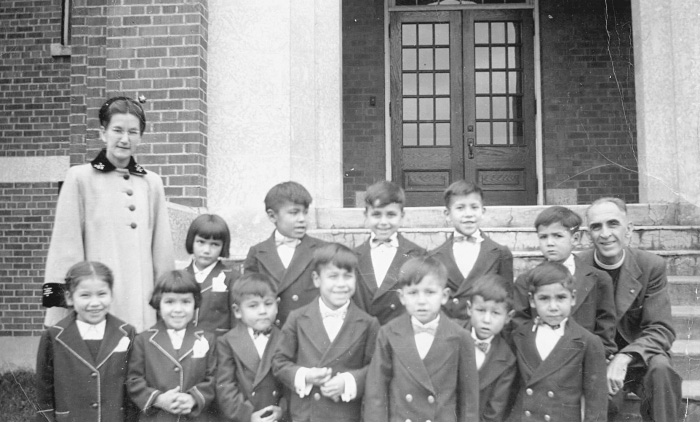

Featured Image: Staff and students at the Shingwauk Indian Residential School, circa 1940
Readers will be aware that History Reclaimed has followed the scandal of the Indian Residential Schools in Canada with great interest. The scandal is not about the treatment of the children. This was humane and improving, in line with late-Victorian and subsequent ideas about education, and designed to assist native children to find their place in Canadian society. The scandal is about the distortion of the motives of the teachers, the living standards within the school, the hygiene practised in them, and the overall care offered to native children. The lie has been propagated that the schools were carceral institutions that sought to destroy native cultures and which subjected the children to an inhumane, careless regime. The biggest lie of all is that at a site at the Kamloops School in British Columbia there are the remains of 215 murdered children, a ludicrous charge for which there is no evidence, that has been taken as the truth by Canada’s media.
Below we republish the editorial in Canada’s leading daily newspaper, the Globe and Mail, from earlier this summer 2026, in which the paper admits that it accepted and publicised these lies for five years, believing the worst about Canada’s churches and its national history without proof. It is a weak and feeble apology, an admission of professional and moral failure which still includes facts and figures that are wrong. The Globe and Mail pumped out highly controversial and consequential falsehoods about Canada’s past without ever stopping to ask for the evidence.
We also republish the riposte to this editorial by Nina Green which appeared in The Real Indigenous Report, a substack newsletter curated and edited by the retired university anthropologist, Professor Hymie Rubinstein. Nina and Hymie, good friends of History Reclaimed, have led the Canadian campaign for the truth.
We end with a third extract from a news conference last year where Mark Carney, now Canada’s prime minister but then on the campaign trail, was questioned about the residential schools.
1: The Globe and Mail’s ‘apologetic’ editorial, 30 May 2026
‘There is no Reconciliation Without Truth’
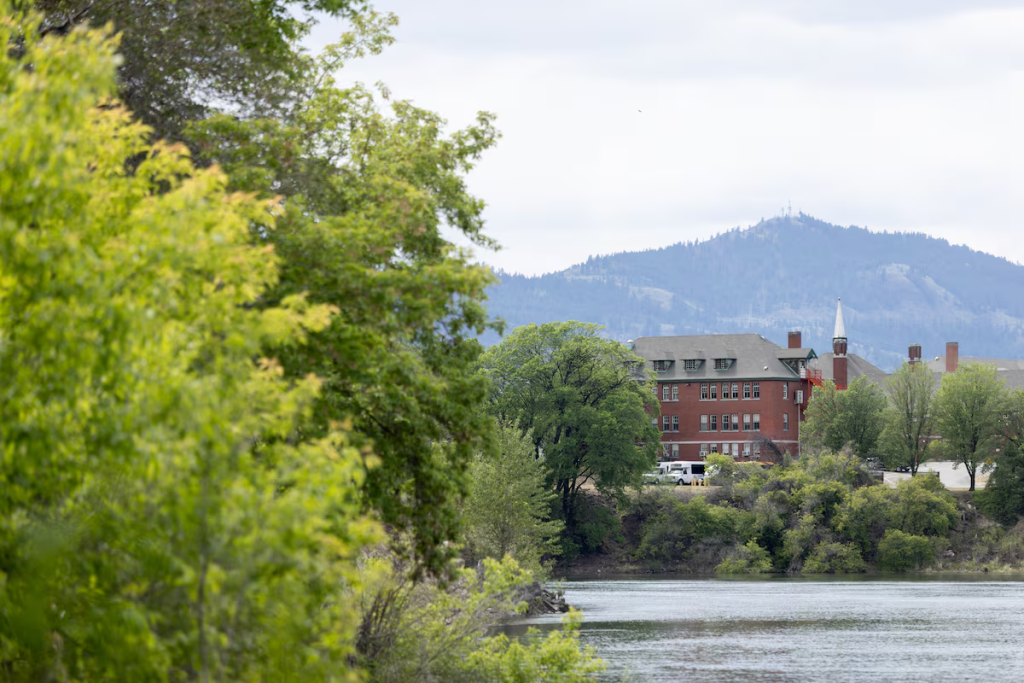
https://www.theglobeandmail.com/opinion/editorials/article-there-is-no-reconciliation-without-truth/
Two things can be true, at the same time. Five years after the startling announcement that there were hundreds of possible unmarked graves near a residential school in Kamloops, B.C., there has been no public confirmation of the discovery of any human remains. That is reality, one reality.
Another is this: 3,200 Indigenous children, at least, died at residential schools, according to the 2015 report of the Truth and Reconciliation Commission. Residential school students died at a rate far higher than children in the rest of Canada – a negligence so deep-rooted that it came “within unpleasant nearness” of manslaughter, according to a government official in the early 1900s.
Many students were physically abused or sexually abused. And all were the target of a systemic effort by the Canadian government, over decades, to snatch them from their homes and families, and to eradicate their culture and heritage. That, too, is reality, a damning reality.
But those two realities cannot be used to negate the other.
That there have been no human remains found at Kamloops does not mean children did not die there. It does not mean that crimes were not committed against children, crimes that were inexcusable. A contention otherwise is denialism, and it is morally repugnant.
But the converse is also true. The fact of the crimes committed against Indigenous children at residential schools over many decades does not automatically validate claims that hundreds of students were dumped into unmarked graves in Kamloops and other residential schools. That is an extraordinary assertion, one that requires proof.
That should have been the starting point for the media in May, 2021, when the Tk’emlúps te Secwépemc First Nation first issued a press release announcing the “confirmation of the remains of 215 children of the Kamloops Indian Residential School” through the use of ground-penetrating radar that identified subterranean anomalies.
The media, including The Globe and Mail, did not initially scrutinize, much less challenge, that assertion. The initial headlines and stories in the media simply stated as fact that the remains of 215 children had been found. Many of those early stories, including in this newspaper, made reference to “mass graves” (a historically fraught phrase that does not appear in the Tk’emlúps 2021 press release).
Perhaps it will be proven, some day, that there are hundreds of unmarked graves at Kamloops. But it was not proven to be true in May, 2021. It is not proven to be true today.
The media changed the description of what had been discovered at Kamloops through the summer of 2021 to possible or probable graves, particularly after an expert working on the Kamloops site made clear the limitations of ground-penetrating radar. Indeed, by February, 2026, the band itself issued a press release referring only to “potential burials.”
That evolution in language does not erase the initial failure of journalism. The lesson of 2021 should be: assertions about residential schools should be listened to carefully, and then, just as carefully, held up to scrutiny.
Politicians also helped to fuel public perceptions that the bodies of hundreds of children had been found. John Horgan, then B.C. premier, called Kamloops “a tragedy of unimaginable proportions” in the wake of the initial announcement. Mr. Horgan had no way of knowing whether that was true.
Former prime minister Justin Trudeau made much more dramatic pronouncements that were also not founded in fact. Three days after the Tk’emlúps announcement, Mr. Trudeau ordered that the Canadian flag be flown at half-mast at all federal buildings “to honour the 215 children whose lives were taken at the former Kamloops residential school.”
Like Mr. Horgan, the former prime minister had no factual basis for that and other similar statements. Unlike Mr. Horgan, who died in 2024, Mr. Trudeau still has the opportunity to set the record straight. He has not; neither has the current Liberal government. Nor has Ottawa provided clarity on how the hundreds of millions of dollars sent to First Nations to establish whether the soil anomalies are human remains have been spent. Canadians are owed an explanation.
First Nations are owed a greater debt. Lasting reconciliation between Indigenous communities and the rest of Canada has barely begun. But that reconciliation must be founded on the truth, wherever it leads.
2: Nina Green: ‘The Globe and Mail Got it Wrong Again’,
From the Real Indigenous Report, 2 July 2026
In an article on 30 May 2026, The Globe and Mail finally admitted – five years after the fact – that its initial reporting on the Kamloops Band’s claim was wrong:
. . . claims that hundreds of students were dumped into unmarked graves in Kamloops and other residential schools . . . is an extraordinary assertion, one that requires proof. That should have been the starting point for the media in May, 2021, when the Tk’emlúps te Secwépemc First Nation first issued a press release announcing the “confirmation of the remains of 215 children of the Kamloops Indian Residential School” through the use of ground-penetrating radar that identified subterranean anomalies.
The media, including The Globe and Mail, did not initially scrutinize, much less challenge, that assertion. The initial headlines and stories in the media simply stated as fact that the remains of 215 children had been found. Many of those early stories, including in this newspaper, made reference to “mass graves” (a historically fraught phrase that does not appear in the Tk’emlúps 2021 press release). Perhaps it will be proven, some day, that there are hundreds of unmarked graves at Kamloops. But it was not proven to be true in May, 2021. It is not proven to be true today.
Did the Globe and Mail profit from the belated realization that it had gotten the Kamloops story completely wrong?
Sadly, no. Throughout the rest of the 30 May 2026 article, the Globe and Mail makes one false and unsubstantiated claim after another, beginning with the issue of deaths at Indian residential schools, about which it erroneously states:
3,200 Indigenous children, at least, died at residential schools, according to the 2015 report of the Truth and Reconciliation Commission.
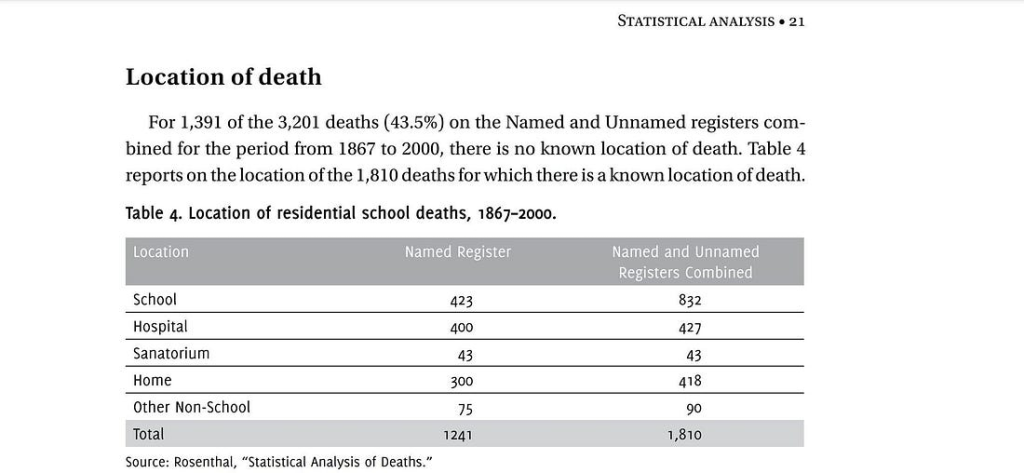
3200 children did not die at residential schools, nor did the TRC make that claim. The TRC report (see attachment) states that only 423 named children died on the premises of an Indian residential school. [See ‘Location of Death’ table below]
To put that number in perspective, that’s 423 children out of the 150,000 children alleged to have attended the 139 schools over a period of 133 years, or a little over three deaths a year in the entire residential school system.
The Globe and Mail article also states:
Residential school students died at a rate far higher than children in the rest of Canada – a negligence so deep-rooted that it came “within unpleasant nearness” of manslaughter, according to a government official in the early 1900s.
The reason children at Indian residential schools died at a higher rate than children in the rest of Canada is that the entire Indian population died at a higher rate than the general population. As explained here and here, the mortality rate among Indians was much higher than the mortality rate in the general population due to disease, primarily TB, which resulted from lack of sanitary knowledge on the reserves.
Dr Peter Bryce, Medical Inspector for the Department of the Interior and the Department of Indian Affairs, wrote in the DIA Annual Report for 1906 that the indigenous population of Canada was declining, despite a high birth rate. He ascribed the decline to disease, estimating that ‘the Indian population of Canada has a mortality rate of more than double that of the whole population, and in some provinces more than three times’, and that ‘the one dominating cause of the excessive mortality everywhere is this lack of sanitary knowledge or of how to live in houses, and that the death-rate is due to the same cause, tuberculosis’.
Significantly, in a 1909 study, Bryce found that almost all Indian children came to the residential schools already infected with TB, usually in a latent form which might or might not develop into active TB. In other words, Indian children contracted TB at home on the reserves, and brought it to the schools.
As for the Globe and Mail’s claim that a ‘government official’ considered deaths at Indian residential schools to be attributable to a deep-rooted negligence unpleasantly close to manslaughter, everything about the Globe and Mail’s version is factually inaccurate.
The source – which the Globe and Mail fails to provide – is a letter by Samuel Hume Blake published in a pamphlet entitled ‘To the Members of the Board of Management of the Missionary Society of the Church of England in Canada’ (see attachment, pp. 21-3).
Blake was not a ‘government official’, as falsely claimed by the Globe and Mail, and the statement in his letter to the Honourable Frank Oliver, Minister of the Interior, on 27 January 1907 was not about residential schools.
In fact, in his letter Blake made the same point Dr Peter Bryce had made in 1906 – that lack of sanitation in Indian homes on reserves led inevitably to TB, and to an appalling number of deaths. As a solution, Blake recommended that the Department of Indian Affairs set up at least 50 nursing stations in the Northwest to instruct Indian women and children about these ‘domestic matters’ connected with hygiene.
Blake wrote:
1. If you seek to draw the Indian from the wigwam and out-of-door life, you must educate him in the ordinary hygienic rules—the non-observance of which cultivates tuberculosis and scrofulous affections—principal causes in the high death rate. The appalling number of deaths among the younger children appeals loudly to the guardians of our Indians. In doing nothing to obviate the preventable causes of death, brings the Department within unpleasant nearness to the charge of manslaughter.
(a) Let there be in at least fifty carefully chosen centres in the North West a thoroughly trained nurse appointed to carry on this work, and to give systematic instruction to the Indian women and children in regard to those domestic matters, of which they, in their new life, are ignorant, and which make so much for the health and happiness of these fellow-beings so largely dependent upon us.
In the balance of his lengthy letter, Blake went on to make a number of recommendations about Indian education, but said nothing about deaths at Indian residential schools.
The Globe and Mail then goes on in the 30 May 2026 article to make excuses for former B[ritish] C[olumbia] Premier John Horgan:
Politicians also helped to fuel public perceptions that the bodies of hundreds of children had been found. John Horgan, then B.C. premier, called Kamloops “a tragedy of unimaginable proportions” in the wake of the initial announcement. Mr. Horgan had no way of knowing whether that was true.
Of course Premier Horgan had a way of knowing whether the Kamloops Band’s claim was true. The Globe and Mail and the City Council in Kamloops had advance notice of the Kamloops Band’s claim. It is unthinkable that the Kamloops Band would have given a heads-up to the Kamloops City Council and the Globe and Mail without also giving a heads-up to the Premier of British Columbia. All Premier Horgan had to do was ask the RCMP and the BC Coroner to investigate, and to insist that the Kamloops Band not recklessly send out a media release until the RCMP and the Coroner had completed their investigations.
The Globe and Mail article of 30 May 2026 is a unsettling testimony to the state of journalism in Canada. The Globe and Mail admits that it utterly failed to get the Canadian news story of the century right, but in the process further misleads Canadians on every additional point addressed in the article.
Nina Green
Readers may also be interested in another refutation of The Globe and Mail, written by Michelle Stirling: ‘Globe and Mail: Still in the Grip of Mass Graves Psychosis’, 31 May 2026.
https://michellestirlingg.substack.com/p/globe-and-mail-still-in-the-grip
3: Mark Carney on Canada’s Residential Schools
Mr Carney is well known to British readers of History Reclaimed as the less-than illustrious and successful Governor of the Bank of England between 2013 and 2020. What is less well-known is that his father was a teacher at one of these residential schools for indigenous children. Mr Carney was thus caught between filial devotion and the dictates of anachronistic progressive opinion in Canada, which mandates belief in the destructive regime followed in these schools. See
For comment on this see the following piece in Canada’s National Post by Christopher Dummit, 8 April 2025:
History Reclaimed


