


Part1: The Story of Vishnu Raghavan, and his review of Kwame Nkrumah: Visions of Liberation

Kwame Nkrumah (1909-1972) in 1962
Jeffrey S. Ahlman, the chair of the History Department at Smith College, is a specialist in Western African history, and the author of the well-received book Kwame Nkrumah: Visions of Liberation, published in 2021 by Ohio University Press. But this biography of Nkrumah, who was born in Nkroful in Western Ghana, who died in Bucharest, Romania, in 1972 (which was then under the rule of Nicolae Ceaușescu), and who governed Ghana from its independence from British rule in 1957 until 1966 when he was deposed in a coup, falls short. Historical and political biographies, at their core, must situate their subject in the context of the history of the nation or region that he or she governs or governed. Ahlman’s biography is full of evasions about that history, however. In this review, I address the arguments and claims made in the book, hopefully creating a more accurate account of Ghanaian history as a result.
Ahlman argues that the British destroyed indigenous self-determination in encroaching on, and eventually overtaking the Ashante Empire in 1901; that the British colonial era was profoundly racist; that Nkrumah sought to liberate his country and other African countries, and stimulated Ghanaian development until he was unfairly deposed on his way to North Vietnam of all places. The truth is that the Ashante Empire exhibited far greater racial animosity than the British, who sought to protect minority tribes from Ashante aggression. In fact, despite its flaws, the British empire proved to be the most benign ruler in the modern history of the Gold Coast. Nkrumah, meanwhile, demonstrated clear signs of megalomania, ultimately ordering the imprisonment and death of his main political opponent, J.B. Danquah, in 1965. Danquah’s development efforts would almost certainly have rivaled those of Nkrumah’s regime.
The Colonial Era
Ahlman frames the Ashante Empire as legitimate and the British as inherently evil and illegitimate. He writes:
As the Asante [sic] state sought to adjust to the region’s new economic realities and an encroaching European presence on its borders, which included a series of wars with the British, the nineteenth century fundamentally tested the cohesion of the famed empire. By the last quarter of the century, Asante [sic] was in a state of civil war. It would ultimately fall to the British in 1901.
In fact, there was no encroaching European presence on the Ashante borders until the Ashante decided to enslave, sacrifice, and pillage other tribes. As a result, in the 2020 dissertation A History of Language Planning in the Gold Coast, 1874-1957, argues the Ghanaian scholar Bright Adomah-Gyekye, the “hostilities” between minority tribes and the Ashante, which Ahlman accepts was the “most powerful state” in the region, led to the Mfantse and Ga states entering “into several treaties of protection with the British prior to the year 1874.”
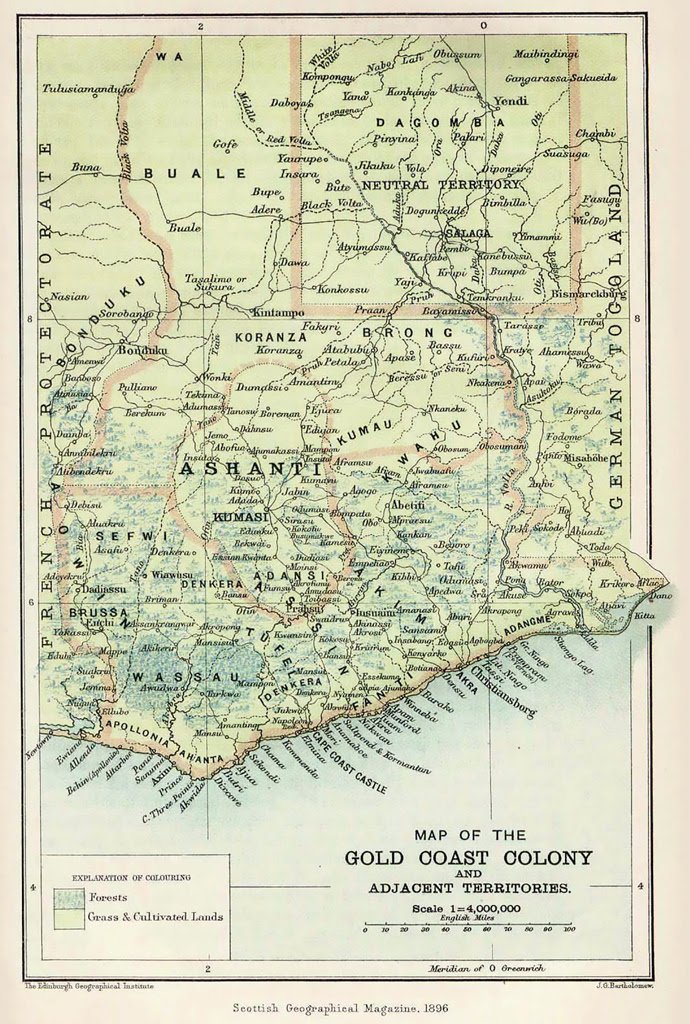
The Ashante sought to expand their influence primarily through the conquest and enslavement of tribes such as the Fante, Denkriya, and Ga. Prior to the arrival of the British in 1821, the Ashante had conquered and murdered Fante tribesmen in 1806. In 1821, the Ashante began to attack and pillage the Ga tribe, which drew the British Brigadier General, Charles MacCarthy, who arrived in March 1822 from Sierra Leone, to organize a protectorate and a standing militia of both British and native troops to repel subsequent Ashante invasions. In mid-1822, an argument between an Ashante trader and a sergeant of the Royal African Colonial Corps at the British fort at Anomabu led the Ashante to kidnap the sergeant and bring him to the Ashante king at Kumasi. He was ultimately executed without the formal proceedings of a trial in February 1823.
The British sent a small expedition in March to punish those responsible, but the expedition returned empty-handed. MacCarthy would eventually mobilize an expedition with the assistance of the Ga, Wassa, Fante, and Denkyira, all of whom had been enslaved by, and sacrificed for, the Ashante, prior to his arrival. MacCarthy built a force of 2,500 including native soldiers, who were attracted by the British commitment to end both slavery in the region and the sacrificial practices of the Ashante.
Yet by January 1824, both the Denkyira and the Wassa had reported that the Ashante had invaded their territory under the British protectorate, and the majority of the Fante soldiers sent to guard MacCarthy had perished. MacCarthy fought valiantly, but was killed by the Ashante. His skull was taken to Kumasi, the capital of the Ashante Empire, and adorned with gold as a trophy. Fortunately for the minority tribes and the British, the Ashante were beset by disease in the summer of 1824 and withdrew to Kumasi. Without this, and despite British reinforcements, it is unlikely that the British and the minority tribes could have lasted.
In negotiations the following year, 1825, Major General Charles Turner gave up the dual aims of abolishing slavery and human sacrifice in the Ashante Empire. He proposed a peace treaty with the sole condition that the Ashante respect the sovereignty of neighboring tribes. But the Ashante king, Osei Yaw Akoto, refused the offer and in January 1826, launched another incursion against the British and their native allies. Regarding the Ashante brutality, in the 2021 work Britain at War with the Asante Nation, 1823-1900, the historian Stephen Manning observes that ‘Once again, the Asante [sic] troops left a trail of destruction in their wake. Settlements were burnt and plundered, and anyone who was unfortunate enough to be in their path was either enslaved or butchered.’
In August 1826, British, Danish, and native troops routed the Ashante. In 1831, governor George McLean concluded a fair treaty with the Ashante, Denkriya, Assin, and Fante chiefs. In 1844, a new treaty included other Fante chiefs, who accepted British administration and the merging of British law with Fante law. Despite skirmishes in 1863-4 the British never attempted to annex the Ashante. Even in 1873, when the Ashante violated their previous treaty and invaded the protectorate, the British made no attempt to seize Kumasi. Instead, they again signed a treaty with the Ashante on February 13, 1874, one that was generous to the Ashante, who were required to pay 50,000 ounces of gold, cease human sacrifice, maintain the Accra-Kumasi road, alongside other minor provisions.
It was not until 1895 that Britain would invade; and the historian Robin Law has found no evidence that the Ashante ever attempted to cease human sacrifice after the 1874 treaty, with slaves and foreigners particularly susceptible to grotesque killing by the king. The 1896 diary of Major Robert Baden Powell leaves no doubt that natives within the borders of the protectorate were kidnapped for sacrifice, and the British delegation found evidence of fresh blood in the main square of Kumasi. Despite British goodwill, the Ashante violated their treaties with impunity, and were absorbed by Britain as a result. The Ashante king was exiled to the Seychelles, though allowed to return to the Gold Coast in 1924.
Ahlman cannot provide any of this context, for if he were to admit that the British selflessly fought against tribal enslavers and murderers, and in defence of smaller, vulnerable tribes, he would expose both the brutality of indigenous rule and the truth that there was little liberation required on the part of Nkrumah.
This does not mean that there were not legitimate failures of British colonialism, but Ahlman does not engage in good-faith criticism of the colonial era. He argues that colonial efforts to provide primary and secondary education for the native population, including through indigenous languages, reflected the “racial and paternalist [sic] assumptions that undergirded the stated aims of the colonial project.” If Britain provides education, so much so that Nkrumah could attend school even though his mother could not, Britain is set down as paternalistic, and therefore racist. Had the British not provided education, they would have been simply racist. Arguably, one of the greatest failures of British colonialism was the lack of universities in the empire as a whole, but Ahlman does not mention this, perhaps because the University of Ghana was founded in 1948 through the extensive lobbying of Nkrumah’s chief rival, J.B. Danquah.
Arguably Ahlman’s most paradoxical criticism of the colonial era is his argument that the colonial administration “further ossified” pre-colonial hierarchies since Britain governed through tribal chiefs. If Britain respects native authority, according to Ahlman and Nkrumah, it opens Ghana to the possibility of neocolonial exploitation. Yet, had Britain deposed tribal chiefs, as Nkrumah would do during his regime, Ahlman would have undoubtedly criticized such a move. Paradoxically, there is no criticism of the Ashante in the book for disrespecting Ga, Fante, or Denkriya authority. There is also no genuine attempt on Ahlman’s part to assess the policy of Nkrumah that arbitrarily revoked the authority of the tribal chiefs post-independence, which had formed the backbone of Ghanaian political culture for centuries.
Ahlman spends two out of his seven chapters discussing anti-colonial activism on the part of Nkrumah and Nnamdi Azikiwe, who would later become the leader of independent Nigeria. He observes that until the late-1940s, the worst punishment that the British meted out against the nationalist activists was the quiet expulsion of Azikiwe to Nigeria. He does not cite even one instance of a pro-nationalist newspaper being shut down. Indeed, Nkrumah himself would meet with the Trinidadian socialist George Padmore in London and organize Pan-African conferences in Manchester. British administration of the Gold Coast was not particularly repressive towards anti-colonial activists, in short.
After Independence
On March 29, 1946, the governor of the Gold Coast, Sir Alan Burns, made the colony the most democratic in the entirety of Africa. Its new constitution gave it a majority of black members in its legislature. Of the Legislative Council’s 32 members, 21 were African, including all its 18 elected members. Other members were nominated by tribal chiefs, and the Ashante region was no longer governed by gubernatorial authority, but by tribal nomination and direct election. British advisors would sit on the council, which was the first step to return self-government to the Gold Coast. Ahlman neglects to mention this, instead asserting that the initial elections occurred in 1951, which was not the case. It was in 1951, however, that self-government would be fully returned to Gold Coasters, and on March 6, 1957, Ghana would attain independence.
Ahlman discusses the return of Nkrumah to the Gold Coast on December 10, 1947, when he was invited by Danquah. Ahlman then points out that Nkrumah was arrested for participating in a riot in 1948 and accused of having communist sympathies. Ahlman portrays the accusation as unfounded, and implies that the British simply fabricated an accusation to incarcerate Nkrumah. The British made no such fabrication, and also incarcerated the capitalist-oriented Danquah. Nkrumah indeed had Communist sympathies; a document found on him at the time of his arrest for participating in the Accra riots shows that he wished to create a “Union of African Socialist Republics,” essentially a Soviet Union in West Africa with its capital in Accra. The document is quoted in full in Elie Kedourie’s 1970 work Nationalism in Asia and Africa, which is not included in Ahlman’s bibliography. Nkrumah’s early totalitarian tendencies are never mentioned, nor such documents as the report by Lord Rennell from July 24, 1952 that the Accra riots were planned, and that Nkrumah wished to prohibit any opposition parties once the British were to leave.
Out of a litany of issues with this biography, the most serious concerns Ahlman’s treatment of the Nkrumah regime. Ahlman praises Nkrumah for his educational reforms and infrastructure projects, thereby ignoring Danquah’s role in establishing what is still the best university in the country. Ahlman also praises Nkrumah for his role in the infrastructural development of Ghana, particularly the development of the Akosombo Dam, which is currently responsible for the vast majority of Ghanaian and Togolese electricity and one of the earliest examples of hydroelectric power in an independent African state. However, despite the dam having been completed during the Nkrumah regime, Nkrumah does not deserve the credit.
Ahlman asserts that the plans for the project were made in 1952, when Nkrumah was in charge of the provisional government under British supervision. However, documents show that the plans were promulgated in 1947. Among these documents is a map archived at the Library of Congress, dated to June 1947, though the precise date is unclear. Given that Nkrumah arrived in the colony only in mid-December, it is impossible that he was involved in any way with the original plans, which were carried out between the colonial administration and Danquah. In 2016, the current Ghanaian prime minister, Nana Akufo-Addo, cited meeting minutes from September 1947, which he utilized to argue that Danquah had proposed the construction of the dam. Though I could not find the meeting minutes, the map I did find at the Library of Congress vindicates Akufo-Addo. Nkrumah was almost certainly never involved in the plans, and simply repackaged Danquah’s idea as his own.
Ahlman also fails to understand that even if Nkrumah was fully responsible for the Akosombo Dam, the project was actually a repudiation of Nkrumah’s ideology. Ahlman admits that Nkrumah was influenced by Lenin, and both Ahlman and Nkrumah criticized “western capitalism.” Nkrumah would state on 25 November 1964 that he was committed to the construction of a “socialist society.” Yet an undated propaganda publication from the regime itself, archived at the Library of Congress, proudly announced that 52.5% of the financing of the dam came from American private companies. Western financial institutions, such as the World Bank, were also directly involved in the project. Either Ahlman can grant credit to Nkrumah for the commissioning of the dam, and admit that Western capitalism facilitated Ghanaian energy production, thereby repudiating socialism, or he can give the credit to Danquah and the British. What Ahlman does, but what belies logic, is give the credit to Nkrumah but still defend Nkrumah’s ideological position. Ahlman must do this, of course, because he knows that Danquah would have achieved similar results as Nkrumah had he been given the opportunity to govern. Instead he was murdered in Accra’s Nwasam prison.
Yet perhaps the weakest positions adopted by Ahlman are his twin attempts to whitewash Nkrumah’s increasing domestic totalitarianism and irredentist foreign policy. Ahlman admits that in 1958, one year after the departure of the British, Nkrumah would pass the Preventative Detention Act, and that nearly all opposition figures, including Danquah, would find themselves detained or in exile as a result. However, Ahlman frames it as necessary for state security, even though it was a blatant and naked power grab. His only, and flimsy, justification for the law is an alleged plot by General Benjamin Awhaitey to assassinate Nkrumah. Yet Ahlman provides no primary sources which indicate Awhaitey’s guilt, nor any primary source regarding any supposed collaboration with the opposition. The reader ought to take this claim at face value: Ahlman himself writes that Awhaitey was only “accused”, never found guilty.
Nkrumah would quickly turn the country into a one-party dictatorship, similar to the Soviet Union or Maoist China. The Minneapolis Spokesman reported on February 12, 1960 Nkrumah’s statement that “the Ghana [sic] government is only an agent of the Convention People’s Party.” By October 27, 1961, the Evening Star reported that there were 400 political prisoners in Ghana, who, according to the government would “never see the sun.” The political scientist Bruce Gilley had observed that 586 political prisoners were detained in Ghana in 1963 and 1,200 were detained in 1965. Additionally, the Evening Star report from October 1961 indicated that there was little difference between the Ghanaian system and a Communist regime. On August 29, 1963, the President of the Ghana Student Association of the Americas testified to the U.S. Congress that Nkrumah ingratiated himself with the Eastern Bloc countries, especially East Germany, and was emulating their totalitarian policies. Ghana had effectively become a Communist and authoritarian regime, and Nkrumah had shut down the opposition newspaper Ashanti Pioneer in 1962.
The regime would turn totalitarian with a referendum on January 31, 1964, that made Ghana officially a one-party state. To his credit, Ahlman does call the outcome of the referendum “implausible,” but miscalculates the electoral results. He writes that the referendum passed with a 92.8% vote, when the election data says it passed with 99.91% of the vote. Admittedly, there is functionally no difference between 92.8% and 99.91%, especially when the British High Commissioner to Accra would call the referendum “obviously rigged” once Nkrumah was in exile in 1968.
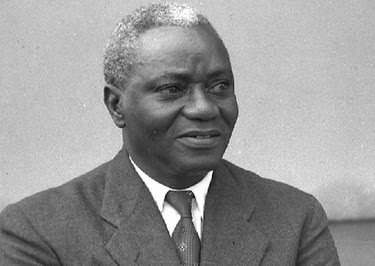
Joseph Danquah (1895-1965)
Next comes his treatment of Danquah’s death on February 4, 1965, while in prison, arrested without charge. Ahlman cites a letter from Danquah to Nkrumah in which he contrasts his incarceration conditions. Under the British, he had a bungalow, access to reading and writing, and three solid meals a day, whereas under Nkrumah, he could barely stand in his cell and was mistreated. Yet Ahlman never criticizes Nkrumah for this. Danquah died from a cardiac arrest, but the cardiac arrest was probably caused by repeated torture and a starvation diet of cassava root only, and in minimal portions. Starvation can lead to cardiac arrest, a connection that Ahlman never makes. For all Ahlman’s praise of Nnamdi Azikiwe, the leader of independent Nigeria in 1965, he does not point out that Azikiwe strongly condemned Danquah’s murder. As the New York Times would report on February 9, 1965, in his vociferous condemnation of the murder of the Ghanaian patriot, Azikiwe said: ‘If independence means the substitution of indigenous tyranny for alien rule, then those who struggled for the independence of former colonial territories have not only desecrated the cause of freedom, they have betrayed their peoples.’
No truer words have ever been spoken about decolonisation, but they have been excluded from this biography of Kwame Nkrumah. Despite the fact that Nkrumah “desecrated the cause of freedom”, Ahlman argues that he wished to bring freedom and equality to Africa. In truth, not only was he a megalomaniac in his own country, but an imperialistic despot across the continent who sought to spread socialist authoritarianism, not freedom, to the rest of Africa. Lord Rennell was justified in his reservations about Nkrumah, as he sought to annex other African countries or convert them into socialist bastions against the will of their people. The Minneapolis Spokesman report from February 1960 indicates that the Nigerians wanted nothing to do with Nkrumah’s socialist Pan-Africanism. Documents declassified by the post-coup military government, now archived at the Library of Congress, provide incontrovertible proof that Nkrumah personally ordered espionage activities against the Nigerian government, with support from the Soviet Union and the East Germans.
According to these documents, Nkrumah not only wished to carry out espionage operations, but also to aid “freedom fighters” so long as they were leading an anti-colonial struggle “carried out along revolutionary lines.” These fighters never fought for freedom: they wished to impose a totalitarian regime similar to Nkrumah’s own. The case in point is the Marxist-Leninist SAWABA party of Niger, which attempted to assassinate the Western-oriented Nigerien leader Hamani Diori in 1965. The declassified Ghanaian documents prove that Soviet, Chinese, and East German advisors trained the militants in camps established by Nkrumah, including in Mankrong, north of Kumasi. Additionally, the SAWABA party received financial support from the Ghanaian Bureau of African Affairs. After the successful Ghanaian military coup in 1966, while Nkrumah was traveling to North Vietnam, the Nigerien militants were extradited to Niamey for their role in the invasion of Niger and the attempt to assassinate Diori, while others sought refuge among the Bulgarian and East German diplomatic delegations. None of this context is provided by Ahlman.
Nonetheless, to his credit, Ahlman briefly mentions the assassination of the Togolese president Sylvanus Olympio in 1963, and mentions that some narratives accuse Nkrumah of being responsible for the shooting near the American embassy in Lome on January 13, 1963. However, Ahlman does not discuss the Ghanaian irredentism regarding Togo, prior to the assassination. As the Evening Star would report on January 14, 1963, Nkrumah wished to completely annex Togo. Additionally, on January 12, 1962, the State Department would refer to Nkrumah’s efforts to forcibly annex the country as evidence that his regime would be “one of the foremost practitioners of subversion in Africa.” The diplomatic cable stated specifically that Nkrumah has become particularly interested in subverting Togo. Yet Olympio had never attempted to interfere with the Ghanaians; in fact, he had advocated a Schengen-like agreement with Accra. There were no official Ghanaian responses to the Togolese olive branch that I could find. Ahlman also ventures into Nkrumah’s time in Guinea, where he worked with the leader Sekou Toure to destroy the country through Marxism-Leninism, but he makes no mention of the 50,000 who were brutally tortured and murdered under Toure.
His conclusion to the book focuses on Nkrumah’s legacy, and Ahlman at least acknowledges that there is a debate over this in modern Ghanaian society. This is unlike the situation in Uganda, Zimbabwe, and Tanzania, where debate over post-colonial history is virtually impossible. The arguments about Nkrumah are possible, however, because, after alternating civilian and military dictatorships, Ghana finally returned to a democracy in 1992, with a 250-member parliament for elected representatives and a National House of Chiefs. Likewise, and unlike Zimbabwe for example, Ghana is prosperous because it returned to free market capitalism, which Ahlman inevitably criticizes. Indeed, modern Ghana has become one of the freest societies in Africa precisely because it has rejected Nkrumah’s philosophy.
Ahlman cites a speech by Danquah in which he argued that “British freedom…is a precious thing. But British freedom is not Gold Coast freedom.” After his torture and death, and the subsequent Communist tyranny and turmoil that lasted for three decades, Danquah was vindicated in 1992. Ahlman fails to acknowledge that the true founder of modern, democratic Ghana is J.B. Danquah, a man who sought to preserve and build on both British liberal institutions and Ghanaian culture. Ahlman’s omissions should be set aside. I hope that I have facilitated a better understanding of Ghanaian history as a result of this review.


