


If Roman Britain is chiefly remembered for its road network, British India should be remembered for its canals. Regrettably, these extraordinary feats of engineering are seldom discussed in Britain today.
There had been irrigation works in India since ancient times. These include the grand anicuts (weirs) of the south, the many works of the Mughal emperors on the Ganges and the Jummna, and the canals in Sind. The development of irrigation under the British followed the lines indicated by the works of old Indian rulers and the practice of Indian cultivators, but the application of modern engineering made these projects possible on a much larger scale than before.
Irrigation under the British falls into three well-marked periods. In the first, the East India Company maintained and improved indigenous works and then launched on major projects from surpluses of revenues, During the next period after 1858, Raj officials realized the magnitude of the task of preventing loss of life in famines, and decided to employ loan funds to accelerate progress on irrigation works of a remunerative character. However, famines continued, and in 1901 an Irrigation Commission was established and further major irrigation schemes were undertaken which were practically complete by the end of World War One.
Modern irrigation was inaugurated in 1819 when Lieutenant Rodney Blane of the Bengal Engineers was sent by the East India Company to a site on the west bank of the Jummna river, 120 miles from Delhi, to re-open a canal built by Feroz Shah in the mid-14th century and later re-modelled by Shah Jehan in the mid-17th century to irrigate the Emperor’s gardens in Delhi. The canal had become derelict during the anarchy following the end of Mughal Rule. The original alignment was adhered to but this wasn’t ideal and swamping took place upstream of the canal and the canal was remodelled in the 1870s.
Blane died of malaria and the most successful of his immediate successors was Proby Cautley, then a captain in the Bengal Artillery. Cautley had been involved in attempts to improve the alignment of the Jumna canal and in 1836 became Superintendent-General of Canals. He was responsible for the Ganges Canal which was one of the greatest feats of engineering in the 19th century. This irrigated the watershed between the upper reaches of the Ganges and Jumna rivers, an area which suffered greatly in the famine of 1835-38. Many thought that a canal in this region was impossible to construct as the terrain was uneven, the river flowed at a steep gradient, and the water flow varied considerably, the monsoon flow being a hundred times of that during the winter. Cautley surveyed the region himself and devised a plan for a canal which necessitated the three-mile Solani Aquaduct, the longest in the world at the time.
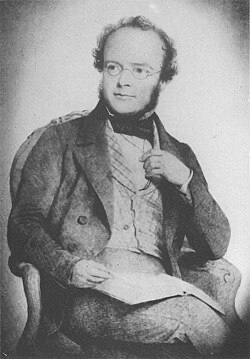
Sir Proby Thomas Cautley (1802-1871), Civil Engineer and Palaeontologist
But in the absence of a precedent and the likely difficulties of obtaining materials and artisans to complete such a tremendous project, there was considerable official opposition to the scheme. Cautley overcame these and digging started in December 1839. The project faced many challenges. These included the production of the 300 million bricks that were needed, engineers having to be recalled for active duty in the Sikh and Afghan wars, and Cautley falling ill and having to return to Britain for a period. In spite of these difficulties the canal was opened on schedule in 1854, though further subsequent modifications have taken place. On the centenary of its opening in 1954 the President of India headed a boat processing down part of the canal. By then the canal was irrigating 1,700,000 acres of crops making this region one of India’s richest agricultural regions.
Following the completion of the canal Cautley’s bust was placed in Calcutta Town Hall and later in Roorkee University which originated as a college established by Cautley to train his engineers. Cautley’s role in constructing the Ganges canal is still remembered with admiration in India ( https://www.youtube.com/watch?v=3jg-sFJauqk).
The second great irrigation system in northern India was the Upper Bari Doab Canal in the Punjab which irrigated the watershed between the Ravi and Beas Rivers. This provided agricultural employment for disbanded Sikh soldiers. The first canal was 140 miles long and opened in 1859. It had to be modified in the 1870s to cope with the heaviest rainfall. By the 1920s it was 324 miles long, and irrigated over one and a quarter million acres.
Earlier, in the Madras Presidency in Tanjore, work was undertaken to improve the ancient irrigation works in the delta of the Cauvery River. The Great Anicut or weir, built in the 11th century, did not incorporate sluices and there was a tendency for the Cauvery to silt up. Captain Arthur Cotton of the Madras Engineers constructed an upper anicut in 1836-8 which resolved the problem and Tanjore became one of the richest districts in Madras. There were modifications to increase the sluiceways in 1843-5 and the whole system was remodelled in 1899-1902. Before the construction of the Upper Anicut, 600,000 acres was irrigated. By the 1920s the acreage had increased to over a million with nearly 1,500 miles of main canals and 2,000 miles of distributaries.
Cotton’s next project on the Godavari River was as impressive as the Ganges Canal. The river rises in the Western Ghats, divides into three branches, and discharges its waters into the Bay of Bengal. The possibility of irrigating the delta had been considered for some time but years of calamitous famines from 1832 to 1840 spurred the government into action. In 1844 Cotton, then a Major, was asked to propose a solution and he advocated a comprehensive scheme for irrigating the delta with an anicut at Dowleswaram. Here the river was from bank to bank about 4 miles wide, but each of the two main channels was subdivided by small islands which permitted the work to be carried out in four sections. The Godavari Anicut is 3.6 km in length with 175 bays in 4 arms. The work was completed between 1847 and 1852 with some modifications in 1910. There are 253.7 km of irrigation canals in the Eastern Delta, 185.7 km in the Central Delta and 354.6 km in the Western Delta irrigating 800,000 acres.
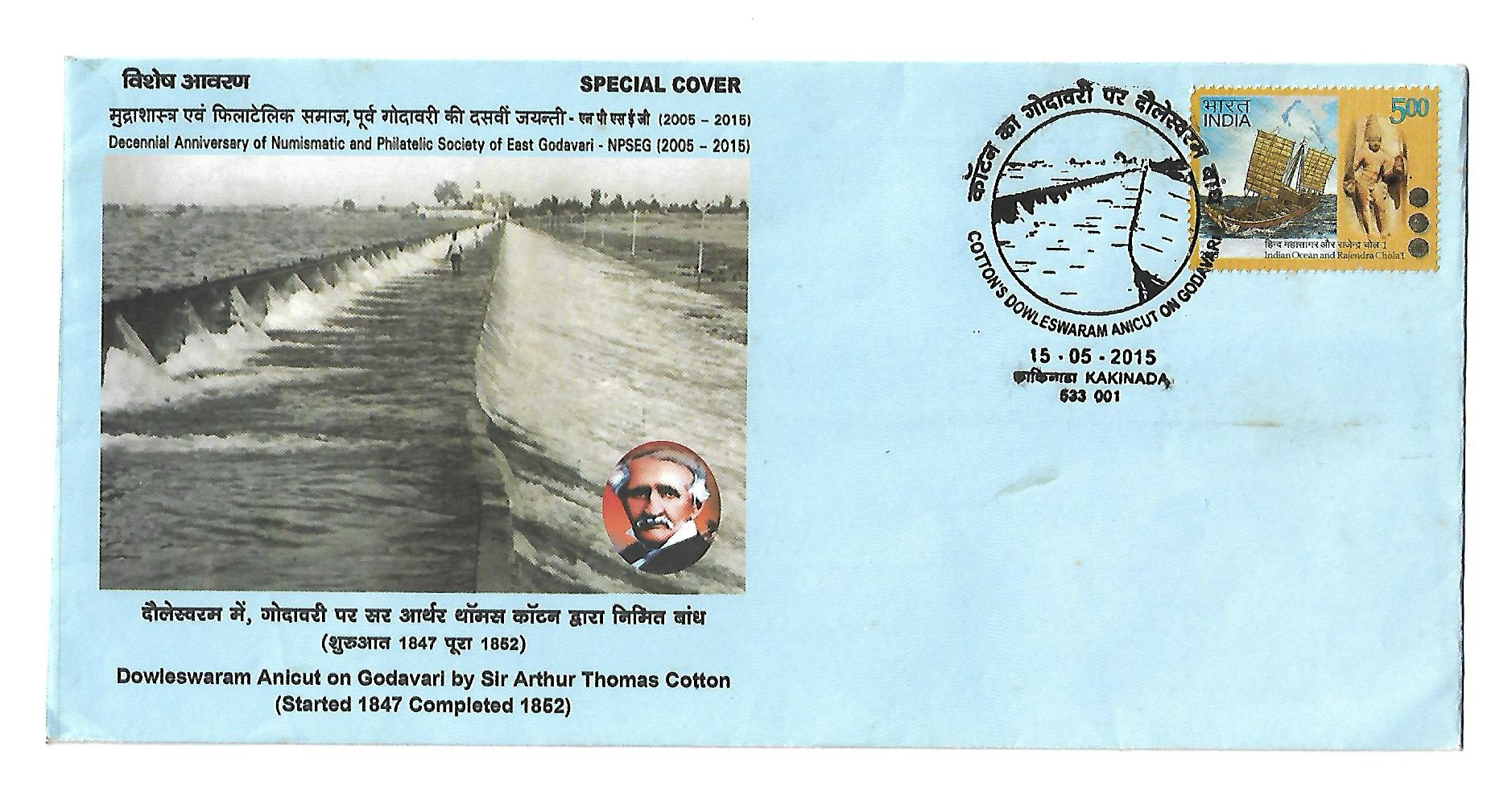
First Day Cover of an Indian stamp, issued in 2015, commemorating the Dowleswaram Anicut on the Godavari River, designed and built by Sir Arthur Cotton
The Godavarri Delta system has been of untold value to the tract it irrigates. The delta, which was formerly one of the regions most susceptible to famines, is now an expanse of paddy fields broken by gardens of fruit trees. The construction of the Godavari Anicut and Cotton’s role are described in the following film:
Another area that required attention was the great indigenous irrigation systems in the Sind province which were in a neglected state and had fallen into disuse. The real work of improvement began with the appointment of Sir Bartle Frere as Commissioner in 1851. He started with the enlargement of the Begari Canal which has a length of 244 miles, including branches and distributaries, and runs from the Indus towards the hills of Baluchistan, irrigating nearly 300,000 acres. Other canals that were much improved was the Fuleli Canal, the largest in the Sind, with a total length, including branches and distributaries, of 1,000 miles, irrigating 450,000 acres, and the Ghar and Sukkur Canals.
The irrigation works described above were constructed from revenue surpluses, but the next phase was by private enterprise and some of these projects, such as the Kurnool Cuddapah, Orissa and Midnapur Canals, in the 1850s to 1860s, were largely unsuccessful. This was owing to private companies, desirous of immediate profits, rushing into schemes without a thorough assessment of technical difficulties. While the Orissa Canals were under construction, the limitations of private enterprise were becoming apparent when the great famine of 1865-6 struck and over a million people died.
As a result of this calamity, General Sir Richard Strachey, the first Inspector General of Irrigation in India, prepared a scheme to construct irrigation works from loan funds in 1867. The direct result of this new policy was the inauguration of five canal schemes – the Sirhind, Lower Ganges, Agra, Lower Swat and Mutha Canals – which were constructed between the late 1860s and the 1880s. There were several smaller schemes, as well.
Though there had been progress in irrigation up to the 1880s, some of the earlier projects had not been particularly successful and the Famine Commission of 1880 recommended a further programme of work. This led to the creation of the Punjab Canal Colonies. The Punjab contains five rivers (Jhelum, Chenab, Ravi, Beas and the Sutlej) but receives little rainfall. Hence, except on the fringes of the river, the whole vast stretch of country was a desert waste before the introduction of irrigation.
But was an additional problem: whereas in other irrigation schemes the main purpose was to improve existing cultivation, in the Punjab, there was no resident population and it was necessary to transport whole communities into those areas which were opened up by irrigation. Great difficulties had to be overcome to achieve this. Those due to malaria and cholera were climatic. Those due to the absence of transport were removed by constructing roads and railways. The suspicions of local nomads were addressed by buying them off with generous tracts of land.
Though proposals for canal schemes in this region had long been considered, it was only with the opening of the Sirhind Canal that the government considered the time was ripe to embark on the scheme. The Lower Sohag and Para Canals on the Sutlej and the Sidhani from a weir on the Ravi were early successes, but the Chenab inundation canal silted up and the completion of the Lower Chenab Canal, which irrigated the watershed between the Chenab and Ravi Rivers in 1892 was the first major success. Once the fertility of the watershed was demonstrated, towns began to spring up and the population increased ten-fold in a decade. The Jhelum Canal was completed in 1901 and the Jhelum Colony was developed between 1902 and 1906. A total of nine canal colonies were established between 1885 and 1940 settling a large population in an area with well-developed system of waterworks, sewerage, roads, telegraph, schools and hospitals with the Church Missionary Society providing several services. Towns such as Lyallpur, Sargodha and Montgomery received significant development.
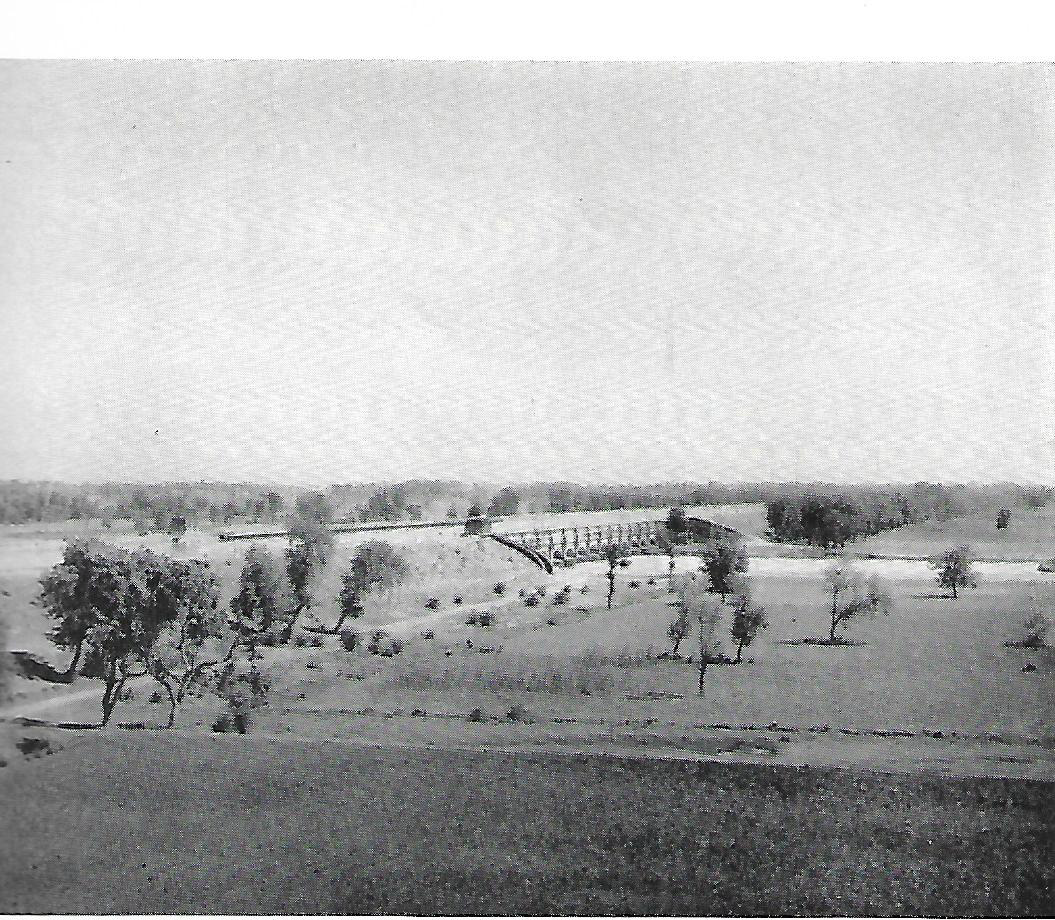
In spite of these major efforts, only parts of the country benefitted and serious famines occurred in 1897-8 and 1899-1900. This prompted Lord Curzon, the Viceroy, to establish an Irrigation Commission in 1901 to report on irrigation as a means of protection against famines. As a result of its recommendations, the total irrigated area by public and private works increased to 39.5 million acres by 1921. The new projects started included the Triple Canal and the Upper Swat River Canal projects. The major projects in the second decade of the century were the Sarda Canal, the Lloyd Sukkhur Barrage and Canal in the Sind, and the Sutlej Valley Canals in the Punjab.
The Lloyd Barrage was one of the largest irrigation projects in the world. The Barrage was a mile long across the Indus and enabled seven large canals to irrigate an area of about 8 million acres. It was opened by the Viceroy in 1932. Another important project in the 1930s was the Cauvery-Mettur Project which was inaugurated in 1934. This improved existing, fluctuating, water supplies in the Cauvery delta which irrigated a million acres and extended irrigation to a new area of 300,000 acres.
These projects increased the area in India under irrigation steadily in the 20th century as can be seen in the following table:
|
Year |
Main Canals and Branches, miles |
Distributaries, miles |
Area irrigated by canals, acres |
Total area irrigated, acres |
|
1918 |
16,135 |
38,066 |
18,005,590 |
45,806,845 |
|
1929 |
22,976 |
49,402 |
26,830,874 |
49,761,691 |
|
1941 |
19,239 |
54, 080 |
28,595,600 |
60,833,191 |
No famines took place in India, other than the appalling Bengal Famine which was caused by factors resulting from the Second World War, in the 20th century. Many of the canals that the British built continue to benefit the country though some are in a state of disrepair as is the case with these in Calcutta:
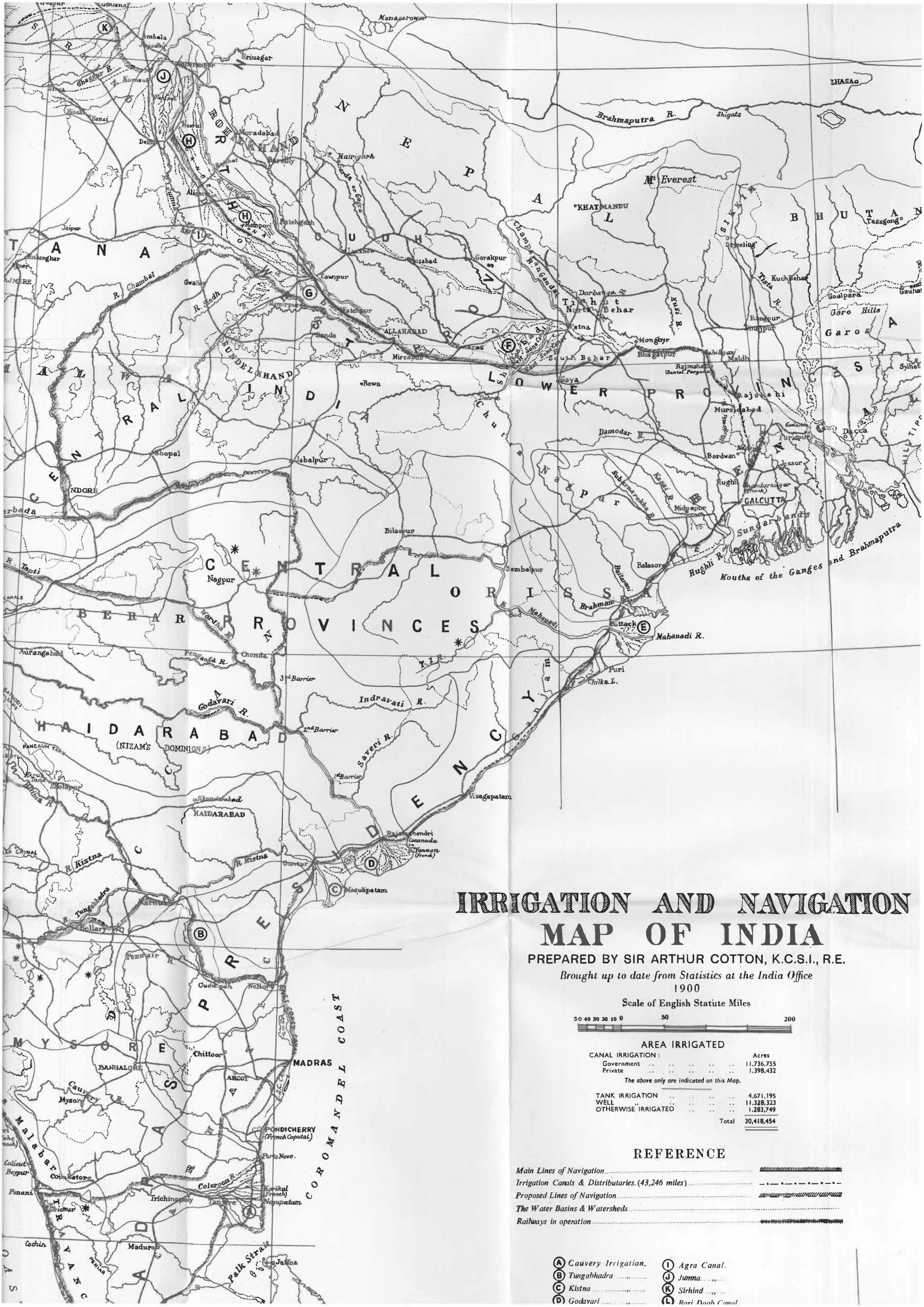
Irrigation and Navigation Map of India, prepared by Sir Arthur Cotton, published in 1900
The role of the British Engineers has been recognised in independent India. The commemorations for the centenary of the Ganges Canal have already been mentioned. On the centenary of the completion of the Godavari and Krishna irrigation projects in August 1959, portraits of Sir Arthur Cotton, known as the ‘Father of Irrigation’ in Southern India, Colonel John Pennycuick, builder of the Periyar Dam project, and General Charles Orr, who built the Krishna project, were unveiled by the British High Commissioner at the Andra Pradesh Centre of the Institute of Engineers and the Chief Minister of Andra Pradesh said on the occasion that he hoped that these portraits would inspire the engineers of today. Pennycuick is revered in Tamil Nadu for building the Periyar Dam and his birthday is celebrated every year ( https://www.bbc.co.uk/news/world-asia-india-62816672).
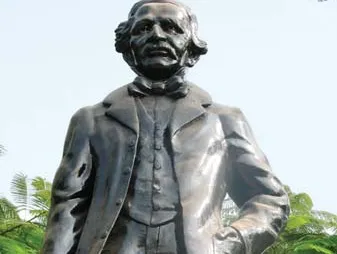
Sir Arthur Thomas Cotton (1803-1899), Statue in Hyderabad
There are several statues of Cotton in India including at the Sir Arthur Cotton Museum which is located in the building occupied by him while working on the Godavari scheme and opened by the Chief Minister of Andra Pradesh in February 1988. Even more than official recognition, the respect and gratitude shown to the memory of Sir Arthur Cotton by the farmers in Southern India are remarkable. He has become an object of religious worship and there are estimated to be 3,000 statues of him in Andra Pradesh at which farmers pray for a good harvest. On his birthday each year a statue of him in the East Godavary district is garlanded by a local dignitary:https://www.deccanchronicle.com/nation/in-other-news/160523/farmers-pay-tribute-to-sir-arthur-cotton-on-220th-birth-anniversary.html.
It is deeply disappointing that these magnificent canals and weirs and the extraordinary men who designed and built them are virtually unknown in the UK.
References
Public Works Department, Government of India (1922) Triennial Review of Irrigation in India (1918-1921)
Sir Thomas Ward (1932) Modern India, Irrigation
D R Gadgil (1933) The Industrial Revolution of India in Recent Times, Irrigation
Panjabi R M (1957), The Geographical Magazine, Cautley and the Ganges Canal
Numismatic & Philatelic Society of East Godavari (2015) Dowleswaram Anicut on Godavari by Sir Arthur Cotton
Wajid Bhatti and Altafullah (2022), Ancient Punjab, Vol 10, 111-121,The Roots of Colonization in Punjab
Deccan Chronicle (15 May 2023) Farmers Pay Tribute to Sir Arthur Cotton on 220th Birth Anniversary
T Appala Naidu (Sept 02, 2023) The Hindu, The British Engineer Remembered, Revered for Eternity by India’s Farmers, https://www.thehindu.com/news/cities/Visakhapatnam/the-british-engineer-remembered-revered-for-eternity-by-indias-farmers/article67255515.ece
The Hindu Bureau (Jan 15 2025) Farmers Celebrate 184th Birth Anniversary of Col. Pennycuick at his Memorial, https://www.thehindu.com/news/cities/Madurai/farmers-celebrate-184th-birth-anniversary-of-col-penny-cuick-at-his-memorial/article69101555.ece


