


The Palace Trust,
Wells
Dear Palace Trust,
Transatlantic Slavery and the Church
A group of us had a wonderful two days visiting Wells Cathedral, the Palace, Vicars’ Close and the Town Hall. Many congratulations are due on the facilities, information available, organisation, guides and so on. We also much enjoyed the Palace, but were particularly struck by the ‘Transatlantic Slavery’ information boards. [See: https://wellsandtransatlanticslavery.com/ ]
In part, these provided a rounded view with interesting coverage on the Bishops’ roles in the abolition movement, presumably based on the student work of Debbie Manners (March 2023). However, we were disappointed with the factually incorrect picture presented on the South Sea Annuities and, subsequently on Queen Anne’s Bounty. It is appreciated that the Trust was merely relying on, and quoting from the ‘Church Commissioners’ Research into Historic Links to Transatlantic Chattel Slavery’ (2023), a piece of ‘research’ from a firm of accountants that has been extensively debunked by a number of eminent historians (see History Reclaimed and the Times Literary Supplement, 9 May 2025).
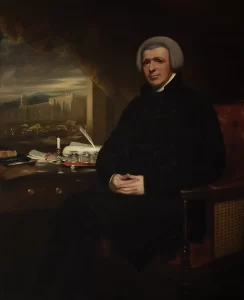
Bishop George Henry Law, Bishop of Bath and Wells1824-45, and an abolitionist.
The South Sea Company was created by an Act of Parliament in 1711 to take over existing government obligations and debts. It was to absorb short-term unfunded government debt by converting it into company shares that could be traded on the stock market. In return, the government paid interest to the South Sea Company which went to investors, alongside any trading profits made. In 1720, the final tranche of Government public debt, including the Queen Anne’s Bounty holdings, was converted into shares but many of the new shareholders did not want to participate in the Company’s risky trading activities, particularly in relation to the 1713 Assiento slaving privilege, so in 1723 the shares were split into trading shares and annuities (Velde, 2022). The Bounty sold its trading shares in 1728 at a serious loss but continued to hold its annuities and to invest in further annuities, only disinvesting in 1778.
Hence the Church was only invested in Government securities over period 1728-1778, though it did hold South Sea Company trading shares between 1721-1727, during which time the Company shamefully transported 19,034 West Africans. However, the Company did not make any profit during this period and the Bounty therefore did not derive any income from slave trading (Dale, 2016), as the report actually acknowledges (p.39). Your quote also refers to benefactions and the Church Commissioners’ research in this area is heroically speculative, ostensibly based on the highly contested proposition that slavery was fundamental to British prosperity in the 18th century and hence a large proportion of people giving money to the Church must have had ‘links’ to slavery, be they iron puddlers, ship owners, or cotton spinners.
Your display boards also referred to Bishop Willes and his £100 bequest to the Society for the Propagation of the Gospel in Foreign Parts (SPG). This Society, by contrast, has a highly documented involvement in slavery over 1710-1838 resulting from Sir Christopher Codrington’s benefaction of two Barbadian sugar plantations, with 700 acres, operated by 300-400 slaves. Abolitionist Sir George Stephen referred to the SPG as “The Honourable Bench of Bishops and Slaveholders”.
Against that, in the words of the United Society Partners in the Gospel, the present-day successor to the SPG, the SPG “sent over 15,000 missionaries worldwide. Many of these missionaries were pioneers, some were involved in tackling slavery, championing women’s rights and opposing racism. They also helped to establish Indigenous Anglican churches in the countries where they worked, helping to build what is today the global Anglican Communion”.
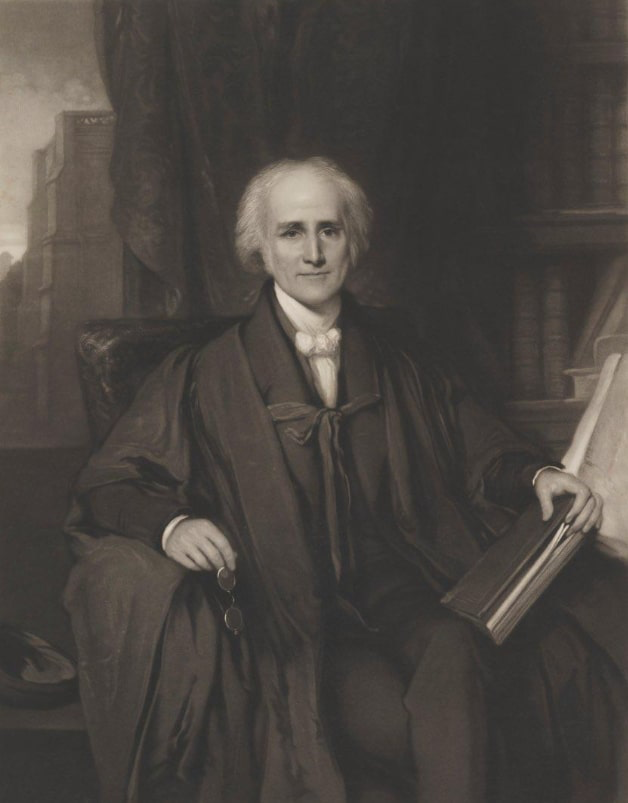
Rev. John Hothersall Pinder (1794-1868), first Principal of the Wells Theological College. He was born on Barbados, educated in England, and returned to the island to minister to the slaves on the Codrington plantation. He returned to England after emancipation in 1834.
Today the SPG is often vilified by applying contemporary ethical constructs to the world of the 18th century. Few now attempt to understand the Church within the social, legal and economic constraints it then operated under. As the SPG Trustees reported in 1830, in considering the options and determining upon a gradual emancipation of the slaves before the 1833 Act,
The Society … who feel as deeply as any part of the community, the duty incumbent upon a Christian people, to put an end not only to the odious traffic in slaves, by which this country was so long disgraced, but also to the great evil of slavery itself; have of late been exposed to some obloquy as holders of West Indian Slaves; and it cannot be denied that the Society are Trustees for the Codrington Estates in Barbados; that those estates are cultivated by slaves and that their produce is received by the Society for the purposes of such trust, and expended, according to the provisions of General Codrington’s will, in support of Codrington College in that island. But surely the acceptance of a trust, which took place more than a century ago, when the great question of Negro slavery had excited but little attention even in the more religious part of the community, is hardly to be brought forward as a charge against the present conductors of the Institution, who finding itself in the character of Trustees of West Indian property for a specific object …” (Tucker, 1898).
The most substantial research on the Codrington Estates by Frank Klingberg and colleagues (1949) is now rejected as outdated Anglican humanism in favour of modern ‘critical race’ theory used by Glasson (2012), Gerbner (2018) and others, supporting the movement for reparations, based on heredity rather than need. Naturally there is also the key question as to why the Church chooses to focus on just its involvement in transatlantic slavery rather than the larger flow from East Africa in the Indian Ocean slave trade. Arguably here, the Church had an equally important history, particularly through the Church Mission Society (CMS), and surely this is at least as significant an arena for research and reflection? In this, I ought to declare that I was born in CMS Mengo Hospital in Kampala and my CMS godparents were Rev. Benoni Lwanga-Kagwa and Dr. Sosamma Thomas of Gujarat.
I do not anticipate that the Trust will correct its factual mistakes or misleading exhibition boards but, nevertheless, we did not want the Trust to assume that all visitors were tacit in accepting these modern dogmas.
Regards
Alistair Parker
Islington, London.
Mr. Parker received a courteous reply from the Wells Palace Trust. They stated that:
‘We are always open to updating our research and appreciate the time and trouble you have taken to not only share your views about our content, but also to back them up with detailed references. This will be very useful for us and we will endeavour to look into the points you have raised.’
REFERENCES
Bennett, J, 1958. Bondsmen and Bishops: Slavery and Apprenticeship on the Codrington Plantations of Barbados, 1710-1838 (University of California Press, Berkeley).
Carswell, J., 1960. The South Sea Bubble (London, Cresset Press)
Dale, R., 2016. The First Crash: Lessons from the South Sea Bubble, (Princeton University Press)
Gerbner, K., 2018. Christian Slavery: Conversion and Race in the Protestant Atlantic World, (University of Pennsylvania Press, Philadelphia)
Glasson, T., 2012. Mastering Christianity: Missionary Anglicanism and Slavery in the Atlantic World, (Oxford University Press, Oxford).
History Reclaimed, ‘The Fitzwilliam Museum, Fact and Propaganda’,
Klingberg, F., (edit) 1949. Codrington Chronicle; and experiment in Anglican Altruism on a Barbados Plantation 1710-1834, (University of California Press, Berkeley)
Neal, L., 1991. The Rise of Financial Capitalism: International Capital Markets in the Age of Reason, (Cambridge University Press)
Tombs, Robert, South Sea Trouble, Times Literary Supplement, no. 6371, 9 May 2025, 7-8.
Tucker, H., SPG, (edit) 1898. Classified Digest of the Records 1701-1892, (Spottiswoode & Co., London). [https://missiology.org.uk/pdf/spg/digest-of-spg-records.pdf]
Velde, F., 2022. ‘Winners and Losers in Britain’s 1722 Debt restructuring’, Federal Reserve Bank of Chicago.[https://debtcon6.princeton.edu/sites/g/files/toruqf3611/files/documents/velde.pdf]


