

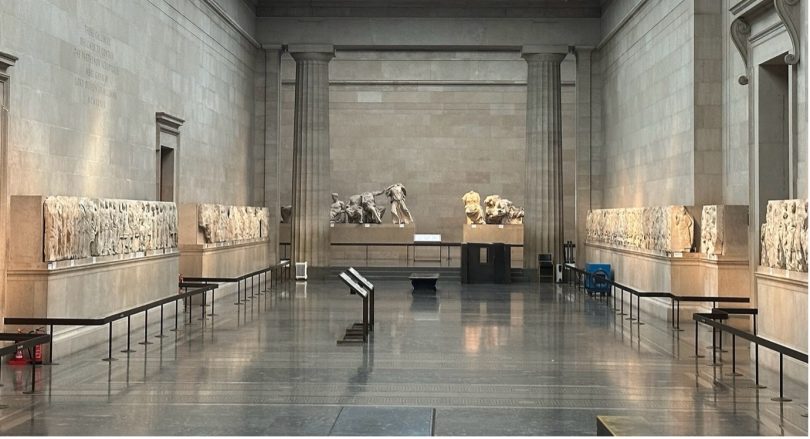

What can Nicholas Cullinan, the newly appointed director of the British Museum, possibly have in common with Pius VII, the Roman Pontiff who acceded the throne of St. Peter in 1800? They are both leaders of influential and glorious institutions, but the similarities seem to stop there or thereabouts. Yet, looking closely, they both were, and are, individuals faced with a difficult choice, and the way they react to it defines how their tenure is going to be regarded.
From the latest interview with the British Museum Director published in the Times, I learned with some relief that Mr Cullinan has no intention to apply “hyper-politically correct labels” to the items in the collection and that he is fully focused on making a success of the much-needed revamp programme of an institution that has three centuries of history, lives in a building that is two centuries old, and cares for a collection spanning several millennia. But when you have the opportunity to speak to the man at the helm of the British Museum, there is but one question that no one can resist asking: what about the Elgin Marbles? Cullinan parried, said he was not “dodging the question”, and then replied that it was not up to him. Once again, the usual script.
If you consider the answer from a legal perspective, he is of course spot on. The Director of the British Museum is not at liberty to dispose of items from the collection for any reason unless they are irreparably damaged, infested, or useless; this is what’s written in the British Museum Act 1963, the most up-to-date version of the fundamental law governing the Museum. And to be fair to him, this is also what previous Directors have said in response to the same question. But could he have taken a different route?
To test this, we must go back two hundred years to Pope Pius VII. Right in the middle of the Napoleonic wars, French troops entered the Papal States, and in July 1809, they kidnapped the pontiff from the papal apartments in the Quirinale Palace in Rome. The extraordinary act was the climax of a crisis that had seen the Pope stand up to Napoleon on trade policy, the nomination of bishops within the French Empire and ultimately over the very sovereignty over the occupied Papal States. And that’s when the story becomes really interesting: the Pope was not arrested immediately; on the contrary, he was offered all sorts of compromises. All he had to do was to accept them in exchange for his freedom. On that fateful summer night, his defiant reply remained famous: “Non debemus, non possumus, non volumus” (we must not, we cannot, we will not). Here was a man of principle standing his ground in the face of strenuous adversities. Let’s not forget that Pius VII’s predecessor, Pius VI, had died as a prisoner of the French just a few years before. Pius VII knew perfectly well that the same fate could also befall him, yet he stood firm.

Pius VII (1742-1823) by Sir Thomas Lawrence, 1819
Why do I tell you all this? Because what makes the Pope’s refusal to concede ground to the French army interesting is not just his claim that he could not do what they required of him, but also his affirmation that he shouldn’t, and that he disagreed with the objects of the request. Such difference with the answer given by the Director of the British Museum! The requests the latter is subjected to are several orders of magnitude smaller, and there is no immediate existential threat therein, yet he covers his face and points the finger away.
It is not enough for Cullinan to say that the alienation of items that are part of our cultural heritage and placed under his care is outside his remit. That’s the easy way out. What I expect of a man in his position is a defence of the right of his institution to hold onto the Elgin Marbles because of the legitimacy of their acquisition. Taking a leaf from the book of history, he should really be saying not just “I cannot”, but also a resounding “I must not”, preferably accompanied by an enthusiastic “I will not”.
Our museum leaders, be they directors or trustees, should not bow to political pressures and tear apart pieces of a legacy they are there to steward and transmit not just intact but even – if they possibly can – augmented. And the case of the claim for the Elgin Marbles is so easily identifiable as a political revendication that it should be easy enough for anyone to dismiss it for what it really is: emotional drivel on a substratum of propaganda from a foreign power.
While many repatriation requests originate from acquisitions that were either illicit or in the “grey area”, there is no historical evidence authorising an unbiased scholar to think about the Marbles in terms of theft. We possess the letter of permission that Lord Elgin received from the legitimate and internationally recognised authority over the city of Athens. His motives for the removal of the sculptures are documented as selfless and noble, and his actions were an unplanned reaction to the deplorable state of the ruins, which every foreign traveller lamented at the time. The institutional framework, the cultural sensibilities at the time, and even the local customs authorised and justified his conduct. There is plenty here from which the British Museum could make a powerful case to defend its ownership of the Elgin Marbles, proudly proclaiming that “we should not” send them back to Athens.
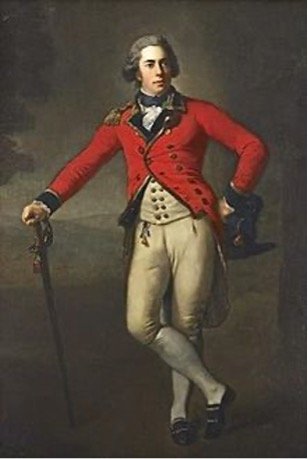
The 7th earl of Elgin (1766-1841) by Anton Graff, c. 1788
But the truly important part is the last one: that “I will not”; the moment when the Papal response reveals the man behind the institution. I would love to see our museum directors personally invested in the educational and cultural mission of the institution for which they are responsible. It’s not just a matter of legal ownership or opportunity. These people should see themselves as continuators of that same spirit that animated the individuals who collected the items now residing in their elegant glass cabinets, the people – like Lord Elgin- who put their entire fortunes on the line to bring the knowledge of places distant in space and time to these sceptred islands, the explorers who overcame a thousand difficulties for the advancement of science and culture.
I am not saying this should be a dogmatic default position for every museum director confronted by every restitution claim. I am saying that we should see more of that scientific spirit of the Enlightenment – the same spirit that brought about institutions like the British Museum – and consider these repatriation claims in light of the inconsistent and scattered evidence they are all too often based upon. Our cultural institutions are occupied by an army of operators who see themselves more as administrators than stewards and push forward a political project with a contradictory and unscientific foundation. Decolonisation, inclusivism, and reinterpretations force the real curators into an undeserved and unproductive exile, either segregated into remote academic niches still relatively untouched by the “modernisers” or fatefully forced out of the institutions they love altogether.
I long for leaders who have the courage to say “enough!” to these invaders; moral visionaries who can authoritatively pronounce a firm “non debemus, non possumus, non volumus”. Can Nicholas Cullinan become Pius VII?
Dr Mario Trabucco della Torretta is a classical archaeologist with expertise and publications on problems of Greek architecture and sculpture of the classical period


