

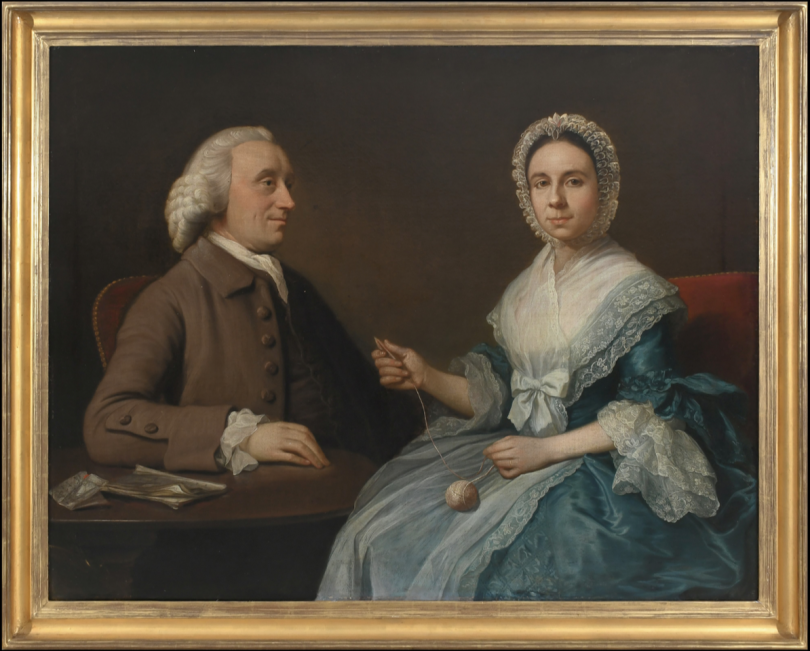

John Newton’s story is very well known. Born in 1725, he was a young slave captain who gave up the sea and slave trading on his conversion to Christianity in the 1750s. At first a dissenter, Newton was subsequently ordained in the Church of England and became the curate of Olney in Buckinghamshire. He composed many hymns with the poet William Cowper and many more on his own, among them ‘Glorious things of thee are spoken’, ‘How sweet the name of Jesus sounds’ and, of course, ‘Amazing Grace’.
In 1785, John Newton’s advice was sought by William Wilberforce, MP for Hull. Through his meetings with Newton, Wilberforce made the decision not to enter the ministry himself, but to remain an MP and become the voice of the abolitionist movement in parliament. Newton then wrote the pamphlet “Thoughts upon the African Slave Trade” in January 1788. The newly formed Committee for the Abolition of the Slave Trade paid for 3,000 more copies to be printed and sent a copy to each member of the House of Commons and the House of Lords.
But how and by whom was John Newton first converted? Who helped this slave trader to become one of the most famous abolitionists? The answer is Captain Alexander Clunie.
I have to confess at the outset that I knew nothing of the existence of Captain Clunie until I started doing some research into a painting that I recently bought, attributed to Nathaniel Dance RA, entitled ‘Portrait of Captain Alexander Clunie and Mrs Jane Clunie’. That brought me to the website of the Cowper and Newton Museum at Olney. Most of the following information I have about Captain Clunie comes from there, including quotes in John Newton’s own words.
It was August 1753 when ’The African’ (Newton’s ship) returned to Britain and only six weeks later sailed again for West Africa. The trading was poor and Newton carried only 87 slaves to St Kitts (St Christopher’s) in the West Indies, instead of the usual 220. However the increased room below decks meant an increased survival rate and the entire voyage passed off without a single death, amongst either crew or slaves.
It was while in St Kitt’s that Newton met someone who had a profound effect on him. Alexander Clunie was a sea captain who was not involved in the ‘triangular trade’. They soon became friends. Clunie was a Scot and belonged to the Independent Chapel in Stepney, London. His minister there was Samuel Brewer, a friend and pupil of Dr Jennings, who had been pastor to Newton’s mother, Elizabeth Newton, at the Independent Meeting House at Wapping, where John had been baptised in July 1725. Both Brewer and Jennings had been friends with Isaac Watts (1674-1748), the famous hymn writer.
Under the influence of Clunie, Newton’s understanding of his faith became more focused.
“I was all ears and what was better, he not only informed my understanding, but his discourses inflamed my heart.” For nearly a month the two met regularly on board each other’s ship.
Although Newton had read and re-read the Bible and other religious books such as Hervey’s ‘Meditations’ and Henry Scougal’s ‘Life of God in the Soul of Man’, meeting Clunie turned an intellectual exercise into a more outward expression of his faith. With encouragement Newton began to pray aloud. Clunie also gave him addresses of others from whom to seek further instruction. Newton lost no time and began, in June 1754, a series of letters to Dr David Jennings. He also kept in regular contact with Clunie and his letters to his friend between 1761 and 1770 (the year Clunie died) were later published as The Christian Correspondent’ in which Newton paid him this tribute: “Your conversation was much blessed to me at St Kitt’s, and the little knowledge I have of men and things took its first rise from thence.”
Newton’s voyage back to England from St Kitt’s was uneventful, apart from storms in the Western Approaches, and when ’The African’ docked in August 1754 Newton was unaware that he would never go to sea again. He had a period of illness and had to seek a job on shore. In 1755, he took the position of Tide Surveyor at the Port of Liverpool. This coincided with the Seven Years War, which reduced maritime traffic, giving him time to meet with preachers and evangelists such as George Whitfield and John Wesley. Following Clunie’s advice, he attended the Stepney Dissenting Chapel.
The only other snippet of information that I have been able to discover about Captain Clunie is from the National Archives at Kew, which shows that he was still a captain of the 200-ton ‘St Kitt’s Merchant’ with a crew of 30 in November 1757. However, he must have retired soon after that. He apparently had a warehouse in London where his business dealt with a wide range of imported goods.
Two years ago, in 2023, there was an exhibition at the Cowper and Newton Museum at Olney, which featured some newly discovered letters from John Newton to his ‘close friend’ Alexander Clunie. https://cowperandnewtonmuseum.org.uk/dear-brother/ The letters, 22 in total, were found in 2018 in the archive of a long-established London lawyer’s office where Captain Clunie had been a client. According to the exhibition, which provided an illustrated display about the two men and their wives,
Clunie is mentioned in John Newton’s ‘Authentic Narrative’ as the man whom he met in St Kitts on his last voyage, and who over the course of a few weeks became his spiritual adviser. The friendship lasted. The letters were written between 1765 and 1769 and tell us something about John and Polly Newton’s life at the vicarage in Olney. The accompanying display also tells us a little about Clunie, a merchant who in earlier years had explored the hinterland of North America and Canada. Clunie never engaged in the slave trade.
Newton never returned to the sea again after the year he met Clunie. He benefited from the teaching of Clunie’s pastor at the Stepney Independent Meeting and other evangelicals across London. Taking a job in Liverpool, he studied for a possible career in the church and was eventually ordained to Olney in 1764. In London Clunie had various business interests and owned a warehouse. He performed frequent errands for John Newton, and it was to Clunie that the Newtons turned when they needed goods for the vicarage.
Alexander Clunie was a regular visitor to Olney. He got to know Newton’s parishioners and in hard times provided money and supplies for the poor. Newton kept him informed of the topics he chose for sermons.
Newton wrote regularly to Clunie, and sometimes Polly Newton added her own postscripts. Although she was less of a fluent and elegant writer than her husband, Polly did not shy away from chastising Mr Clunie for the poor quality of tea he supplied and delays to her order for new grates! Polly cared very much about her appearance and her clothes. In March 1767, the Newtons planned a journey to Helmsley in Yorkshire, for which Mr Clunie provided Polly with a portmanteau.
In 1770, Alexander Clunie was in poor health and passed away. After his death Clunie’s son from an earlier marriage published John Newton’s correspondence with his father (a total of 61 letters), though without seeking permission from Newton. The majority of the 22 letters on loan to the museum were included in this printed collection, but the editor cut out most of the domestic details and Polly’s contributions.
From the costume details we think the painting we have was commissioned around the time of Clunie’s retirement from the sea. It may even have been to celebrate his second marriage.

Portrait of Captain Alexander Clunie and Mrs Jane Clunie’ (attributed to Nathaniel Dance, RA, circa 1758)


