

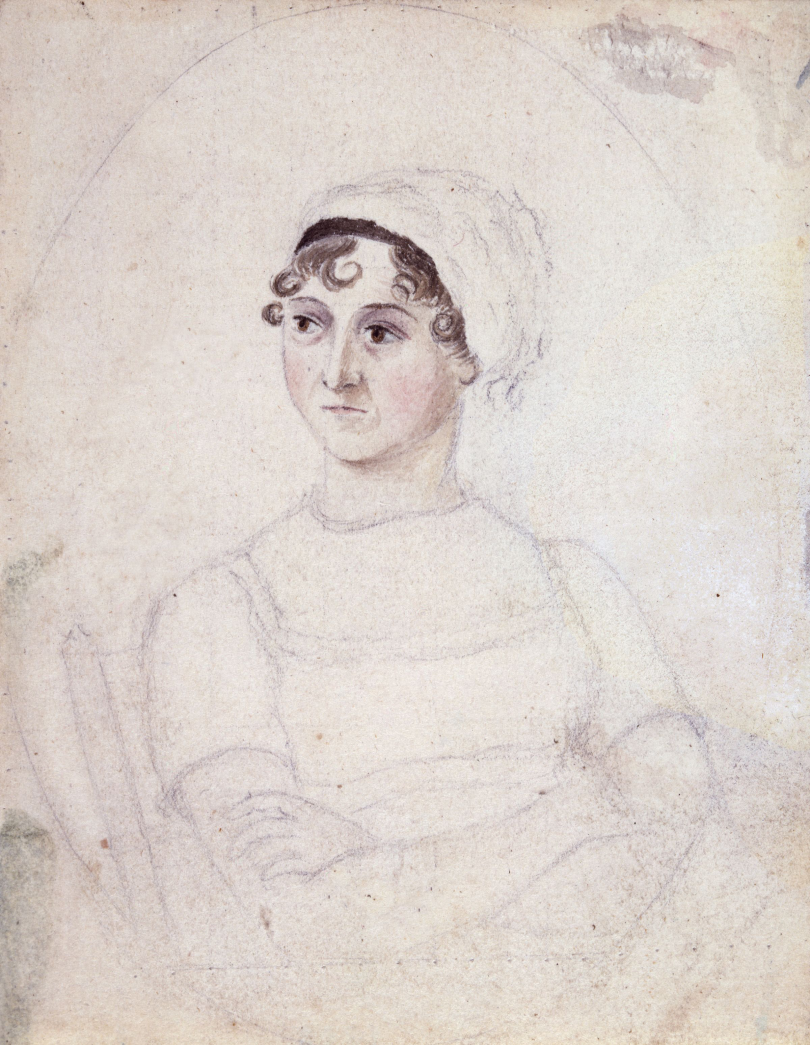

Featured Image: Jane Austen by Cassandra Austen, circa 1810, National Portrait Gallery
Jane Austen: Rise of a Genius, a BBC documentary created in partnership with the production company 72 Films, aired in the UK in May of this year. As with Shakespeare: Rise of a Genius (2023) and Mozart: Rise of a Genius (2024), the format features commentary from “writers, actors, and experts” alongside dramatic re‑creations of the artist’s life and times in which the actors emote, but do not speak. Shakespeare walks down a mucky, ribald, dangerous street in Tudor London and looks concerned as fights break out and a man is hung from the gallows; Jane Austen walks down a mucky, ribald, dangerous street in Georgian London and looks concerned as a black man is dragged away for some unspecified reason.
These scenes set the stage for exploring the central theme, which is evidently: how did Shakespeare and Austen express their opposition to social injustice in their writing? And additionally in Austen’s case: how did Austen express her rebellion against patriarchal oppression?
Both programmes are notable for their unfounded assertions and missing context. For example, we are told that Shakespeare’s tragic play about the nobly-born teenage offspring of two wealthy feuding families is—somehow or other— “a response to the social injustice he’s seeing.” This is because “up until now, romantic plays have been comedies, but Shakespeare writes this as a tragedy.”
Are we to believe that not a single person currently employed in BBC Arts knows that Shakespeare didn’t create Romeo and Juliet by upending a romantic comedy? He sourced his plot from a 1562 poem, The Tragicall Historye of Romeus and Iuliet. Emphasis on “Tragicall”. Likewise, Shakespeare’s regrets about his failings as an absentee father might possibly have informed King Lear, but shouldn’t we also tell the viewers that the play is sourced from ancient fables such as in Holinshed’s Chronicles?
The Jane Austen programme is a compendium of disinformation and distortions. One presenter assures us that Austen’s teenage creation, Lady Susan Vernon, was a convention-busting anti-heroine. “Lady Susan is the hand grenade that Jane Austen is lobbing into Georgian society. Women are meant to present in a certain way, and she did away with all of that… it’s unfathomable”. Again, does nobody at BBC Arts understand how ridiculous that sounds? What is really unfathomable is that the BBC, with all the resources at its command, with their extensive archives, with the institutional power and prestige which guarantees their enquiries will be answered by any university on the planet, did not check to see if the story of a wicked aristocrat who tries to coerce her daughter into a mercenary marriage was an outlier in Georgian fiction.
The producers ignore readily available information in favour of making up their own version of Austen. Austen’s nephew James Edward Austen-Leigh recollected that his aunt “never was seen, either morning or evening, without a cap” (73). Nevertheless, the actress portraying Austen in the dramatic vignettes is never seen with a cap indoors or a bonnet out of doors. This may seem like a pedantic objection, but the BBC’s renegade bareheaded Jane is emblematic of their agenda. For the BBC, the important thing to know about Austen’s genius is not her wit and her cool irony (hardly mentioned), her revolutionary narrative techniques (briefly mentioned), but that Austen—a woman, let’s remember—sought for a way “to tackle big subjects and say something about the world without alienating readers and critics”.
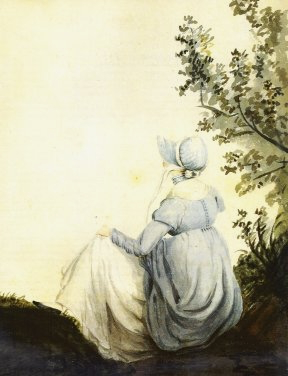
Watercolour of Jane by her sister Cassandra, 1804
We’re invited to believe that the critics ignored Mansfield Park because it rebuked the institution of slavery. To prove this, they show an excerpt from the 1999 film adaptation of Mansfield Park, with dialogue hinting at sexual concubinage—dialogue which is not in the novel.
It’s unknown why Austen’s third novel wasn’t reviewed but it might have been for no reason at all. The comprehensive British Fiction database lists 441 titles published between 1811 and 1817, the years that Austen was active. Of those, 201 titles have contemporary reviews. But this programme is singularly devoid of basic fact-checking or consistency. We’re told that because of Mansfield Park’s failure to gain critical attention, “Jane realizes that if she wants to pose big questions, and challenge social convention, she must do it through a more engaging and entertaining heroine.” Next, we hear from an Austen scholar who quotes Austen’s famous remark that Emma Woodhouse is “a heroine whom no one but myself will much like”. Further, Austen began writing Emma before Mansfield Park was published: she created Emma Woodhouse before any critic could have ignored Mansfield Park.
While the viewers are knocked over the head with the usual historical context about sexism, empire and slavery, they are given almost no literary context whatsoever. Nobody explains that many novelists criticized the institution of slavery. The Advantages of Education (1793) and Lady Maclairn (1806), for example, discuss sexual concubinage in the West Indies. Instead, the viewers of Jane Austen: Rise of a Genius are taught that Austen was “brilliantly subversive”. In Pride and Prejudice, “she’s going against the hierarchical nature of society, of class, of class divide.” Never mind that Austen famously described her tale of Darcy and Elizabeth as “too light, and bright and sparkling” because it was devoid of the kind of sententious lectures featured in many novels of the time. Never mind that the standard impediment in a sentimental novel was the apparent class divide between hero and heroine.
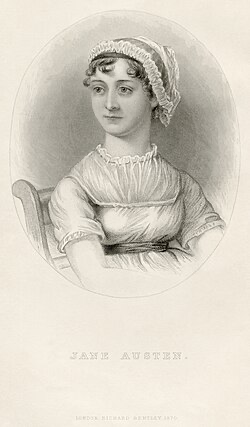
The depiction of Austen
The depiction of Austen taken from A Memoir of Jane Austen (1871) written by her nephew James Edward Austen-Leigh, and based on the sketch by Cassandra, her sister.
An excerpt from the 1996 movie version of Emma shows the sequence when Emma is rude to the garrulous spinster Miss Bates and is scolded by Mr. Knightley. This is described as Austen’s critique of “the disparity that is going on in the country between rich and poor.” And yet Emma, for all her faults of self-importance, is the only Austen heroine who visits a poor family, and the narrator tells us she is sensible and benevolent. Austen is rather unique in not depicting her heroines as ministering angels who bring succour to the poor; it was a trope of the time.
The assertions in Jane Austen: Rise of a Genius are not only undermined by Austen’s own novels, but they have not been put to the simplest of tests: Austen was a subversive social critic—compared to whom? As James Walton noted in The Spectator, this documentary erases all mention of other female novelists.
To take a few of many examples: Elizabeth Helme castigates the selfishness of the privileged in Albert, or the Wilds of Strathnavern (1799). Her character Mrs. St. Aubyn prefigures Scrooge: “Does not the parish provide plentifully for the poor?”
Agnes Hall, writing as Rosalia St. Clair, attacked “the absurd institutions of society, which so strongly tend to exalt the mere accidental distinction of birth, or the possession of property, over intellectual attainments or moral worth” in The Banker’s Daughters of Bristol (1824).
Novelist Ann Ryley, like Austen, detested the Prince Regent. Unlike Austen, Ryley didn’t confine her thoughts to her private correspondence. A formidable dowager in Ryley’s Fanny Fitz-York (1818) repeatedly attacks the Regent and the entire British political establishment. She condemns them for “an impoverished revenue—a starving people—and the misery of thousands of individuals, who deplore the loss of husbands—fathers—brothers—and friends in this unjust, unnecessary, and destructive war.”
And yet, the female authors I’ve named are forgotten today. Could it be that Austen’s immortality derives, not from her supposed passion for social justice, but from some other attributes? Shamefully, the BBC is now utterly incapable of exploring what those attributes are.
Works Cited
Austen-Leigh, James Edward. A Memoir of Jane Austen. 1870. Wordsworth Editions, 2007.
Garside, Peter, et al. British Fiction Database 1800-1820: A Database of Circulation, Production & Reception. http://www.british-fiction.cf.ac.uk/index.html
Walton, James, “Why is the BBC Making Stuff Up About Jane Austen?”. The Spectator, May 31, 2025.
Lona Manning (MA Res U of York) is an independent researcher and writer. She lives in Canada. She studies the forgotten sentimental novels of the long eighteenth century, which are a rich trove of information about the social attitudes of the time. www.lonamanning.ca


