

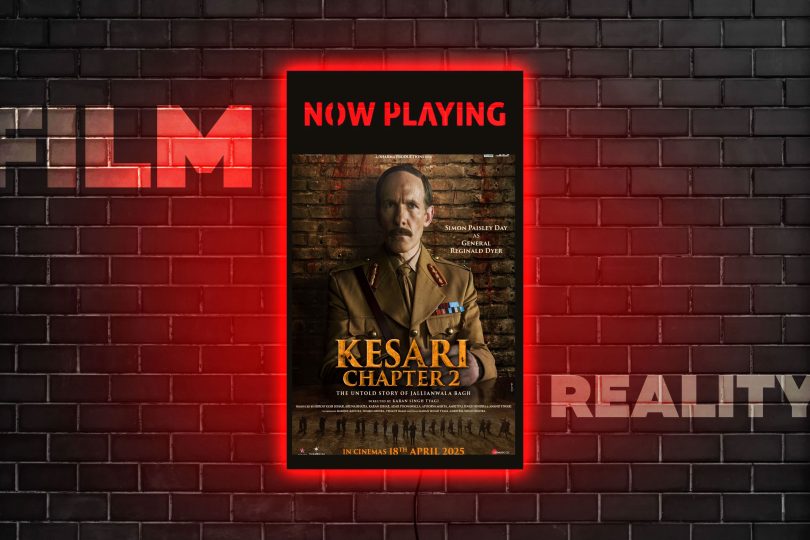

A century on, the Amritsar massacre continues to be, as the Times wrote on General Dyer’s death in 1927, `a subject of protracted and embittered controversy’.[1]
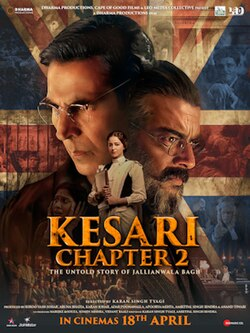
Emotion has resurfaced in India this year with the release of the Hindi-language Bollywood blockbuster premiered in April to mark the 106th anniversary of the massacre —`Kesari Chapter 2: The Untold Story of Jallianwalla Bagh’. The film, starring Simon Paisley Day as General Dyer, is loosely based on The Case that shook the Empire. One Man’s Fight for the Truth about the Jallianwalla Bagh Massacre by Raghu and Pushpa Palat.[2]
Reviewer M.R. Deepak comments that `the movie has accurately depicted the terror Gen. Dyer created. You will be moved when you realise how so many innocents were killed to satisfy the blood lust of a racist Briton. The movie also points out how the British have still not apologized for this genocide’(sic).[3]
It is undisputed that there were some 400 deaths among the unarmed crowd shot down by rifle fire at Dyer’s order in Jallianwalla Bagh on 13 April 1919, and that this served to alienate many moderates in India from the British connection. India, particularly the Punjab, had served loyally in the First World War and had been promised under the Montagu-Chelmsford reforms `responsible government’, understood to mean self-government and Dominion status. These expectations were confounded, however, by the draconian Rowlatt Acts, or the Anarchical and Revolutionary Crimes Act of 1919, which provoked the very disturbances it was designed to prevent, and which led to the Amritsar Massacre.
The Hunter Commission which investigated the uprisings in the Punjab found General Dyer guilty of a serious ‘error of judgment’ in failing to give a warning before firing and for allowing the firing to continue from between 10 to 15 minutes.[4] Relieved of his command and placed on half pay, he returned to England a sick and broken man.
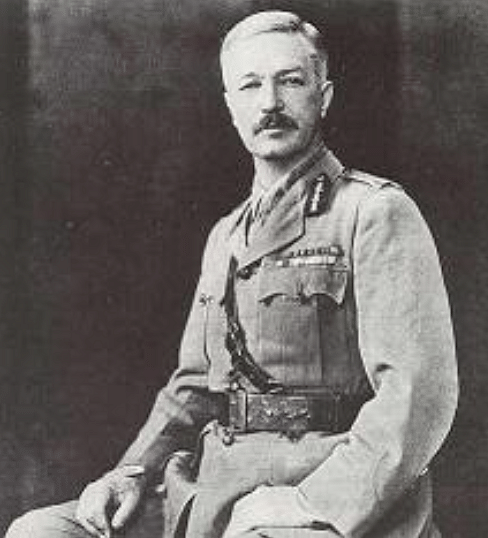
General Reginald Dyer (1864-1927) photographed in 1922
The successive but independent involvement in the controversy of two British judges offers another narrative. The first, Lord Sumner, was a celebrated Law Lord and a leading light in the Die-Hard wing of the Conservative party, and the spokesman behind a successful motion in the Upper House in 1920 deploring Dyer’s treatment as unjust and setting ‘a precedent dangerous to the preservation of order in the face of rebellion’.
The Hunter Committee, established in October 1919 to investigate the Massacre, by a majority of four (British) to three (Indian), found that the Punjab had been in `a state of open rebellion’. `Let us stick to that word’, said Sumner, `and not attempt to get away from it.’ In his view, it was not a question of dispersing a riotous assembly or restoring order in the streets, but of suppressing rebellion. The core contention of the Lords’ motion was that, confronting rebellion in a city of 150,000, cut off from railway and telegraphic communication, and under de facto martial law after three days of mob rule, violence, arson and slaughter, which were motivated, according to the Hunter Report, by ‘a murderous antipathy towards all Europeans’, Dyer, sent to restore order, was duty-bound to act as he did: in Sumner’s drastic words, `to fire and to take life.’
Lord Sumner
Once admit the necessity of firing on a large crowd in the confined enclosure of Jallianwalla Bagh, said Sumner, and heavy casualties were inevitable. With a force of 90 under his command facing a crowd of between 5,000 and 20,000, how long firing should continue -`a second, a minute or any number of minutes’ –`no one could tell except General Dyer himself’. `There can be no other rule’, Sumner declared: `A Government formed of natives of India would have been forced to apply the same rule and the same severity.’ His words were applied, in theory at least, by the Indian Army in Amritsar itself in 1984, when a Sikh rebellion was put down on the orders of the then Prime Minister, Indira Gandhi.
The Hunter Commission held that Dyer should have issued a final warning before giving the order to fire, though it found it improbable that the crowd would have dispersed even had he done so and `much more likely that recourse to firing would have been necessary.’ Sumner found this censure excessively legalistic. Dyer had proclaimed a ban on public meetings in 19 different locations across Amritsar – though not, as he admitted, in Jallianwalla Bagh – and the Hunter Commission did not believe that the majority of those present were ignorant of the ban when they defied it.
The function of the Commission, whose findings were accepted by the British Government, has been widely misunderstood. It was a committee of enquiry, not a court of justice. Its findings were not judicially tested. Appearing before it unrepresented and without benefit of legal advice and mistakenly believing that his action would continue to enjoy the initial approval of most of his military superiors and the plaudits of the Anglo-Indian community, Dyer was damned out of his own mouth. He admitted that, unfamiliar with Amritsar, he had not proclaimed the ban in Jallianwalla Bagh itself, so that `there may have been a good many who had not heard the proclamation’. Unwisely, and disastrously for him, he alsoasserted that his intention had been to set an example that would quell rebellion throughout the Punjab and `give them a lesson’, a policy for which there was no legal authority and which was justly and severely condemned by Hunter. Sumner observed, however, that Dyer had been singled out not for what he did at the time but for what he said about it later.
In India the Lords’ motion –`Dyer-hards’ the Indian press called them – provoked understandably strong resentment. Controversy over Amritsar was still simmering four years later when it boiled up again in 1924 in the case of O’Dwyer v Nair, the ostensible subject of this year’s film, which features as its hero a hitherto
little-known figure, Sir Chettur Sankaran Nair. Shortly before the film’s release and to mark the anniversary of Jallianwalla Bagh, Prime Minister Narendra Modi hailed Nair as `the real inspiration behind our country’s freedom struggle’, who should be known to `every adult and child’. This was a deliberate attack on the Nehru-Gandhi dynasty for allegedly suppressing Nair’s contribution.
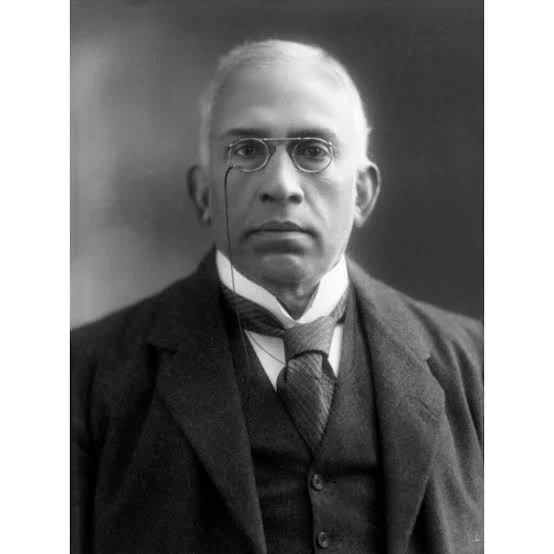
Sir Chettur Sankaran Nair (1857-1934)
Nair was a distinguished Indian, a devout Hindu, a respected former judge of the High Court of Madras, and from 1915 a member of the Viceroy’s Executive Council, one of the few Indians to occupy that position, in which he assisted in the formulation of the Montagu-Chelmsford reforms. He had also been a President of the Indian National Congress, from which he later distanced himself. He resigned from the Viceroy’s Council in protest at the Amritsar massacre, which his decision to defend the suit in O’Dwyer v Nair brought once more to public attention.
Nair was unique in his independent stance, opposing the excesses both of British rule and of Gandhi and his campaign of passive resistance, which he considered both naïve and dangerous, and bound to `lead to bloodshed’. In Gandhi and Anarchy (1922) Nair had denounced Gandhi for stirring up, by his encouragement of civil disobedience, the very unrest and violence which had led to the massacre.[5] He also dealt some glancing blows at Sir Michael O’Dwyer, Lieutenant-Governor of the Punjab.
O’Dwyer, who had approved Dyer’s action as `the decisive factor in crushing the rebellion’, was criticised in the Hunter Report. He resented this, and when Nair’s book came to his attention, while thoroughly approving its castigation of Gandhi, he sued the author for libel. The trial, which took place in London, lasted an unparalleled five weeks, of which nearly three were devoted to the events at Amritsar.

Sir Michael O’Dwyer (1864-1940), Lieutenant Governor of the Punjab 1913-19.
The film ‘Kesari Chapter 2’ purports to be a re-enactment of the courtroom drama. However, as the opening credits admit, `it is a pure work of fiction’, and in the words of film critic Anuj Kumar it `milks the sacrifice of the martyrs of Jallianwalla Bagh to create a trumped-up narrative around the tragic episode’ and `to distort well-documented historical facts.’[6] The case is represented as taking place in India, not England, and, anachronistically, as an action for `genocide.’ Nair is represented as the defendant acting in person, unrepresented by counsel, and the plaintiff in the film is not O’Dwyer but General Dyer himself, who at one point contemplates murdering Nair. Nair uses the F-word in court, members of the jury are bribed, etc. etc. A pity, since the actuality was dramatic enough for a really good film.
In his book Nair held O’Dwyer responsible for authorising and approving Dyer’s action at Amritsar. The words O’Dwyer complained about stated ‘that it was in the power of the Lieutenant-Governor, a single individual, to commit the atrocities in the Punjab we know only too well.’ Nair pleaded `justification’, that is, that the words were true and constituted `fair comment.’ It was agreed by both sides that the crucial issue of fact for the jury was `whether General Dyer was right or wrong, whether he was guilty of an atrocity or not’.
The judge, Mr Justice McCardie, the second judge central to this episode, was no die-hard. He was thought to be ‘of pronounced Labour sympathies’, and his name had been on a list of candidates for Lord Chancellor in Ramsay MacDonald’s first cabinet in 1924. His radical views on legal reform, fearlessly expressed from the Bench, raised eyebrows, as did his frequent interventions in the case before him.
Like Sumner, McCardie said that the key question was whether Dyer’s action was `necessary for the prevention of anarchy. If it were, can it be said to be wrong?’ If it was not necessary but was carried out in good faith, then ‘an error of judgment’, as found by the Hunter Commission, was `a wholly different thing’ from an `atrocity’.
Was it, then, an `atrocity’? The lawyers thrashed over the evidence heard by Hunter and much else, including depositions from witnesses in India and direct evidence in court. Under cross-examination Nair, who had originally approved the imposition of martial law, made the significant admission that the order to fire would have been justified had it been preceded by a warning. In his address to the jury McCardie offered his own opinion — which he was fully entitled to do but courted fresh controversy thereby — that Dyer `acted rightly’ and had been ‘wrongly punished.’ The jury agreed with him by a majority of eleven to one.The dissenter was Harold Laski, the socialist intellectual and later MP, who nonetheless praised McCardie’s `magnificent impartiality’.[7] Nair refused O’Dwyer’s offer to forego damages and costs in return for an apology.
Both Sumner and McCardie were heavily criticised, Sumner for intervening in a political issue while liable as a member of the Judicial Committee of the Privy Council to adjudicate on appeals from India, where, said the Times, `the personalities and views of the members of the Board are closely scrutinised’.
The rebukes to which McCardie was subjected were more bitter, lasting and damaging: from George Lansbury MP,[8] who requested a motion for McCardie’s removal from the Bench; from the Prime Minister, Ramsay MacDonald, who reproved McCardie for `the harm that has been done in India’; privately but most unfairly and woundingly, from the Lord Chancellor, Lord Haldane, who maintained, utterly perversely, that Dyer’s conduct was not an issue in the case; from the Secretary of State for India and from the Viceroy, Lord Reading, who, reiterating the official view that the conclusions of the Hunter Report and the Government’s decision to dismiss Dyer must be upheld, declared that `further discussion of the question is not conducive to the public interest’. McCardie, hurt and indignant, circulated a convincing `statement’ to his fellow-judges, the substance of which was reproduced in The Law Journal. An accompanying editorial deplored `the most unjust charges which were made against him’ and insisted on `the propriety of [his] conduct of the case’.
From 1 to 10 June 1984 Indian army forces, using artillery, tanks and helicopters, attacked a body of Sikh insurgents holed up in the complex of the Golden Temple at Amritsar, close to Jallianwalla Bagh. Losses were officially put at 576 insurgents and 83 soldiers of the Indian Army, but actual casualties were far greater, especially among the thousands of unarmed and innocent pilgrims worshipping at the holiest of Sikh shrines and shot on sight without warning or excuse. One of India’s most respected journalists, G.K.C. Reddy, concluded that the operation `will go down in history as one of the biggest massacre[s] of unarmed civilians by the organised military force of a nation’.
The storming of the Temple also saw the extra-judicial murder of captive Sikh combatants, summarily shot, their hands bound behind their back with their turbans. In his foreword to a circumstantial report, Supreme Court Justice and prominent civil rights campaigner V.M. Tarkunde, wrote of `inhuman barbarities, . . .sadistic torture, ruthless killings…calculated ill-treatment of women and children’.[9] These undoubted atrocities far exceeded the 1919 massacre.[10] Many have called on the British Government to apologise for the Jallianwalla Bagh massacre but few of these in recent years make any reference to the events of 1984.
Sir Sankaran Nair was an honourable man, a moderate, a cultivated anglophile and Gladstonian liberal, loyal to the Empire, a gradualist and a constitutionalist, sidelined by the Congress Party for his opposition to Gandhi. Modi’s championing of Nair as an unsung hero of Hindu nationalism, who resisted both the Raj and the Mahatma, should also be understood as part of the BJP campaign of opposition to the Congress Party in advance of forthcoming elections in Kerala, where Nair was born.[11]
‘The big boys of Bollywood’, writes Anuj Kumar `are meddling with modern history’. Veteran journalist Majur Lookhar agrees: ‘We now live in an India where patriotism and jingoism thrive, leaving little room or demand for objectivity’.[12] In this, as in other narratives of Jallianwalla Bagh, images of Dyer, O’Dwyer and now Sankaran Nair continue to be influenced by ideology and politics.[13]


