

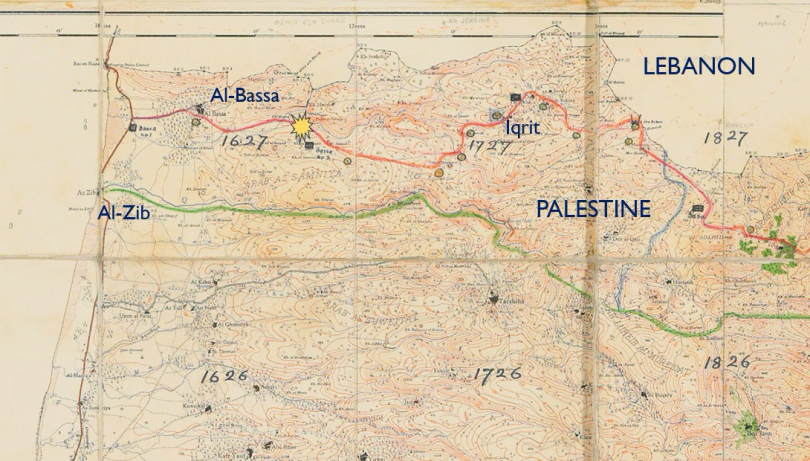

Featured Image: Royal Ulster Regiment Operational Map for Al-Bassa
1. ‘Britain Owes Palestine’: Reparations for the British Mandate for Palestine, 1920-1948
The BBC News recently reported that, in 1938, ‘the people of al-Bassa got their lesson in imperial brutality when the British soldiers came after dawn … Villagers were rounded up while troops later herded men onto a bus and forced them to drive over a landmine which blew up, killing everyone on board’[[1]].
This event is a key part of the ‘Britain Owes Palestine’[[2]] campaign, launched in a renewal of the efforts by Munib al-Masri, the Palestinian industrialist, to secure acknowledgement, satisfaction and reparation for ‘British war crimes’ in Palestine committed over the period of the Palestine Mandate. Reportedly, the envisaged reparations might amount to some £2 trillion [[3]]. Al-Masri started a UK Parliamentary Petition in 2017 for the British Government (HMG) ‘to openly apologise to the Palestinian people for issuing the Balfour Declaration’. HMG then responded:
The Balfour Declaration is an historic statement for which HMG does not intend to apologise. We are proud of our role in creating the State of Israel. The task now is to encourage moves towards peace. The Declaration was written in a world of competing imperial powers, in the midst of the First World War and in the twilight of the Ottoman Empire. In that context, establishing a homeland for the Jewish people in the land to which they had such strong historical and religious ties was the right and moral thing to do, particularly against the background of centuries of persecution [[4]].
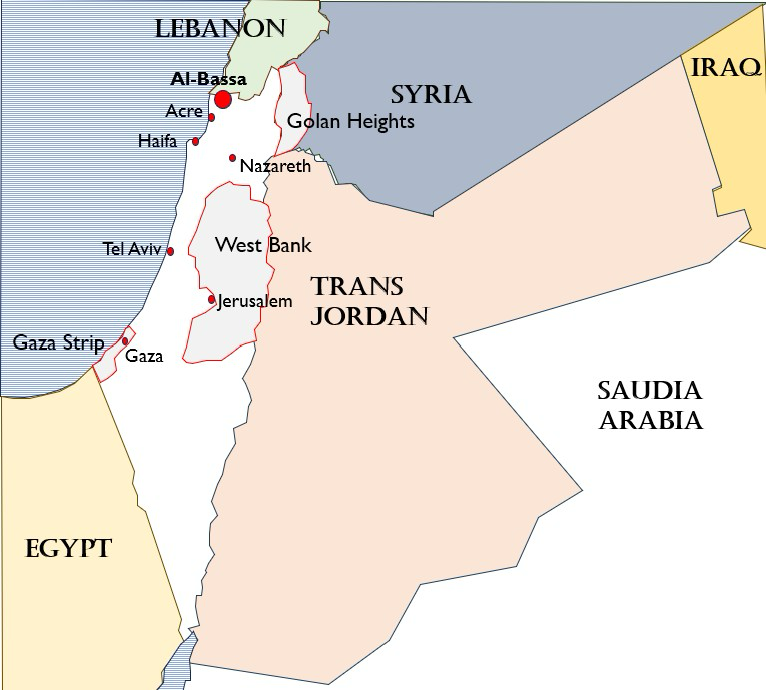
Ben Emmerson KC, former UN Special Rapporteur on Human Rights, said that the legal team had unearthed ‘shocking crimes committed by certain elements of the British Mandatory forces’. The latest lengthy legal petition refers to the northern village of al-Bassa and notes that ‘the killing of approximately 50 people was part of a reprisal for the death of four soldiers of the Royal Ulster Regiment (‘RUR’) from the detonation of a roadside bomb on the evening of 6 September 1938’. It goes on to say that this was ‘the most egregious event that has been uncovered from the period’.
Rather than describing this episode as ‘unearthed’ or ‘uncovered’, it would be more accurate to acknowledge that it was documented by Matthew Hughes in his 2009 articles [[5]] and, in greater depth, in his meticulously researched book published in 2019 [[6]]. Hughes, more than anyone, has investigated the violence of the British Army during Britain’s Mandate for Palestine (1920-48). He identified the al-Bassa event as the ‘worst single atrocity that this author can uncover’, suggesting that twenty – rather than fifty – Arabs were killed, after being forced onto a bus that was deliberately driven over a buried road mine. He provides four British sources.
2. What happened at Al-Bassa?
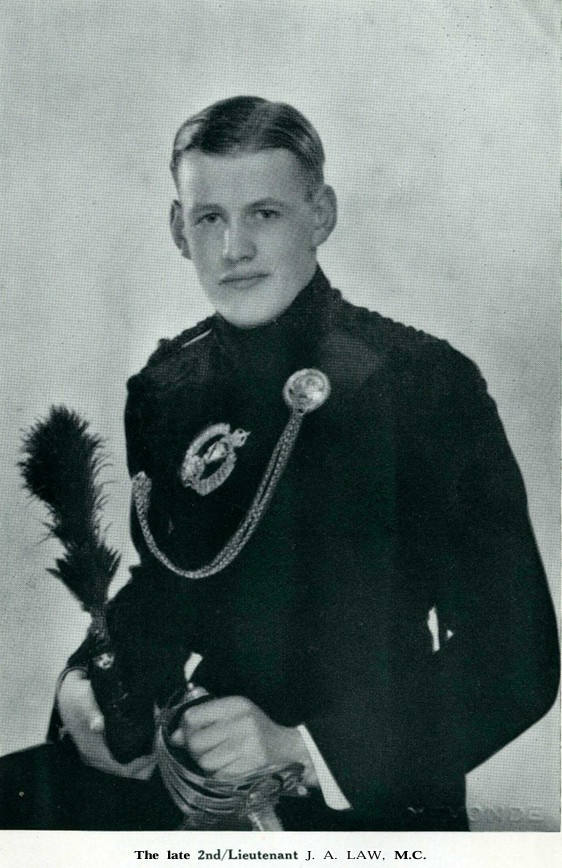
Late on the night of the 6 September 1938, a patrol of ‘B’ Company, 2nd Battalion RUR (2/RUR) left Iqrit travelling west to al-Bassa, near the northern Lebanon frontier road. Approximately three miles west of al-Bassa, close to al-Bassa Police Post No. 2, the second vehicle in the column – an armoured truck – detonated a land mine. Two soldiers were killed instantly, a third died on the following day, and the 22-year-old officer, 2nd Lieut. John Anthony Law MC, died on 9 September [[7]]. The press reported that ‘punitive measures are being taken against the villages of Bassa and Zib near the scene of the landmine explosion last night that caused the death of three soldiers’[[8]]. The following day it was reported that ‘Troops later blew up several houses in the villages of Bassa and Zib as a punitive measure’[[9]]. The RUR regimental journal similarly recorded that ‘At dawn of the 7th September certain punitive measures were taken against villages known to have had knowledge of the outrage’.
Hughes’s first source is the 1998 memoir [[10]] of Harry Arrigonie (1908-1990), a Palestine Police Sergeant, that covers the incident which occurred a week before his arrival in al-Bassa. Arrigonie suggests that ‘Three days later an army reprisal force of about 20 soldiers were sent into Bassa village and collected 50 men, herding 20 of them onto a bus. Villagers who panicked and tried to escape were shot (killing several). The driver of the bus was forced to drive along the road and over a land mine buried by the soldiers’.
Raymond Cafferata MC PM (1897-1966), a senior Palestine police officer, is better known as the Hero of Hebron when, in August 1929, Arab mobs savagely attacked the Jewish Quarter, killing 65 Jewish men, women and children. Cafferata, the only British police officer in the town, held off eighty Arabs with just a revolver, having shot one Arab policeman cutting off a child’s head with a sword and another stabbing a woman [[11]]. Seven weeks after the al-Bassa events, Cafferata wrote to his wife: ‘You remember reading of an Arab bus blown up on the frontier road just after Paddy was killed. Well, the Ulsters did it – a 42-seater full of Arabs and an RE Sgt blew the mine. Since that day not a single mine has been laid on that road’ [[12]].
An Arabic account of the event was posted in 2004 by Eid Haddad, a Christian Arab, who recalls what his father told him of the 1938 event that he witnessed as a 15 year-old boy [[13]]. This account tells of a military jeep being blown up by a mine; another road mine discovered by the British ready to explode; and British troops killing six villagers, destroying lots of private properties, and taking Bassawis men away and torturing them. The British then forced 30 men from the neighbouring Al-Zeeb village onto the bus and made them drive over the road mine, which then exploded.
These are hearsay accounts, in contrast to that of Lance Corporal Charles Tinson of Squadron A, 11th Hussars, who largely worked on convoy protection in a troop of three 1908-14 Rolls-Royce armoured cars. In an interview fifty-seven years later he recollected being present at al-Bassa when his troop ‘flattened’ the village. He made no reference to a bus but did refer to the use of known insurgents riding in leading vehicles to discourage indiscriminate minelaying.
And I don’t know if I should tell you this, but there’s a place called Bassa and, uh, the company or the CEO of the Black Watch come from there and they give all that village – ‘cos the terrorists were coming from Syria through this village – and they give them 48 hours to get out of them houses …. And they blew the lot. They got the people out and they just flattened it. Twice they done that. And we found out … that the terrorists are in there, they are using them’ [[14]].
Also present at the time was Lt.-Col. Desmond Woods MC (1917-2002), then a freshly commissioned 20 year-old subaltern in ‘C’ company of the 2/RUR, who recalled in an interview some fifty years later, without any reference to a bus, that his company was ordered to al-Bassa to take punitive measures:
I will never forget arriving at al-Bassa and seeing the Rolls Royce armoured cars of the 11th Hussars peppering Bassa with machine gun fire and this went on for about 20 minutes and then we went in and I remembered we had lighted braziers and we set the houses on fire and we burnt the village to the ground’ [[15]].
He mentioned that Major-Gen. Gerald Whitfield MC (1896-1975), then the Major in command of the 2/RUR,
realised the Arab gangs when they started to operate would warn the villagers about what they were going to do in laying ambushes…[and] had informed the mukhtars of all the villages in the frontier that if any of our men were blown up by mines he would take punitive measures against the nearest village to the scene of the mine because we knew that the Arab gang that lay the mine would always inform the villagers nearest to it so they wouldn’t be blown up by those mines.
He also recalled how;
this mining continued and we decided the best thing we could do would be to put some taxis … in front of our patrol, fill them with Arabs, the naughty boys we had in cages in these camps … hoping the gangs would realise that there are Arabs in front of our patrol and they would think twice about laying a mine but unfortunately the gauge of those taxis was not the same as our 300 cwt trucks and it wasn’t very effective, so after that we got hold of buses and we used to fill them with Arabs and send them down the road in front of our patrols and that did the trick and there were many fewer mines after that’.
The Arab rebels made land mines from old Turkish artillery shells filled with scrap iron and gelignite that were indiscriminately fired by a nail activated by a pressure ‘mouse trap’. Between March and December 1938, the press reported 55 deaths from 20 land mines including 21 Jews, 16 Arabs and 17 soldiers. One land mine accidentally exploded in the courtyard of a Jaffa house in October, killing six Arabs and wounding three. [[16]].
On the 14 September, days after the al-Bassa events, the press reported that ‘Ten Arabs were killed and ten injured when a land mine blew up a bus on the Northern Frontier road today’ [[17]]. The RUR regimental journal for November 1938, usually written by those on the ground, may well provide the most accurate and credible account of what transpired at al-Bassa. It noted that
A system of mine sweepers has been started. This consists of having an Arab car in front of our patrols, and was a very wise move (from our point of view), as an Arab bus, carrying twenty Arabs, was blown up on the same spot that ‘B’ Company had lost their truck. Ten Arabs were killed and ten wounded as a result [[18]].
There appear to be two reasonable explanations of these events, therefore. Either 2/RUR troops returned, unusually [[19]], for a second time on the 8 or 9 September and forced 20, 30 or 42 villagers, from either al-Bassa or al-Zib, into a bus which was then driven over a mine they had laid (or knew was there) near al-Bassa, and all the villagers died. Or, alternatively and perhaps more plausibly, a bus with 20 Arabs accidentally drove over a mine laid by rebels on the 14 September in the same place and ten died. The simple coherence of the latter explanation can be contrasted to the confusion over dates, villagers and the number of dead in the former account.

Roll-Royce Armoured Cars used in Palestine under the Mandate
3. The Context of the events at al-Bassa: The Palestine Mandate
There is no lack of British source material for the Palestine Mandate over the years 1922-1948, with annual reports to the League of Nations, Blue Book annual returns (1927-1938), Statistical Abstracts (1936-1945), three Government White Papers, seven Commissions, four Inquiries, and so on. Hence we know that the stone-built village of al-Bassa had, in 1931, a population of 1,948 made up of Arabs, Christians and Jews in 479 houses. In 1945 it had a population of 3,100 in 700 houses, and thus it is difficult to accept that it had been wholly destroyed, flattened or burnt to the ground in 1938. It was, however, entirely razed by the Zionist paramilitary Haganah in May 1948.
Al-Masri’s ‘Britain Owes Palestine’ petition maintains that Britain reneged on the Husayn-McMahon agreement with the Sharif of Hijaz (Hedjaz) that Palestine was to be included in the British promise to support Arab independence; that Britain had no right to issue the Balfour Declaration supporting a Jewish national home in Palestine; that the British unlawfully governed Turkish sovereign territory and unlawfully held a ‘self-granted’ Mandate from the League of Nations which had unlawfully issued it, breaching the 1899/1907 Hague Convention regulations. It is claimed that Britain also committed war crimes. Moreover, in withdrawing from Palestine in 1948, it is contended that Britain unlawfully terminated its unlawful Mandate and unlawfully breached obligations ‘codified’, over 50 years later, in the 2001 ILC draft articles [[20]]. Britain, it is maintained, failed ‘to protect the Palestinian Arab people from foreseeable harm, including atrocities and mass expulsions from their national homeland’ in the 1948 ‘nakba’ (meaning ‘catastrophe’).
The 423-page Peel (Royal) Commission report in 1937 examined in detail the legal arguments raised by Arab bodies (Ch. 2) and the 1915 Husayn-McMahon agreement [[21]] with Sir Henry McMahon denying ‘definitely and emphatically’ that Palestine was included in the promises to the Arabs. That remained the British government line [[22]] though the point remains disputed today. However, the Mandate could reasonably be said to be ‘self-granted’ as Lord Balfour, the first President of the League of Nations Council, explained to its 18th session in May 1922, in that ‘the League of Nations is not the author of the policy, but its instrument’. Or, as the Secretary of State for Foreign Affairs noted in 1920, ‘the gift of the Mandate … rests with the Powers who have conquered the territories’.[[23]]
The interim Palestine civilian administration, set up in 1920 with 39% Arabic- speaking British civil servants [[24]], faced a number of problems from the outset: the ‘quasi-feudal’[[25]] Arab society, the Ottoman’s weak economic legacy, the ‘absorbative capacity’ for immigrants, the archaic land tenure system, and Jewish land purchases. [[26]] The British administration viewed the sparsely populated region as ‘a semi-derelict, over-burdened, ex-Ottoman vilayet’ characterised by ‘a conglomeration of archaic land tenures, prohibitive taxation of the medieval Moslem type’ and disorganised, illiterate, indebted ‘starving peasants who lacked the initiative to improve the land and held fatalist ideas about their position on it’[[27]]. In 1924, 78% of the population were Muslims.
Political consciousness was associated with a small urban effendi elite, shaped by Ottoman bureaucratic culture and regarded by British officials as venal, corrupt and factional. This elite was seen as divided between the rival Husayni (Husseini) and Nashashibi families, whose competing claims were believed to inhibit a coherent Arab political programme and to complicate British efforts at governance [[28]].
By contrast, the rapidly growing Jewish population was regarded by the British administration as organised, motivated, literate, politically coherent, semi-industrial, and furnished with comparatively cheap capital – though it was often judged to be ideologically ‘infected’ with socialist or communist tendencies [[29]].
The British believed that under the Mandate the welfare and prosperity of both populations had substantially improved thanks to the extension of education, health provision and public order. Consequently, the ‘1919-1938 population doubled when it had been static for two centuries under the Turks’… ‘Broadly speaking, the Arabs have shared to a considerable degree in the material benefits which Jewish immigration has brought to Palestine’[[30]]. During the period 1920-1948, Palestine’s per capita income growth was among the highest in the world [[31]]. However, by 1938, as the Woodhead Report noted, Jewish taxpayers were, in effect, subsidising the Arab population at an approximate annual cost of £1.25 million.
The Arab Revolt commenced with attacks on Jewish settlements, public infrastructure, the Palestine Police, and the British military. In 1936, the population of some 1.36 million were restrained by only 3,486 military men, commanded by the RAF, and regulated by 3,216 policemen, of whom 59% were Arab [[32]]. Initially the Mandate Government was committed to a policy of reconciliation instead of repression, a stance which was, both at the time [[33]] and subsequently, criticised [[34]]. The revolt waxed and waned around various events but after the Arab assassination of District Commissioner Andrews in September 1937, the British gloves came off with the grant of emergency powers, the arrest/exile of leading Arab nationalists, and a military surge of reinforcements [[35]]. By 1938, the police force had grown to 5,400 and the military, now led by the Army, to some 20,000 men, who switched from garrison defence to offensive operations.
Fresh promises made to the Arab population in the 1939 White Paper and increasing assistance for the British from disenchanted villagers, combined with the heavy military presence, helped bring the Arab Revolt to a sputtering end. The imposition of village searches, curfews, travel restrictions, collective fines, long prison sentences and various economic constraints contributed also. Some 3,000-5,000 Arabs, 415-547 Jews, and 294 British soldiers and policemen had been killed, but ‘almost as many Arabs were killed by Arabs … as the total number of Jews killed during the Revolt’[[36]]. This reflected the slide into anarchy with the struggle for dominance between the leading political families, inter-village blood feuding, intimidation and banditry. Arab rebel operations were funded by robberies, extortion, and drug running across the borders. There were also contributions from Italian and German sources [[37]].
The Jews, who had largely constrained their forces, began a more aggressive approach after the third White Paper in May 1939 [[38]] which rejected partition, capped Jewish immigration, and promised independence within 10 years. 27,000 Jews (5.7% of their population) joined the British military, in contrast to the 12,400 Arabs (1.1%) who also joined [[39]]. Many leaders of the Arab rebellion adopted a pro-Axis position, notably Haj Amin al-Husseini, the Grand Mufti of Jerusalem, who fled to Berlin and, when the war ended, was indicted for war crimes by Yugoslavia for helping to raise Bosnian SS battalions. He was listed as a Nazi war criminal in July 1945. It was his young cousin, Yasser Arafat, who later succeeded him as leader of the Palestinian cause.
The 1939 White Paper was seen to revise Mandate policy in favour of the Arabs. The lesson learnt by the Jews from the Arab Revolt was that violence paid, and the ‘immediate result of the success of Arab terrorism was the beginning of Jewish terrorism’[[40]]. The subsequent ‘Jewish Insurgency’ was met, when the 3rd Infantry Division arrived in Palestine in 1947, by about 100,000 British troops, five times the amount used to control the Arab Revolt. The population had by then risen to 1.8 million, and the cost of the operation was ‘£30 million to £40 million a year from our diminishing resources’, spent ‘upon this vast apparatus of protraction and delay’[[41]]. A further 754 British service personnel and policemen died trying to maintain law and order in the 1945-48 period [[42]].
4. Policing Palestine: The Context of the al-Bassa events
In testimony to the 1946 Anglo-American Committee of Inquiry, Jamal Effendi Husseini, leader of the Palestine Arab Party, said ‘that it was the wish of the Arabs of Palestine that British forces and police should be withdrawn forthwith’. Auni Bey Abdul Hadi (Awni Abd al-Hadi)[[43]], President of the Independence Party of Palestine and its representative on the Arab Higher Committee, ‘expressed his agreement’ (Ch.8, s.8) [[44]]. Having given formal notice in February 1947, the British finally withdrew in May 1948 and abandoned the Mandate to the care of the United Nations. Civil war intensified and, after Israel declared its independence, the uncoordinated and inexperienced Arab armies from Lebanon, Syria, Iraq, and Egypt, joined by contingents from Yemen, Morocco, Saudi Arabia and Sudan, invaded the former Palestinian Mandate in November. The experienced Arab Legion of Trans-Jordan, largely British officered and British led [[45]], intervened in the conflict to successfully seize the West Bank but, by the armistices in early 1949, the Israeli army had secured most of Palestine, leaving Egypt and Jordan in control over the Gaza Strip and the West Bank respectively.
All of this occurred in an era when the maintenance of law and order was widely regarded as the primary duty of government. As armed rebellions grew, so did government responses. Overwhelmed civilian police were replaced, or supported the army, whose force, or violent brutality, corresponded to the scale of the perceived problem. Sir Charles Tegart, a leading colonial security adviser to the Palestine administration, contended that ‘gangs of banditry armed with rifles cannot be dealt with by policeman with notebooks’[[46]].
Undoubtedly the British army’s approach in crushing the Arab Revolt over six months was brutal, often inhumane, and was occasionally judged illegal in courts by the laws of the time. The army’s actions in Palestine was commonly described as ‘very severe’ or, by Italian or German newspaper propaganda, as atrocities. Under this propaganda pressure, the War Office issued a long statement in 1939 describing the main rebel leaders and their activities. It explained that troops would cordon a village for searches, that all were warned not to break out, and that some ‘cordon breakers’ were shot running away, but ‘not in cold blood’[[47]]. Houses demonstrably used by rebels were demolished. It further contended;
… the principle of collective responsibility for a crime committed within a district is fully recognised and understood by the Palestinian Arab. Collective punishment is the only method of impressing upon the peaceful but terrorised majority that failure to assist law and order may in the long run be more unpleasant than submitting to intimidation[[48]].
At the time, British government had no illusions about the effect of ‘strong measures’ in dealing with the Arabs. As William Ormsby-Gore explained to the Permanent Mandates’ Commission, ‘the more ruthless the treatment by the British military and police of disturbances arising from a political cause, the wider becomes the gulf, not merely between the Arabs and the mandatory Power, but between the Arabs and the Jews’[[49]]. Similarly, the Peel Commission concluded ‘that peace, order and good government can only be maintained in Palestine for any length of time by a rigorous system of repression…The moral objections to maintaining a repression are self-evident’.
Matthew Hughes acknowledges that ‘other imperial powers responded much more harshly than the British’; that ‘the British were often brutal but they rarely committed atrocities’; and that they were ‘relatively speaking, humane and restrained’[[50]]. The British, he suggests, ‘directed the bulk of their violence at property not people’ and ‘this achieved the desired political effect with relatively low casualty rates on both sides and without the use of systematic unsightly deadly force’[[51]]. Elsewhere, however, he has suggested that ‘the British employed considerable excessive violence and atrocities, brutality, torture, shootings, assassinations, during the repression of the Arab Revolt’[[52]] and he commends Caroline Elkins’s work [[53]]. She has argued that ‘racial capitalism can explain everything’ and that it’s ‘brown and black labor that is being exploited for the benefit of white capitalists and people in power’ leading to her conclusion that ‘All empires are violent, period’[[54]]. Needless to say, her work and its conclusions have been criticised. [[55]]
If we return to the case being made by the ‘Britain Owes Palestine’ campaign, the conduct of Arab gangs in assassinating rivals, killing women and children, and bombing civilians was hardly behaviour consistent with the Hague Conventions. There are also significant legal obstacles to the allegation that the British committed ‘war crimes’. First, the 1899/1907 Hague Conventions regulated the conduct of contracting parties, and although the Ottoman Empire acceded to the Conventions in 1907, it was not the sovereign authority during the Mandate period. Palestine itself was not a ‘High Contracting Party’ until 2014. Secondly, war crimes were originally limited to ‘international armed conflicts’ and it was not until the 1994 ICTR (International Criminal Statute for Rwanda) and the 1998 Rome Statutes that they could be applied to ‘non-international armed conflict’. Finally, the Geneva Conventions establish individual criminal responsibility for grave infractions: neither states nor organisations are themselves criminally liable for war crimes.
Given that any individuals alleged to have committed such offences while serving in British forces more than three-quarters of a century ago must now be deceased or close to it, it is evident that the purpose of such accusations today cannot be prosecution. They are driven, instead, by a legal obsession with century-old grievances that are being used to construct a case for national legitimacy based on a claim of historical victimisation. The events at al-Bassa in September 1938 have become part of that claim.
Were the residents of al-Bassa or al-Zib victims of British brutality, and were the victims in the bus killed deliberately by the British? There are several different interpretations of what occurred and it may never be possible to establish the truth at this distance from the events. But the most straightforward and likely of the explanations is that the bus accidentally went over a mine laid – like many other mines before it – by Arab rebels.
[55] Lyman, R., 2022, ‘Violence Against History’, The Critic online. Gilley, Bruce 2022, ‘A history of colonialism that’s more angry than accurate’ History Reclaimed.


