

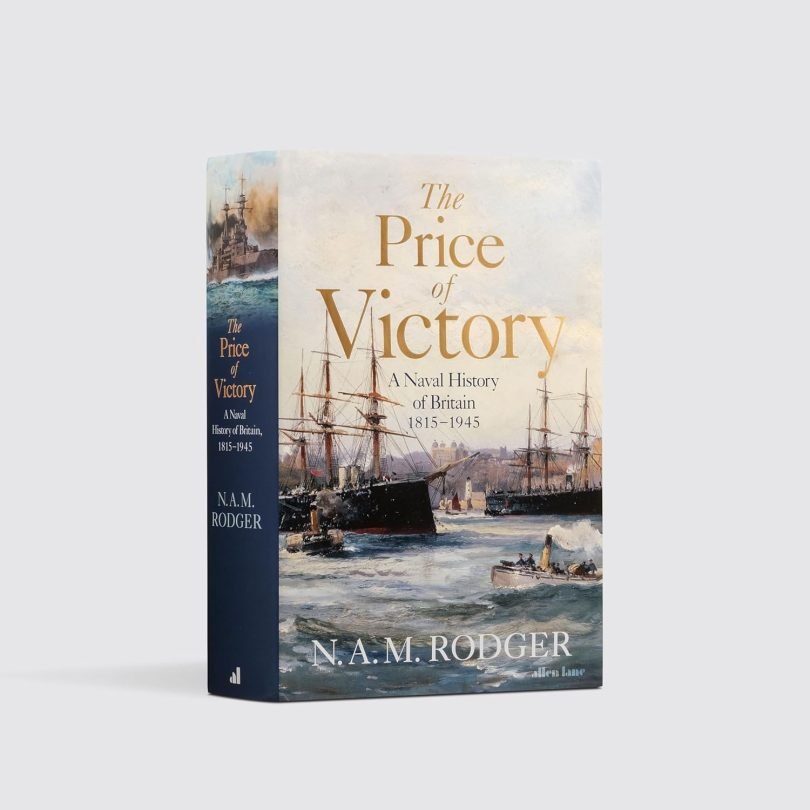

Twenty year ago, N. A. M. Rodger published The Command of the Ocean, the second volume of his naval history of Britain, bringing the story up to the end of the Napoleonic Wars. Now, finally, we have the concluding volume of a magisterial trilogy that covers almost 14 centuries – from 660 to 1945 – and has taken the author, our foremost naval historian, more than four decades to produce. It was, readers will be pleased to hear, worth the wait.
Once again, Rodger deploys the same structure, subdividing the book into four recurring themes: Policy and Operations; Government and Administration, including technical and industrial support; Social History; and Ships and Weapons. The end result, for which he makes no apologies, is that nearly half the book is devoted to the background rather than the foreground of naval history which, for most readers, is war at sea. ‘This is quite deliberate,’ writes Rodger, ‘for there is no understanding battles and campaigns otherwise.’
Rodger’s overarching thesis is that Britain ‘rose during the nineteenth century to a commercial and financial supremacy which depended on the command of the sea and the merchant fleet to exploit it’. This supremacy was challenged in the first half of the twentieth – notably in both world wars – by new enemies and weapons which were ultimately defeated, ‘but at a high price that weakened the national economy thereafter’, hence the title of concluding volume.
One of the chief values of Rodger’s approach – breadth as well as depth – is that he is perfectly placed to explode myths. Hence, we learn, on the very first page, that very little of the popular view of Britain in the nineteenth century – the ‘superpower of the age, bestriding Europe and the world with its mighty empire and its unchallengeable industrial supremacy – was true in 1815. Instead the four victorious Allies – Austria, Prussia, Russia and Britain – were ‘about equal in military strength, but the British had far the largest fleet’. The industrial revolution, moreover, was in its early stages and, as yet, contributed relatively little to British economic growth. We relied instead on trade, and were a ‘warehouse of the world rather than a workshop’.
As for empire, British statesmen tended to avoid it. The experience of Napoleon Bonaparte and, before that, the catastrophe of the American War of Independence, had taught them that ‘trade and prosperity could be had without taking on the thankless burden of governing overseas territories’. Most of the conquered colonies of France and the Netherlands were, as a result, handed back in 1815, with only a small number of key naval bases – Malta, Ceylon and the Cape of Good Hope – retained.
British naval power was used to support trade. The anomaly, for which Britain is still denied due credit, was the use of the Royal Navy to suppress the Atlantic slave trade (which we had abolished, much against our economic interests, in 1807). ‘In a free trading world,’ writes Rodger, ‘British goods, British capital and British merchants were still linked in many ways with the slave economies, but the profits now went elsewhere, and Britain reaped nothing but opprobrium for its [anti-slavery] efforts.’ By the late 1840s, as a result, the anti-slavery campaign was facing collapse. But strong British public support for this moral crusade made it impossible for any government to abandon the effort. From 1816 to 1865, notes Rodger, the British anti-slavery effort cost an average of £250,000 a year, and at its peak in 1845 employed 4,445 men and cost £490,500, 13 per cent of the navy’s manpower and budget. Eventually the pressure told. One after another, the slaving nations outlawed the practice until, by 1857, only Cuba and the United States were still importing slaves across the Atlantic in large numbers.
Naval power was a major factor in the only large-scale ‘European’ war of the nineteenth century – the so-called Crimean War, but more accurately the Russian War, says Rodger, because it involved multiple campaigns spread over thousands of miles of land and sea – sparked by the Russian attempt to capture Constantinople, the capital of the Ottoman Empire. Sadly, the Admiralty had no effective mechanism for forming war policy, the First Lord Sir James Graham was ‘allergic to responsibility and preferred to give hints rather than orders’, and the admirals were left to squabble over strategy. The end result was a protracted siege of the Russian naval base of Sevastopol in the Crimea that demonstrated just how poorly the British army was run: of its 21,000 casualties, only 4,500 were incurred in battle. An unexpected bi-product of the campaign, however – the disastrous Charge of the Light Brigade notwithstanding – was that the British public ‘rediscovered an interest in the armed services and fell out of love with Cobdenite pacifism’.
The big technological change of this era was the gradual replacement of wooden sail ships with iron (and later steel) hulls propelled by steam. For a time there were hybrids: ironclads with sails. But by the 1880s, mastless ships with breech-loading guns – grouped in deck-mounted turrets – were here to stay. The apogee of this technology was the Admiral Sir Jackie Fisher-inspired HMS Dreadnought, launched in 1906, a game-changing battleship that combined speed (from turbine engines), big guns and thick armour, and which at a stroke made all previous battleships obsolete. Germany responded by building dreadnoughts of her own, as did other navies, but the cost was prohibitive and by 1913 it had effectively conceded defeat in the naval arms race.
Some historians have argued that Britain should not have become a belligerent in 1914. Rodger explains why it had no choice: ‘A central fact was that British banks financed a large part of international trade and British ships carried it. Whether as a belligerent or a neutral, Britain could not escape involvement in a general war, and arguably had more to gain and no more to risk as a participant than a bystander.’
The key naval battle was at Jutland in 1916 when Britain’s Grand Fleet clashed with the German High Seas Fleet in the North Sea. Admiral Sir John Jellicoe, the British commander, is typically blamed for throwing away the opportunity to destroy his opponent in a battle that ended in a draw. But Rodger reserves his greatest criticism for Vice Admiral David Beatty, Jellicoe’s deputy, who led his battle cruisers in an ill-judged and chaotic pursuit of his German counterparts, allowing the enemy to gain an early gunnery advantage. Obsessed with rate of fire, Beatty had allowed the removal of many of the anti-flash shutters designed to prevent a fire in a turret from spreading down the ammunition hoists to the magazines, an omission that resulted in three of his ships blowing up during the battle.
Ultimately the German fleet escaped destruction because Jellicoe feared being lured into a destroyer or submarine trap, and chose not to fight at night. But it was far from the decisive victory that the Germans tried to claim. ‘Privately,’ writes Rodger, ‘[Admiral] Scheer and his captains knew very well how close they had come to catastrophe, and the Kaiser was bluntly told that “even the most successful result from a high seas battle will not compel England to make peace”.’
Nowhere is the author’s analysis more incisive than in his survey of Second World War naval operations. Stretched to breaking point by the loss of its major ally France in June 1940, and eventually facing three naval powers in Germany, Italy and Japan, the Royal Navy made a number of early missteps in Norway, the Mediterranean and the Far East (notably the sinking by Japanese planes of the Prince of Wales and Repulse in December 1941). On the other hand, it (and not the small boats, which only saved a few thousand) rescued the BEF from Dunkirk and, with the RAF, discouraged the Germans from invading the UK. The sinking of French warships at Mers-el-Kebir, in June 1940, was necessary ‘to demonstrate to Washington a ruthless determination to fight, and above all to keep the French warships out of German hands’.
Two events saved Britain. The surprise Japanese attack on the American naval base of Pearl Harbor on 7 December 1941 and, four days later, Germany’s quixotic decision to declare war on the USA, thus uniting the European and China wars for the first time. For a time, the near destruction of the British and American naval fleets in December 1941 had dire consequences. Unchecked by enemy naval forces, the Japanese conquered Malaya, the Dutch East Indies and the Philippines in the first six months of 1942.
But the tide turned at the naval Battle of Midway, in June 1942, when the Japanese lost four aircraft carriers to the US Navy’s one. It was a fortunate American victory, but also significant, and one that Rodger compares to Trafalgar. ‘Neither victory won the war, but both defeated dangerous enemy offensives, and significantly changed the nature of naval warfare in the following years.’
The author pulls no punches in his criticism of American admirals. His chief ire is reserved for the erratic and unseamanlike ‘Bull’ Halsey, the commander of the 3rd US Fleet, and the aggressive and overbearing Ernest King, the Commander-in-Chief of the US Fleet. Of the latter, he writes: ‘The fact that such a destructive character, with no extraordinary professional talents and almost no experience of wartime command, was raised to be head of the US Navy and empowered to do it so much damage, does not reflect well on his service or his country.’
Rodger is excellent on all the combatant navies of the war, and reminds us that no sea campaign can be viewed in isolation. They were all linked by the finite resource of Allied shipping (particularly landing craft). In the Atlantic, the depredations of the German U-boat Wolfpacks were eventually defeated by a combination of codebreaking, radar technology, large convoys with destroyer escorts and long-range planes armed with depth charges. But, contrary to Churchill’s fears, the Allies were never in danger of losing the so-called Battle of Atlantic in 1943. ‘In retrospect,’ notes Rodger, ‘it is clear that [Admiral] Dönitz was already losing his “tonnage war” before the end of 1942, and throughout the following year the defensive strength of the convoys was steadily being reinforced.’
From 1944 onwards, and thanks chiefly to America’s huge naval building programme, the Allied navies ruled the waves. Thus was made possible the successful invasion of North-West Europe, southern France, the Philippines and many strategic islands in the Pacific. But Overlord – ‘easily the largest amphibious operation in history, involving 1,931,885 soldiers, 649,554 airmen and 285,000 naval personnel’ – was the daddy.
The financial price to pay for Britain’s belligerency in both world wars was heavy, not least because America had lent money on harsh terms. ‘It is aggravating,’ commented the Economist in 1945, ‘to find that the reward for losing a quarter of our national wealth in the common cause is to pay tribute for half a century to those who have been enriched by war.’
In his epilogue, which brings the story of Britain’s naval history up to the present day, Rodger reminds us that at one point in the early 1950s Attlee’s Labour government was spending 10 per cent of GDP on defence (and proposing to raise it further to 14 per cent). Today, with Britain facing multiple threats, we struggle to reach a figure of 2.5 per cent of GDP. Rodger is alert to the consequences. ‘The question is sometimes asked whether Britain is still a naval power,’ he concludes. ‘It seems more and more likely that our only real question will be whether to fight for ourselves and our friends, or to yield.’
My one tiny regret is that the author did not extend the volume to, say, the Falklands War in 1982, to allow a far more detailed study of the Cold War. That aside, he has produced another tour de force of naval history that, when set alongside the previous two volumes, must be regarded as one of the finest works of historical scholarship of the past 50 years.


