
(This is an edited version of an article first published on The Custodian Substack )

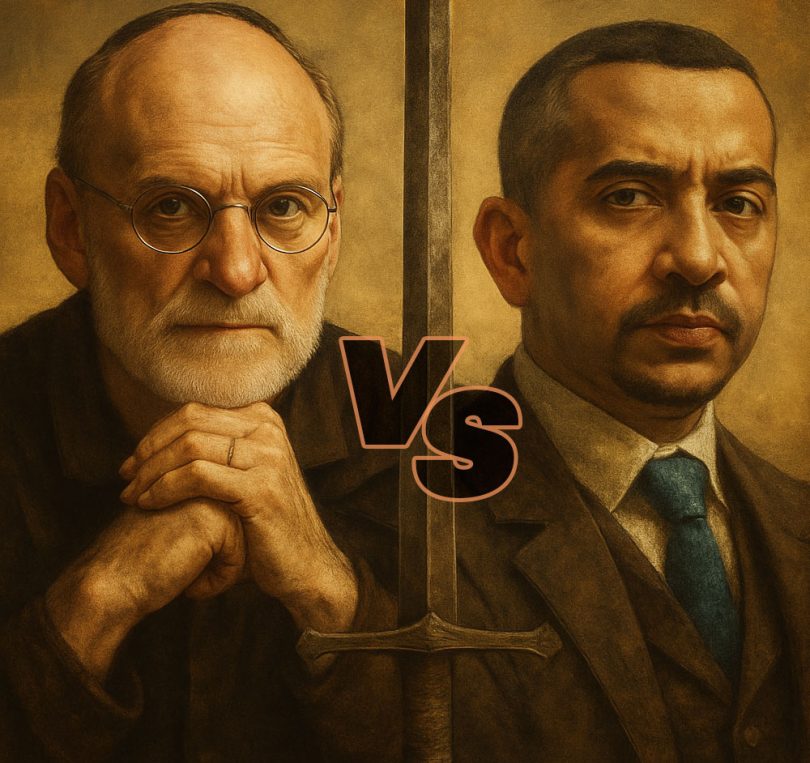
Professor Nigel Biggar and Mehdi Hasan
Earlier this month I attended Al Jazeera’s Head to Head debate, hosted at London’s Conway Hall by the journalist and author Mehdi Hasan. His guest was Professor Nigel Biggar, Lord Biggar of Castle Douglas, who is Emeritus Regius Professor of Moral Theology at the University of Oxford. The discussion revolved around Lord Biggar’s two recent books: Colonialism. A Moral Reckoning (2021) and Reparations. Slavery and the Tyranny of Imaginary Guilt (2025).
It became clear not too long into proceedings that this was less a debate than a hatchet job, with Hasan taking great pleasure ignoring Lord Biggar’s real points, cutting him off mid-flow and constantly finding ways to twist the latter’s words to create some specious link to the next segment of his own seemingly pre-prepared script. From watching some of Hasan’s other “debates” it would appear that being ultra-combative and hostile is his signature style, with his general approach being to caricature rather than to engage open-mindedly with opposing arguments, and to belittle rather than to put genuine questions to anyone who does not conform to his worldview. Partly due to this, there is little point in regurgitating the discussion here, given how one-sided it was.
However, I will attempt to refute one of the superficially clever-seeming but, in fact, false dichotomies presented by Hasan to try and trip up Lord Biggar, because it is this way of thinking that has led to the damaging anti-British rhetoric being pushed in our heritage institutions, among others. Before I do so, let me give the reader some context. Hasan had, throughout the debate, repeatedly been using the pronoun “we”—we did this, we did that—invariably in the context of negative things the British did. The rhetorical sleight of hand is obvious. By conflating the actions of long-dead historical actors with the present-day British public, he sought to entrench the notion of collective guilt, implying that today’s citizens are personally responsible for the sins of centuries past.
So it followed on nicely from this to interrogate Lord Biggar on his use of the phrase “imaginary guilt” in the title of his book about slavery and reparations. Hasan asked Lord Biggar whether he felt pride about the fact that the British defeated the Nazis. ‘Yes’ was the reply. Hasan’s argument was as follows: if we accept Lord Biggar’s premise that we should not as a nation feel guilt for the slave trade because we can only feel guilt for things we did ourselves, but not for the actions of our ancestors, why should we feel proud about things we ourselves did not do?
The refutation is threefold. First, it is natural to feel pride in the victory against Nazism because it is rooted in living memory and personal connection. It is a victory that is woven into family histories and therefore also into the national consciousness. Many Britons, even those in the younger generations, personally knew relatives who fought in the Second World War so we have people we know and to whom we are close to be proud of. By contrast, no living Briton has met a participant in—or, for that matter, victim of—the trans-Atlantic slave trade. Even if some Britons are aware of past links to slavery, we are talking about figures from history rather than people with whom we have any close connection. Moreover, those figures are sufficiently high up the family tree that they will be distant ancestors among countless others: some Abolitionists, some victims (of the slave trade or similar injustices such as indentured labour), some indifferent. Very little is black and white in ancestry, as any genealogy fan will confirm.
This leads on to the next argument against Hasan’s trick question. Not every British family had a link to slavery. Working-class families not only did not profit from slavery but themselves endured historic wrongs and privations, suffering from unfair practices that lasted long after Britain had ended its involvement with transatlantic slavery. How about the many abolitionist families, who went against the grain to fight against what they saw as an abhorrent practice and whose determination led to the ending of slavery? Not to mention that, as Hasan would be the first to remind us, we live in a multi-cultural nation with first, second and third generation immigrants from all around the world whose families almost certainly did not benefit from transatlantic slavery. Why should any of these people be forced to feel guilty about, apologise for or—most unfair of all—pay reparations to people whose distant ancestors were slaves?
As an aside, I had wanted to put this question to Hasan in the Question & Answer session in response to his implication that British citizens should compensate the supposed victims of slavery—I would argue they are long dead—through sizeable reparations. I am myself, on my maternal British side, descended from abolitionists including Sir Thomas Fowell Buxton, one of six great abolitionists in whose memory the Buxton Memorial Fountain was erected in Victoria Tower Gardens adjacent to the Houses of Parliament. On my father’s side, I am fully Ethiopian. I struggle to see any reason whatsoever why I should feel guilt about an episode in history (however tragic and harrowing) with which I have no connection, let alone why my hard-earned wages should be confiscated to buy forgiveness for a crime that neither I nor anyone I know in my family committed.
But there is also another argument which goes beyond blood ties and ancestry, and therefore makes the previous two redundant. The central reason why Hasan’s question is a false dichotomy is the following: pride and guilt are not symmetrical. Pride is aspirational, binding a community together around achievements that inspire. Guilt is moral, requiring personal responsibility. To conflate the two is sophistry.
It is possible that Hasan does not see the intrinsic value of national pride because he considers himself to be a global citizen (he holds American-British dual citizenship) or because, as his earlier writings and speeches suggest, his overriding allegiance is not to a nation but to his religion, Islam. In a 2009 sermon, for example, he disparaged non-Muslims, describing them as “the kuffar, the disbelievers, the atheists who remain deaf and stubborn to the teachings of Islam, the rational message of the Quran”. While he later apologised for his words, albeit over a decade after the event, he still appears to hold a deep disdain for the West.
Nevertheless, it is one thing for a mere individual to express anti-British sentiment, but rather more disappointing when that individual happens to be a British broadcaster addressing a public audience in London.
What is more troubling is the way this rhetoric has seeped into our museums and heritage bodies. Institutions which were established for the enjoyment and education of the British public now appear intent on guilt-tripping visitors, parroting the same arguments that Hasan used. Instead of celebrating Britain’s achievements—artistic, scientific or cultural—they dwell obsessively on its failings, often stripped of context. This is not history but indoctrination. National institutions should take care not to become vehicles for ideological activism. Their remit is to preserve and present heritage, not to impose shame.
A healthy measure of national pride is essential for cohesion. Pride unites; shame divides. Hasan’s double standard was glaring: he invoked “we” and “our” to implicate Britain in every conceivable wrong, yet dismissed the legitimacy of pride in its triumphs. That is not patriotism but hostility masquerading as moral seriousness. Lord Biggar was right to insist that guilt cannot be inherited. To demand otherwise is to impose a tyranny of imaginary guilt—a tyranny that corrodes civic confidence and undermines the very possibility of shared national identity.
We should resist this. We should lament the horrors of slavery, as we lament all human suffering, but lamentation is not the same as inherited culpability. Heritage institutions should not be co-opted into ideological crusades and national pride must not be sacrificed on the altar of perpetual shame. We want good things to unite us, not bad things to divide us. Pride in our nation’s achievements is not only legitimate but necessary. Without it, Britain risks surrendering its heritage to those who would rewrite history as a litany of sins, and its future to those who would deny the value of belonging altogether.
Zewditu Gebreyohanes is the Editor of The Custodian Substack and a Deputy Editor of History Reclaimed.
Readers are encouraged to visit The Custodian which focuses on matters concerning British national cultural heritage.
Readers can watch the debate for themselves on Al Jazeera at 5.30 pm on Thursday 4th December 2025
https://www.jiotv.com/live-channel/al-jazeera/494/head-to-head/251204494031
—