


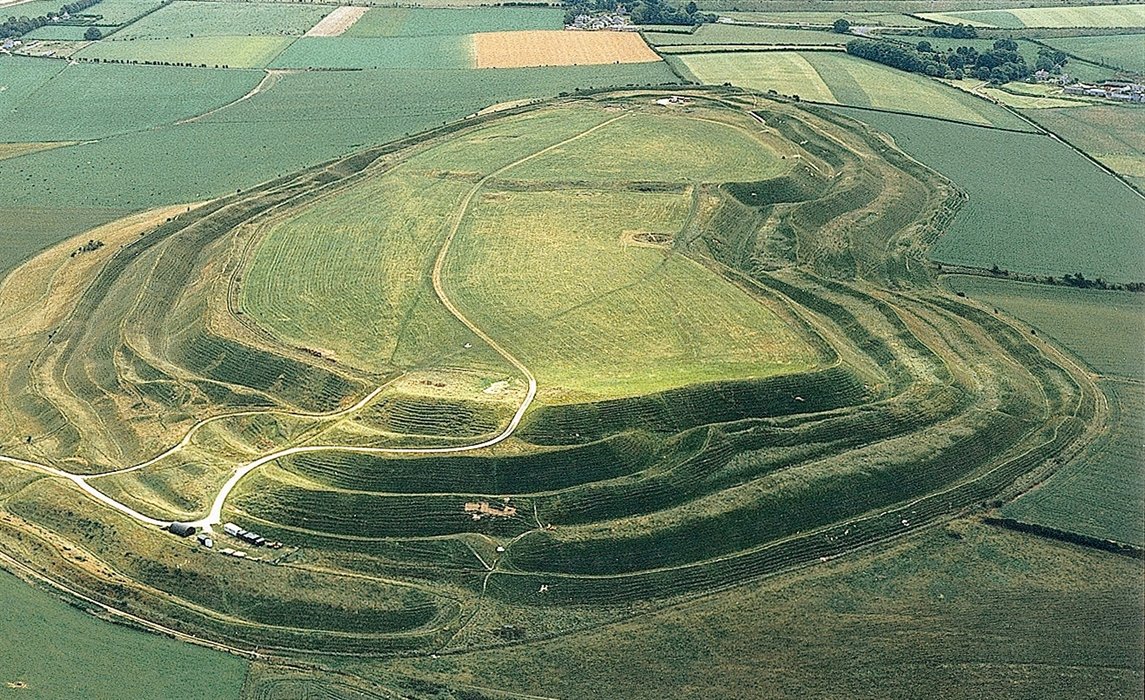
Maiden Castle near Dorchester in Dorset in one of the finest surviving Iron Age sites in Britain, comprising terraced earthworks on an impressively large scale in a landscape of great natural beauty. It was excavated in the 1930s by the archaeologist, Sir Mortimer Wheeler, who, on finding human remains in a burial site there, declared them to have been the victims of the Roman invasion, killed defending their fortress. Several of the skeletons uncovered showed incontrovertible evidence of violent death.
Wheeler’s invasion story was speculative and has been disproved by the discovery of more burial sites and human remains of both sexes, and of the young as well as the old, across Maiden Castle. The story is in some ways worse: ‘three-quarters of the late Iron Age individuals buried around the site – not just those in the ‘war cemetery’ – had met a violent death’. It is likely that some of these people died fighting one another in the pre-Roman period, in addition to those who perished fighting Romans. It should be added, however, that no other Iron Age site in the vicinity of Maiden Castle has as much evidence of violent death.[i]
Maiden Castle came to mind when examining a teaching programme for primary school children that was brought to the attention of History Reclaimed by a concerned reader. Called ‘Chatterpast’, it is designed to develop ‘Tolerant Futures through Ancient Identities’.[ii] It was created in 2022 by academics – rather a lot of them – from the Universities of Edinburgh and Durham, with funding from the UK Arts and Humanities Research Council ‘in partnership with nine heritage museums and sites across Britain’, among them the National Museum of Scotland, Vindolanda and the Roman Army Museum in Northumberland, and Leeds Museums and Galleries.[iii]
Children learn via an interactive website where they encounter seven different young people who have been created to exemplify the diversity of life in late Iron Age and Roman Britain. Each has a carefully-crafted back story. Their families, localities, interests, occupations, and attitudes have all been filled in to bring the history to life. But to what end has this resource been created? It certainly isn’t to teach children the history of this period and interest them in what really happened, as at Maiden Castle.
Remarkably, the academics who have designed this resource are perfectly honest in the very long explanatory document they provide. It’s not really about history at all but about ‘tolerance’.
This guide is intended to help both Primary teachers and heritage educators to discuss tolerance through presentations of the Iron Age and Roman pasts that challenge entrenched, binary ideas about these periods. We hope that this approach will encourage discussion and reflection about how our experience and understanding of the past influences the ways in which we perceive ourselves and others in the present. How can we work towards more inclusive ideas of the other [sic ‘the other’] starting from more ethical and nuanced encounters with the past at an early age?
The resource and its guide ‘are intended to help educators introduce children to the concept of tolerance through non-divisive and less binary storytelling about the Iron Age and Roman periods’. Roman legionaries stabbing rebellious Britons with their famous short swords are most definitely out.
The guide begins with a discussion of ‘concepts of tolerance’ rather than any history. As children work through the resource they encounter characters who ‘talk about their lives and experiences, demonstrating curiosity, empathy and tolerance in engaging with ‘difference’ and other ways of being, living and thinking’. These Iron-Age people ‘have complex and multi-faceted identities’. They ‘reflect a degree of diversity, by presenting differences in gender, appearance, ability, interests, origins and inclinations’.
As for the teachers, they are sternly instructed in the words they may use in an appendix entitled ‘Using Ethical Language to Talk about the Past’. Note that: not ‘historical language’ as in terms that might be academically valid, but ‘ethical language’. ‘Ancient Britons’ and ‘Romano-British’ are out. Better to talk of ‘peoples’ than of ‘tribes’. Calling someone a ‘slave’ is ‘demeaning and strips away their humanity’. The term “romanisation’ has ‘colonial connotations’. As for ‘primitive’, don’t even think about it.
I could go on.
It is unclear how many schools use this material. But what is abundantly clear is that this is not History. It makes no attempt to teach children what we know about the period of Roman invasion and colonisation or introduce them to the evidence we have of that process. Instead, this complex resource invents vehicles to be used to indoctrinate children in approved values. We might agree that tolerance is indeed a virtue. But might it not be better taught and discussed in lessons on bible stories, or what used to be called ‘PSHE’ (personal, social and health education), or just in informal class discussion, than in the fictionalisation and falsification of History?
Most amazing of all is that so many academics and educators involved in this project, and those doling out public money from the AHRC, don’t seem to see what’s wrong with the manipulation of the syllabus and hence of children’s minds. History is the study of the past, not of approved social values. Should we teach the virtues of diversity through Physics, or of inclusivity through Chemistry? The loss to the children of not learning real History is evidently inconsequential to all the people involved in funding and making this resource.
Reinvent history online, at public expense, if you will. But the evidence buried in Maiden Castle can neither be reinvented as something else, nor ignored.


