

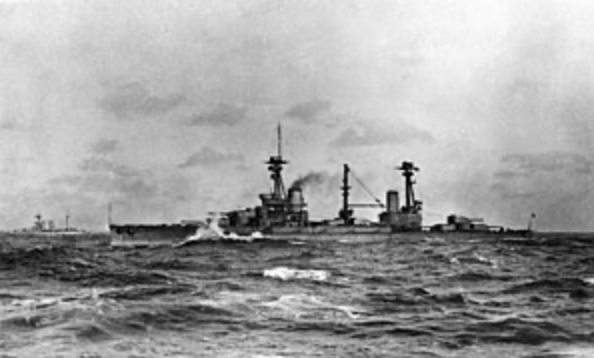

The recent controversy surrounding the renaming of the submarine that was supposed to be HMS Agincourt made me wonder what I would find if I looked at The Times issue which came out on 25 October 1915, the 500th anniversary of the battle. The interesting thing, however, is what I accidentally found on my way there in the issue of 5 August 1914. On page 6, a short report entitled ‘Additions to the fleet — Turkish and Chilean vessels taken over’ says:
“The Secretary of the Admiralty announces:— His Majesty’s Government have taken over the two battleships, one completed and the other shortly due for completion, which had been ordered in this country by the Turkish Government, and the two destroyer-leaders ordered by the Government of Chile. The two battleships will receive the names Agincourt and Erin, and the destroyer-leaders will be called Faulkner and Broke, after two famous naval officers.”
It is not on the decision’s legality or morality that I invite you to muse in this short letter. Rather, it is the fact that the renaming took place after war had broken out between Great Britain and France on the one side and Germany on the other. The Liberal government of Mr. Asquith had no qualms about giving a British ship a name of which no Frenchman could have any reason to be overly fond.
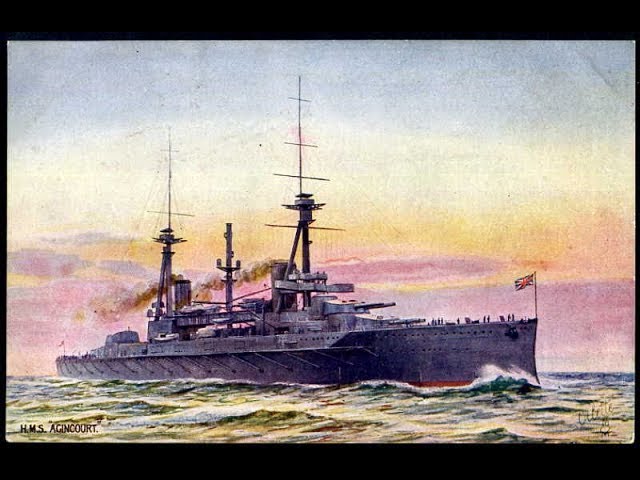
HMS Agincourt on a picture postcard prior to British modifications
It could, of course, be argued that the French had more need of their British ally in 1914 than the British had of the French, and that Marianne was accordingly in no position to cavil at the patriotism of John Bull, particularly when any miscalculation on the Marne would have been able, without effort, to make her forget even his more recent bullying at Trafalgar. (What, by the way, will become of that unfortunate square, with its unfortunate column, in London now?) It could also be usefully added that the new name had to be sufficiently inspirational to bring out the best in all those boys who would be manning the new ship, and whose fault it could hardly be if the tale of one country’s triumphs shared so many incidents with that of the other’s debacles. Presumably, therefore, the editor of The Times put it best when he said in his editorial on the quincentenary of the battle that
“Our French friends and allies understand our pride in Agincourt, as we understand their pride in the feats of Joan of Arc. These memories on both sides serve but to stiffen our resolve in the fray that is upon us to prove ourselves worthy of the blood of which we come.”
Does not the government of this country offer its counterpart across the Channel the ultimate insult when, in seeking to appease the unruffled, it fearlessly implies that the people of France are no longer as charitable as they used to be?
I am, Sir, your obedient servant,
Bilal Haider Junejo, LLB LLM (Lond) CertHE (Oxon) AdvDip (Cantab).
Part of the Bilal Haider Junejo letter series:
Letter 2 of 3: Sla(v)es: A thought concerning the foremost implication of a demand for reparations.


