

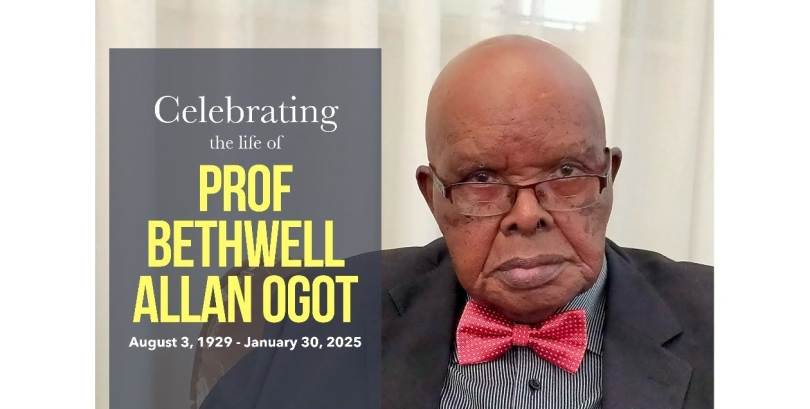

Kenyans mourn the late Bethwell Ogot as one of their founding intellectual fathers. They are right to do so and they are not alone. He is remembered with equal respect in the wider world. In 2001 the American African Studies Association (ASA) honoured him as a Distinguished Africanist. They continue to award an annual Ogot prize, founded in 2012, for the best new book in East African studies. In public the British have so far been more restrained. More privately, I know I speak for many in recording our admiration, our affection, and our debt to Bethwell Ogot.
Ogot’s intellectual hospitality was rooted in his trust in the disciplinary power of historical method. This, in his view, required of all serious historians, no matter what their origin, the same rational distrust of all evidence. Neither the nationality nor the gender of the historian mattered. It was enough that she or he stuck to the discipline, tempered by the sympathy of which, again, all people are capable. None of us, he believed, could claim any superior understanding of a particular people or situation in the past; all pasts are strange to all who come after. None could re-enter even their ancestors’ world; the context would be foreign however familiar it seemed.
Time changes all contexts; no context is ever repeated. Nor are there timeless characteristics. Indeed, the most alien pasts may be those that are supposedly our own; they have more expectations of familiarity to betray. All in all, therefore, anybody, so Ogot assured us, may study any past. Africans can as well study European history as Europeans study African history, gays may study straights, straights gays; women may characterise kings, men understand queens. Rigorous historical method, the constant awareness that one may have failed to grasp inner meanings, together with human sympathy, should get the better of ignorance, preconception, and prejudice. Nobody, finally, can claim to own any part of the past, let alone fence out competitors.1
As a member of an imperial nation (and, in the late 1950s, a former practising imperialist when serving as a conscript junior officer in the King’s African Rifles) I warm to Ogot’s awareness of imperialism’s inescapable contradictions. There was always an inherent racism that, for instance, deliberately tried to humiliate the research student Ogot and his new wife Grace when they were looking for a flat in London.2 On the other hand, Ogot repeatedly records the unselfish, tutorial rather than paternalist, devotion with which individual Britons tried to open up future opportunities for their African students.
He first became aware of this responsible aspect of the imperial relationship as a boy, when seeing the work of Olive Owen among Luo women. She is still remembered as mikayi, the wife of Archdeacon Owen who was himself nicknamed the ‘Archdemon of Kavirondo’ by white settlers angered by his championship of African interests (My Footprints in the Sands of Time, 18). Ogot was most conspicuously grateful to Carey Francis, legendary headmaster of the Alliance High School in the 1940s and ‘50s. Francis was both big and humble enough to admit in front of the school that his own, now outdated, mathematical method was inferior to the newer method taught by his junior, the recently recruited African maths master (Footprints, 60-65, 70-73, 93, 86). In his autobiography Ogot is similarly appreciative of others who were driven by their proper concern for the uncertain future awaiting an African student or junior colleague. He remembers, in particular, Professors Roland Oliver at London’s School of Oriental and African Studies (SOAS) and Kenneth Ingham at Makerere (Footprints, 49, 86-7, 95-6, 99-106, 131).
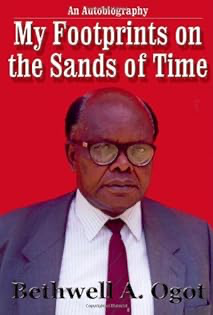
Ogot’s ability to appreciate the liberal humanity of individual Britons, despite his often insulting encounters with other Europeans more anxious to assert their insecure sense of racial superiority, stemmed from his own humane intelligence. He had a wonderful capacity to appreciate the equal value of both the local and the global, both inherited and acquired knowledges and culture, both oral and literate wisdoms. He saw the need to steer between the twin arrogances of Eurocentrism and Négritude (Footprints, 538-9). He constantly strove to create a teaching curriculum that imparted respect for both African and global history. Neither, he felt, could be fully understood without the other.
My reading of his autobiography, My Footprints in the Sands of Time, leads me to believe that Ogot’s concern for a creative balance between ancestral wisdoms and those of strangers followed from his youthful enthusiasm for English literature and European history more generally, and his reciprocal determination to see that, while they enlightened him, they would never dominate his thoughts. In 1946 he entered Maseno School at the impressionable age of 17. It was there that he ‘discovered the beauty and wealth of English literature.’ He ‘voraciously read’ nineteenth-century novelists and poets; Shakespeare ‘really captured [his] soul’ and entered his ‘everyday vocabulary’. Still more importantly, Ogot the teenage scholar was not only bewitched by the literature but remained critically alert enough to realise that his beloved poets and novelists, not least Dickens, portrayed an England that was nothing like as idyllic as the England taught by his history teachers. Ogot already had the historian’s ability to discern underlying, perhaps darker, truths beneath the often-glittering surface of publicly available evidence. The schoolboy questioned the self-interest of his sources long before receiving any professional training in the historical method on which he since placed such importance.
The evidence to which the young man applied his critical mind at Maseno was imperially British. When going on to Makerere and St. Andrews University in Scotland, Ogot continued to cherish ‘a rich and varied Western intellectual menu, especially the philosophical and historical debates. I soaked myself in Western philosophy from Socratic dialogues to Logical Positivism.’ (Footprints, 539) Upon receiving a Litt.D., honoris causa, from Kenyatta University in 1995, he called for the University to be full of the ‘intellectual ferment’ that in the Poland of the sixteenth century had inspired Nicolaus Copernicus to insist on a heliocentric universe. Ogot continued in this globally ecumenical vein to exhort Kenya’s scholars to share the spirit of adventure shown by the seventeenth-century English scientist Isaac Newton, who had imagined himself as a boy playing with pebbles on the seashore ‘while the great ocean of truth lay undiscovered before me.’
That is the point. Only a broad perspective could make it thinkable for African history to be world history and world history African. Ogot was entirely consistent. When in 1957, at the age of 28, he received a colonial government bursary for the fourth year at St Andrews that enabled him to take a BA Honours degree, he was ‘determined, in the words of the University motto, “Ever to be the best”, and not to put to shame the lineage of which I came’ (Footprints, 85). The two ambitions, widely global and intimately local, reinforced each other; they did not clash. After years spent poring over printed texts in university libraries Ogot went on to justify the use of oral tradition in his SOAS doctoral research into the precolonial history of the Kenya Luo. Like virtually all other Kenyans, they had spent centuries living nowhere near Kenya. He asked why anyone should think oral history strange or second-rate: after all, the historians of early medieval England also had to rely on the oral traditions set down in the Anglo-Saxon Chronicles.3
The methods of African history were not suspiciously untried but reassuringly proven by age—if, again, African history was also world history. In Ogot’s view the world was full of equivalents, some clearly significant, some not so obviously so. The Anglo-Saxons were almost certainly of less importance to early medieval Europe than the Luo peoples were to the changing history of precolonial East Africa. But this did not diminish the Saxons’ significance for African historical method.
Ogot was similarly insistent that only widespread, all-inclusive history was good enough for teaching the history of their migrant nation to Kenya’s young. It had to be a history that not only did the obvious in stressing African as much as European achievement, precolonial as much as the colonial past, but also, less obviously but every bit as importantly, had to be about every Kenyan, not just the most powerful or articulate (Footprints 145-159).
To conclude, this insistence was most provocative of constructive debate when, at Atieno Odhiambo’s and my invitation, Bethwell contributed his thoughts on what constituted Kenya’s nationalism and nationhood to our collection in 2003 on Mau Mau and Nationhood.4 Ogot was clear that those who took to the forests of Nyandarua and Mount Kenya were never the only heroes of freedom; nor was their memory alone sufficient to build what would always be a multicultural nation of immigrants. The ‘national project’ had to be capacious, with plenty of respectful room for all of Kenya’s many culturally creative nationalisms, all of them seeking some mastery of global, no less than colonial, modernity. Among these political groups were South Asian Kenyan trade unionists, journalists and lawyers, products of global history, just as most of Kenya’s migrants had colonised their trails across wide swathes of African history, both eastwards around the continent’s equatorial forests and southwards up the River Nile.
To insist on the teaching of African and world history in the school and university curriculum, as well as Kenya’s many-stranded national story, marks Ogot as not so much a nationalist – his natural inclination – but as a citizen, a more demanding consciousness. As an enquiring man of the world, his familiarity with its many histories of struggles for freedom made him more than a nationalist—a convinced, sternly critical, patriot, demanding that Kenya prove itself worthy of its international sovereignty.
Professor John Lonsdale is a Fellow of Trinity College, Cambridge
Notes:
- Bethwell Allan Ogot, ‘Who, if Anyone, Owns the Past? Reflections on the Meaning of “Public History”’ (Kisumu: Anyange Press, 2010), 20-21.
- 2Bethwell A. Ogot, My Footprints in the Sands of Time (Kisumu: Anyange Press, 2003), 106. Future references to this autobiography will be in parenthesis as Footprints and page number.
- B. A. Ogot, ‘Oral traditions and the historian’ in Merrick Posnansky (ed.), Prelude to East African History (London: Oxford University Press, 1966), 140-48; idem, History of the Southern Luo, Vol I: Migration and Settlement, 1500-1900 (Nairobi: East African Publishing House, 1967), 17-18.
- Bethwell A. Ogot, ‘Mau Mau & Nationhood: The untold story’, chapter 1 in Atieno Odhiambo and John Lonsdale (eds), Mau Mau and Nationhood: Arms, authority & Narration (Oxford: Currey; Nairobi: EAEP; Athens OH: Ohio University Press, 2003), 8-36.


