


Dear Sophia, Emily and Sarah,
Thank you for reading my articles about the Benin bronzes, and for your interesting questions. Before answering those, may I make some points?
Research:
There is no better guide to the controversial bronzes, and background to the restitution debate, than Barnaby Phillips’s book “Loot”. He’s an honest reporter, formerly the BBC’s West Africa correspondent, and his book is the result of prodigious original research and interviews.
One of the questions Phillips settles is that in 1897 when the British expedition took brass, wooden and ivory items from Benin – today lumped together as the “Benin bronzes” – these were legally spoils of war, and not illegal loot. It was the Oba’s troops who attacked first, massacring an unarmed British expedition in January 1897, to which Britain responded with a naval expedition the following month.
The Kings of Benin:
The hereditary Obas (kings) of Benin ran a violent regime, propped up by a small group of hereditary Chiefs (in some senses the Oba was their puppet, a situation that continues today, though not mentioned. His Chiefs, not the Oba, ordered the massacre of the January 1897 expedition, which is why the defeated chiefs were executed and the Oba was not). Successive Obas controlled all trade, including the sale of human beings, mainly captured from neighbouring tribes. Their reign of terror was underpinned by regular massed human sacrifices. They kept their Edo people illiterate and were selling slaves before the first Europeans arrived, and continued doing so for many decades after Britain enforced its ban on the trade.
Arrival of the British:
For evidence of how much the Edo preferred British colonial administration to the deposed Oba’s regime, consider what happened: nothing. There were no mass revolts, and Edo people could trade, they received healthcare and education, the rule of law and human rights. Far from leading any revolt, the Oba’s warlord Ojo Ibadan, who had led the attack on the January expedition, went on to serve with distinction in the British colonial forces. The British colonial system wasn’t perfect, but for the vast majority of the Edo it was an improvement on the previous regime.
Vanishing bronzes:
Benin artefacts recently restituted to Nigeria have been vanishing. Not only has there been no stock-check of the world-class Benin collections bequeathed to Nigeria at independence in 1960 – and many pieces appear to have been stolen – but Nigerians have little interest in visiting their museums, which is why they are so dilapidated, with such poor security. German TV crews, interviewing people in the street in Benin, found them far more interested in scratching a living in a deeply corrupt country, and in what a Benin bronze might be worth in cash, than in going to look at one in a museum.
Do artworks have a right to be seen?:
My own view is that when unique works of art and craft have survived for many generations, and are judged to be worth displaying in museums and galleries, it is arrogant of today’s generation to think it has all the answers: what these pieces mean, who should be allowed to see them, whether future generations might come to other views. In short, I believe that over time artworks acquire something like a soul of their own, their own right to exist and to be seen. Certainly not to be made to vanish, as the Nazis did to art, books and Jews.
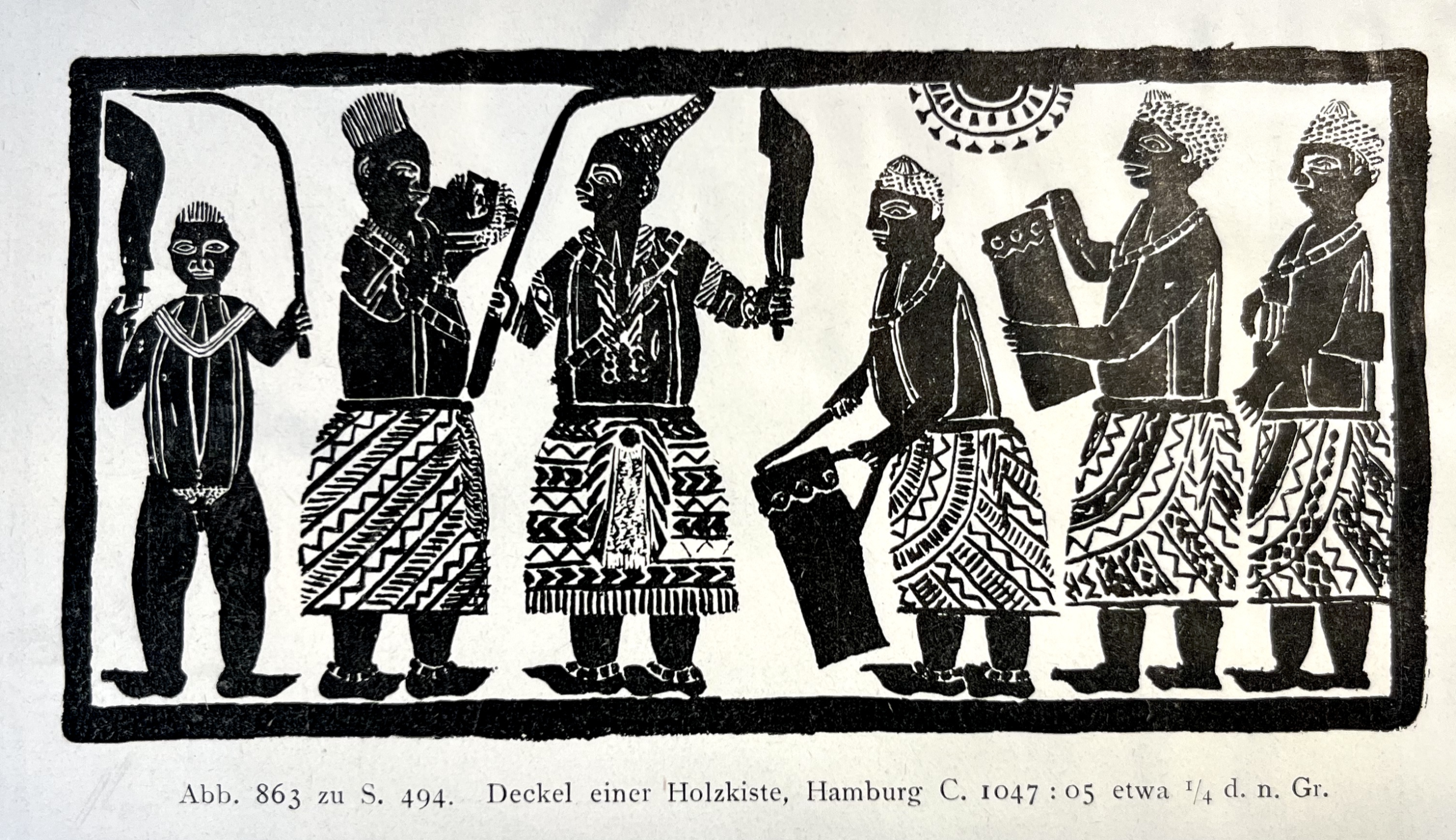
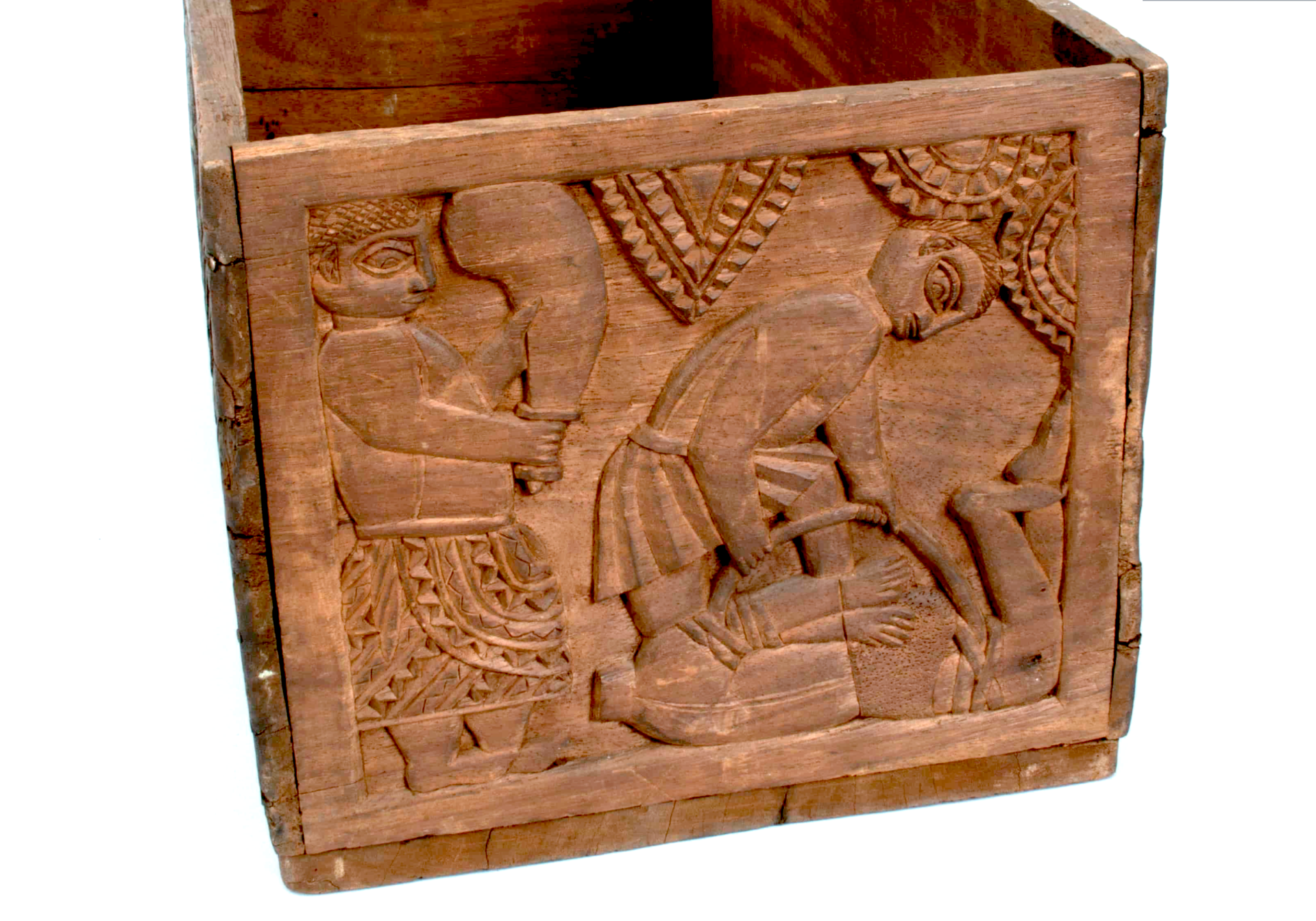
Celebrating Murder. The Museum am Rothenbaum – Kulturen und Künste der Welt in Hamburg (known as MARKK) censored this lid of a carved wooden box from Benin. Only a rubbing from a 1919 book is available. Second left, an executioner brandishes the head of a human sacrifice: each side of him are swords of the type described below. The following photo of one end of the box shows the female victim’s bound and headless body.
Preserving evidence:
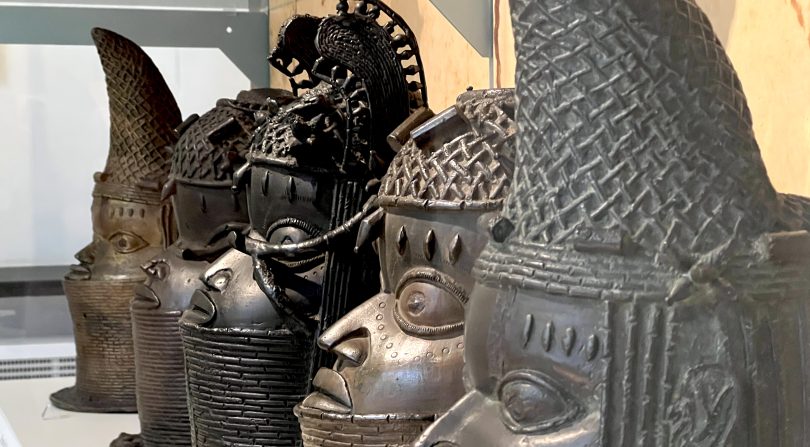
The Benin bronzes are physical embodiments of the trade in human beings, many of them having been cast from the brass ingots with which slaves were purchased from Benin. So it is our duty today to preserve and display this physical evidence of a vile trade – for which Benin’s rulers have never apologised – for present and future generations to learn from.
So arrogant are some museum managers that the director of MARKK Museum in Hamburg – the Museum am Rothenbaum – Kulturen und Künste der Welt, founded in 1879, and one of the largest museums of ethnology in Europe – tried to suppress an image from Benin, carved into a wooden box, showing a ceremonial human sacrifice. Is this physical evidence of a murderous regime, now that it’s been handed over to Nigeria, likely ever to be seen in public again?
————
Now to your questions:
a) “Nigeria has failed to look after the Benin Bronzes it has and shouldn’t be given any more, says top Swiss enthnologist”. Why did you choose to write this article, [or rather] this translation of an interview, about Brigitta Hauser-Schäublin?
(That headline was the editor’s, not mine, incidentally). The late Professor Hauser-Schäublin was one of the few, and most influential, European protesters against German politicians’ rush to purge their country’s museums of their Benin collections.
Personally Hauser-Schäublin was no right-winger; on the contrary, she appeared sceptical of capitalism. But she was an original, thorough and truthful researcher. It was she who pointed out that Germany’s initial handover of Benin bronzes coincided with the first large shipment of Nigerian Liquefied Natural Gas to a nation suddenly deprived of Russian gas; it was she who reported the MARKK director’s censorship (see above), it was Hauser-Schäublin who realised Swiss museum managements had been conspiring for years to purge their museums of Benin artworks. Her death in 2025 was a great loss to the academic community.
Another of Prof. Hauser-Schaüblin’s discoveries was the extraordinary account by the Oba’s warlord Ojo Obadan of his massacre of the January 1897 expedition, widely published in 1899 and then, it seems, completely forgotten. It’s a rare narrative because his account of hand-to-hand combat with Captain Boisragon, one of the two British survivors, exactly matches the account of that fight which Boisragon gave in his own book. (My father’s cousin was a Battle of Britain Hurricane pilot who survived being shot down by the Luftwaffe ace Adolf Galland – who also survived WW2, after which the two of them became great friends!)
b) “The Scandal of the Benin Bronzes”
How would you explain the rush of restitution when the history of the Benin Bronzes is so controversial?
Politically-motivated museum managements imagine that by “decolonising” their collections they can rearrange history, while, happily for their careers. also demonstrating their personal virtue. They try to impose today’s assumptions and values on events and people of the past which they don’t understand, and without considering that future generations may have other ideas.
Prof Hauser-Schaüblin deplored the simplistic “perpetrator/victim narrative” of many of today’s museum professionals: there’s a perceptive article about her approach to her discipline, Ethnology, and her attitude to restituting the Benin bronzes, here:
https://backend.uni-heidelberg.de/en/documents/bblhauser-schaublin/download
c) How can it be that so many people, museums and politicians want to restitute the Bronzes while the descendants of the slaves, that were sold by the Oba, try to stop it? Isn’t that a contradiction?
Indeed it is a contradiction, and an embarrassing one for the restitution lobby in the west. However. while descendants of enslaved people want to preserve and display this physical evidence of the trade in human beings, their campaign has been somewhat derailed by cash reparations offered by, for example, the Church of England – best not to rock the boat, and go after the money. The American word for this is grifting, we don’t really have a word in English.
d) You also mentioned in your article that you were on a photographic assignment in Nigeria: what kind of impression did you get on the whole Benin Bronzes topic? Did it change your opinion in any way? And do you think the Bronzes are safe in Nigerian museums?
In 1978 I was commissioned, as an independent press photographer but sponsored by the Nigerian government, to shoot a wide-ranging coverage of the country – showing how its cascade of new oil wealth was being put to use. Having seen the British Museum’s collection of Benin bronzes, I was keen to see the national museum’s collection in Benin.
There was some difficulty about this, and when I did get into the “closed” museum I understood why. As a curator explained, the collection was being steadily looted by the government, which collected a bronze whenever it needed a gift for some dignitary. At the time I merely tucked away the knowledge – worse things were happening under Nigeria’s military dictatorship – but decades later I was amazed by Nigeria’s demands for restitution from foreign collections, on the grounds that this was Nigeria’s “heritage”. Why not start by tracking down the pieces Nigerians had recently stolen from themselves?
As to whether Benin pieces are safe in Nigeria’s museums, see the multiple examples of theft in “Loot”. Items returned today may be briefly displayed to the press before vanishing into locked store rooms, or they’re quietly presented to the current Oba. They’re not available to ordinary Nigerians, nor to the rest of the world, and certainly not to the slaves’ descendants abroad who consider them to be “blood metal”.
Also, there are Muslim fundamentalist insurgents in the north of Nigeria, to whom any human or animal representation is haram. They would melt down any Benin bronzes they could lay their hands on – see the Bamiyan Buddhas in Afghanistan, Palmyra in Syria, Mosul and Nimrud in Iraq. No, there’s no guarantee Benin bronzes are safe in Nigeria.
e) On the Benin Bronzes restitution debate, you’ve written multiple articles critical of the Benin Bronzes restitution campaign. What first drew you to this topic, and what do you think the mainstream media gets most wrong about it?
I realised that I had, from personal experience, a point of view that was not being published: so I started to research and write. As to mainstream media, publishing the full history and not just a partial account would be a good start. Slavery still exists, sometimes in other guises, and we should learn from the past.
f) On [the Cambridge museum’s] provenance evidence: you argue the provenance documentation for many of the 116 items is too weak to justify a handover. What standard of evidence do you think should be required before artefacts are returned?
“Evidence” compiled by the Cambridge museum would never have survived being tested in a court of law: too much guesswork. This was a charade, to justify an already-decided policy.
As “Loot” makes clear, many Benin items found their way abroad both before and particularly after the February 1897 Expedition: at market in the west, there was prestige, a sort of premium, around “1897” items. Coral regalia which the Oba would annually “purify” by washing it in the blood of slaves sacrificed for the purpose, is routinely described as “looted in 1897”. But I’ve seen no evidence in any of the contemporary accounts that the British either found any coral, or realised what it signified, or removed it.
On the contrary, from his internal exile in Calabar, the deposed Oba later complained to the British that “my boys” were stealing his coral regalia. Perhaps they were delighted he had been deposed and they could make some quick money by telling foreigners why the coral was important, and sell it to them? It was looted, I agree, but by Nigerians.
(g) On the historical context of the Benin Kingdom: you note that the current Oba has never apologised for his ancestors’ actions. Do you think such an acknowledgement would change the terms of the debate for you?
Of course. Well into the middle of the 19th Century, sailors of the Royal Navy’s Preventative Squadron were still dying as they patrolled the coast, intercepting slave ships – by then trading mainly with Brazil – and freeing their captives. Who do people imagine had been enslaving and selling these Africans to the traders?
(h) How do you respond to the accusation that focusing on Benin’s historical practices is a form of “whataboutism” that avoids reckoning with British colonial violence?
The records are there for those who want to study them: the Benin regime’s historical practices were abominable. “British colonial violence” is a loaded phrase which should be either justified or dropped.
Some colonisers were violent, specially so in King Leopold’s private African colony, the Belgian Congo; or the Germans in what is now Namibia, the Romans in what is now Germany, and so on throughout history. A good test of how violently a colony is or was run is to check how many armed troops were needed to keep the population under control: see Japan in China, China in Tibet, Russia in eastern Ukraine today, and so on.
Britain’s colonies often needed remarkably few troops and administrators: famously so in the case of India, after maharajahs, nizams and nawabs, outraged at the loss of their wealth and privileges, had been subdued. The same in west Africa. My conclusion is that populations often preferred the new order – bringing with it medicine, literacy, education, law and right to life – to the old order. They did not favour a return to arbitrary rule by despots.
Benin’s Obas literally had the power of life and death over all their subjects, not just those they’d enslaved (though they knew better than to mess with the Chiefs). This was the meaning of the oversized executioners’ swords which were brandished beside an enthroned Oba, and still are to this day – they meant “Remember, I can make a human sacrifice of you any time I want to”. And the square brass bells which are displayed in so many museums’ Benin collections? These were used to announce the human sacrifices, though you won’t usually read that in the museum captions beside them.
You can call all this “whataboutisim” if you like, I prefer to call it facing facts.
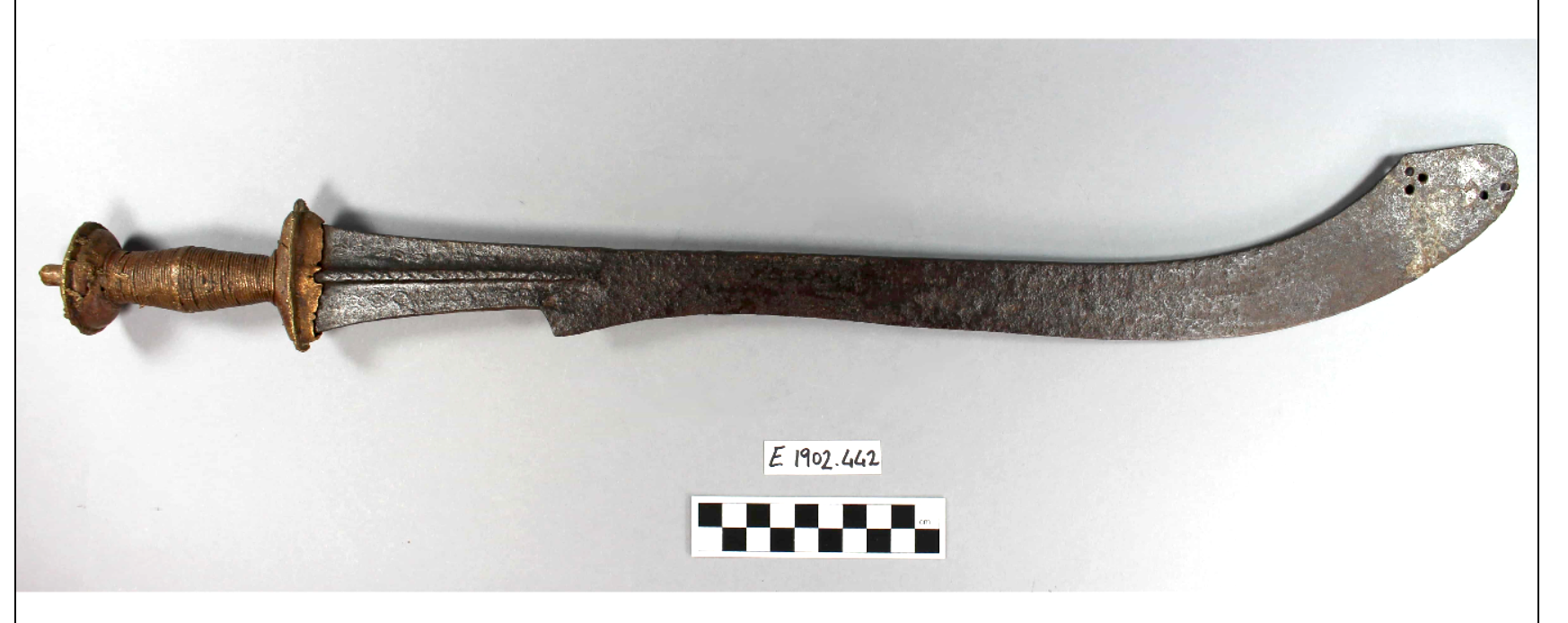
Image of an executioner’s sword previously held in the Museum of Archaeology and Anthropology, University of Cambridge, and now sent to Benin. Digital Benin described it as an “Iron sword of peculiar shape with cast bronze hilt showing skeumorphic [sic ‘skeuomorphic’] wire binding. A label which has since come off said it was an executioner’s sword.” As item 48 on the handover list, it was less candidly described as merely “ceremonial”.
(i) You mention Professor Brigitta Hauser-Schaublin’s work approvingly. Are there other academics or commentators you think are doing important work, that isn’t getting enough attention, on this issue?
The problem for academics is that it’s usually career suicide to speak out against the “perpetrator/victim” narrative (see above) surrounding the Benin bronzes, or to examine too closely the behaviour of West African despots who enslaved their fellow Africans and sold them.
This is why the louder voices in UK are usually retired and emeritus professors: Robert Tombs, Lord (Nigel) Biggar, Lawrence Goldman and others – they’re collecting their pensions and can’t be muzzled. Another such retired professor was the late Brigitta Hauser-Schaüblin.
(j) You refer to a “post-colonial guilt industry”, that’s a loaded phrase. Who specifically do you think is driving it, and what do you think their motivations are?
You call that a loaded phrase: I consider your catch-all “British colonial violence” a loaded phrase. With exceptions such as the notorious Amritsar Massacre, British colonial rule brought a number of benefits to the majority of those colonised, not the least being literacy.
Portuguese traders, the first outsiders to buy Benin’s slaves, taught the then Oba’s family to read and write, but even up to 1897 this was never a benefit Benin’s Obas wanted for their people. As George Orwell described in “1984”, if you control the narrative and can rearrange history however you wish, you control the people. Unfortunately for despots, literacy brings independent thought
And yes, it is an industry. Thousands of academics, administrators, teachers and campaigners live on salaries funded by taxpayers or by billionaire-funded charitable trusts, promoting post-colonial guilt. We would all be happier if we studied and learned from the past, and used it to build a better future. The past was another country, where they did things differently, and we can’t change that.
(k) Where do you draw the line between legitimate acknowledgement of colonial wrongs and what you see as counterproductive guilt? Is there a middle ground?
The middle ground is telling the truth. A good example is South Africa’s Truth & Reconciliation Commission, after the fall of the apartheid regime. The country is by no means perfect, but there could have been terrible bloodshed without the Commission. Granted immunity from prosecution, people simply told the truth about what they did in the apartheid years, and for most people the truth is a better healer of old wounds than revenge is. Most people want to look forward and make a better world for their children.
(l) If the restitution campaign is, as you suggest, largely self-inflicted in its setbacks, what do you think a more credible and honest campaign for cultural restitution would look like?
The setbacks the Nigerian restitution lobby has brought on itself have been laughable. Nor do I understand what western fanatics think is achieved by restitution, other than making themselves look virtuous. Most Nigerians don’t want museums, they want their family to be able to eat and be educated – and ideally, to emigrate, see below.
The Benin bronzes were never the “cultural property” of the Edo people. They belonged to the Obas in person, emblems of their brutal regime and their power of life and death; rarely if ever seen by their people. Most of the British Museum’s remarkable Benin relief panels, for example, were discovered in 1897 burnt, broken and buried under the floor of a storehouse – no-one has ever explained why. Is it not better for future generations, and is it not a better tribute to their long-ago creators, that these remarkable works should continue to be displayed in London – and not reunited with similar pieces which today are hidden in store rooms in Lagos and Benin, and seen by nobody?
Which cultural practices would we, today, wish to see continued? From his house arrest in Calabar, the Oba who’d been deposed in 1897 asked his British captors to arrange for the crucifixion of some female slaves. His people back in Benin were complaining of a drought, and this traditional custom would be sure to bring rain, he said. The crucifixions didn’t happen: the British had freed his slaves, and volunteers were hard to find.
As to the fashion for “cultural restitution”: the Ford Foundation dropped a particular question from the national surveys of Nigerian attitudes which it sponsors, after the proportion who said they would emigrate at once if they possibly could climbed above 70%. Future Nigerians might be more likely to see Benin’s artefacts in New York and London – though not, sadly, in Cambridge. There’s an interesting irony in western fanatics seeking to restitute bronzes to Nigerians who largely want out of their corrupt and dysfunctional country.
———
Thank you Sophia, Emily and Sarah, for reading my articles and for your perceptive and interesting questions. I’ve enjoyed the challenge of answering them. It’s good for someone of my age to be asked to justify their opinions now and again. We’re separated by two generations, in different countries, and my attitudes won’t be yours of course – but perhaps these remarks may be helpful.
I hope you enjoy the rest of your education – keep asking questions, take nothing for granted, read and research! – and please give my thanks to your remarkable Mr Roth for passing you on to me. I’m sure he’s a teacher who you will remember long after you’ve settled into your own careers. (Readers can find Roth’s History Reclaimed article here:https://historyreclaimed.co.uk/benin-coral-regalia-restitution/ )
With all best wishes,
Mike Wells


