


The Second Anglo-Boer War is amongst the most debated events in British history. The contested aspects include the ‘scorched-earth’ strategy, the British concentration camps, the numbers involved and the motivations behind the war. Yet the most striking feature of many narratives is how they are cast through the prism of our contemporary ethics, economics and politics. Prompted by pre-conceived conclusions on globalisation, imperialism, and racism, and energised by the selective search for evidence that fits, these narratives often fail to ‘add up the numbers’, assess the overall context, or judge human agency by the actual constraints of the time.
The Boer War has never suffered from any lack of attention; indeed, the converse is the case, even from the outset, with Leopold Amery’s seven volume Times History of the War in South Africa (1900-09) which included a bibliography listing about 1,570 books. During the 1890s, the press was transforming into a mass medium, and the reporting industry deployed some 276 named correspondents[1] to cover the war, albeit censored in South Africa. The British government had also, for the first time, deployed systematic, high-density bureaucratic recording and formal documentation throughout the conflict, and published 146 Parliamentary Blue Books (Command Papers, Jun 1899 – Dec 1906) detailing the war, together with, after the war, a highly technical eight-volume Official History of the War in South Africa (1906-10).
It was a complete change for a government to publish detailed records during the conflict and to complete the official history within eight years. As Wrench observed in 1958, the clash between Boer and Briton ‘was not only the fundamental cleavage between seventeenth century-minded Dutch settlers and that of nineteenth century Britain, but with a Britain that was itself in a state of change’[2]. He suggested it was a conflict between a seventeenth-century oligarchy and a European parliamentary democracy, between tribal independence and the emerging big modern state, between pastoral and industrial, and between town and country.
The war could not be characterised as a colonial war as it was largely a ‘white people’s war’ with both sides purporting to not involve black Africans[3]. It was a war between the British imperial government and two Boer republics, although the republics had been formed in 1854 and 1881[4] respectively, having violently displaced the Matabele who had, in turn, fled from the Zulu and displaced the Sotho-Tswana and Venda, who had dislodged the indigenous San hunter-gatherers and Khoekhoe pastoralists. The Boer War, in some aspects, can be viewed as a civil war[5] because the conflict deeply divided the Boer population, with a majority residing outside the declared republics and not joining their Boer forces. Furthermore, a near quarter of the Boers’ active fighting force[6] fought, towards the end, on the imperial side (known as Joiners)[7].
Whilst the independent, skilled and brave Boers of the Veldt were widely admired, the government in the Transvaal, or the Zuid-Afrikaansche Republiek (ZAR), was widely reviled as a venal, corrupt and incompetent oligarchy which practised slavery[8] and constantly attacked neighbouring native states[9]: ‘one of the most restrictive, exclusive, and odious regimes imaginable.’[10]
In 1899, the ZAR state almanac recorded that the voting franchise was restricted to just 10.1% of the white population or 3.2% of the total population. It also noted that the non-Boer or disenfranchised ‘Uitlander’ population, composed of British and other foreign migrant workers to the Transvaal, was 210,674 or 73% of the white population. Without any representation, the Uitlander industries were being harassed and taxed to provide 80-90%[11] of the ZAR state’s revenue[12] with few benefits. One Times letter writer noted in 1896 that Uitlander schools got 1.8 shillings per head of annual financial support, versus Boer schools at 166 shillings per head[13].
The Uitlanders had flocked to the Transvaal after the 1886 gold discoveries at Witwatersrand which were producing 27% of the global gold supply within two years, fostering the explosive growth of Johannesburg and generating the ZAR’s rapid fiscal-military expansion with exponential state revenue growth – from £196,236 in 1886 to £3.97 million in 1896[14], peaking at £4.59 million in 1898. ‘The moment that they began to profit by the gains of the gold producers at Johannesburg, then they got a war fund, which they immediately proceeded to devote to arming themselves for an eventual conflict’[15] .
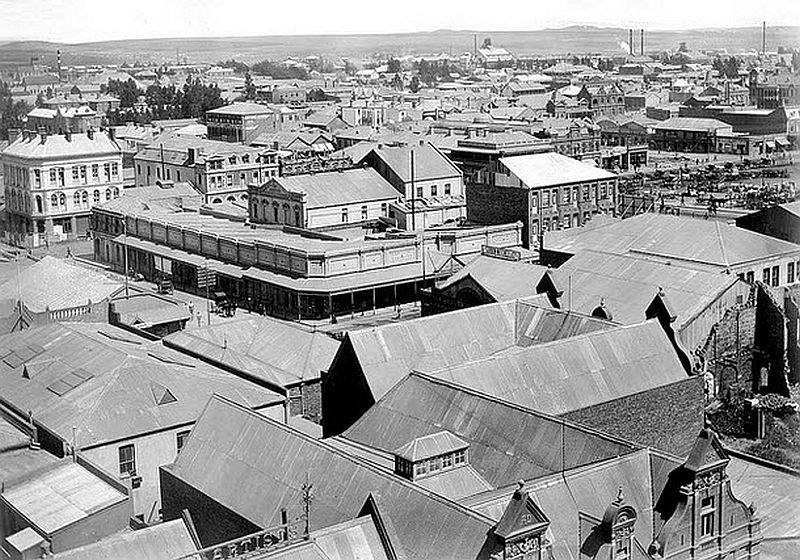
Johannesburg in 1900
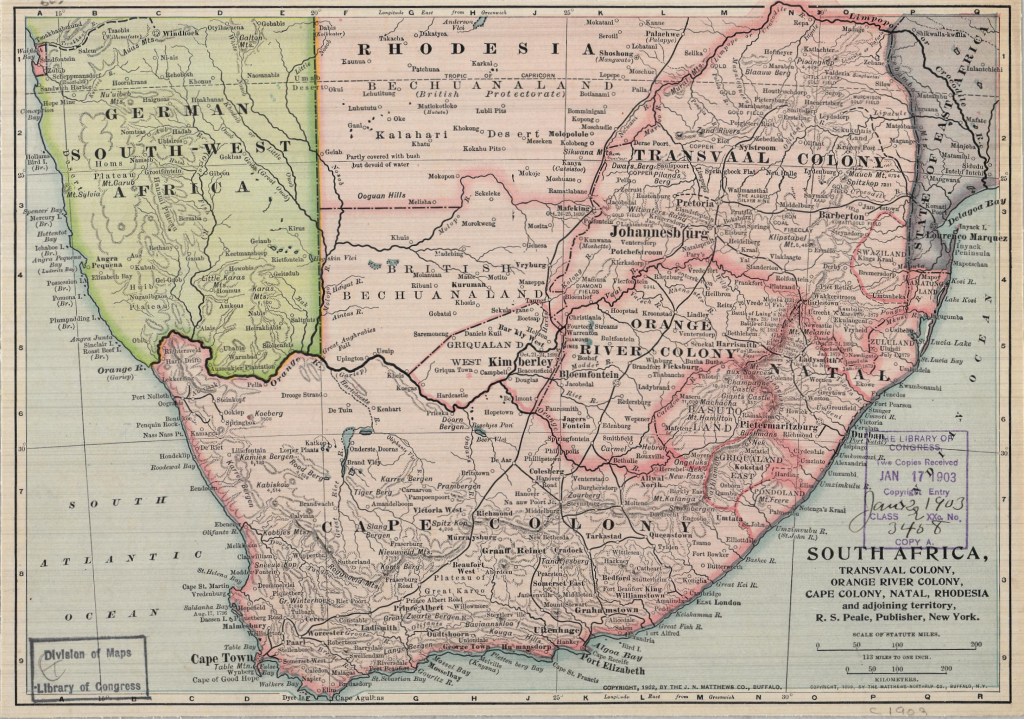
Given that the land-locked Republic was surrounded by British colonies[16], the target for this massive military expenditure was clear. The extension of the franchise, demanded by the British, would mean the Boer ruling cabal would lose control of their own country – one they had only recently secured. The common narrative[17] suggests the imperial government wanted to seize the gold fields of Transvaal, wanted supremacy over the Boers, and planned to impose alien ‘Englishness’ of language, law, commerce, health and education on the Boer culture – that it wanted to force a war and was poised to invade.
Even at the time it was noted that the deep gold mines were already largely owned by British capital[18], that revenue generated in British colonies was generally kept within their self-sustaining economies, and the franchise model the British demanded was the one already existing in Natal and the Cape colonies, and also in the Transvaal before 1881 when President Paul Kruger revoked it.
British imperialism of the time can more plausibly be seen as aiming to encourage ‘civilisation’[19], public reform and free trade: that the ‘imperialism of free trade adopted by the mid-Victorians was a systematic attempt to apply, encourage and ultimately enforce the prescriptions of Adam Smith upon a more or less reluctant world’[20]. The South African Imperial Commissioner, Sir Alfred Milner, denied in March 1898 that ‘Great Britain has some occult design on the independence of the Transvaal – that independence which it has itself given – and that it is seeking the causes of quarrel in order to take that independence away’[21] but he feared ‘the threat of a civil war caused by the existence of two irreconcilable political systems’[22].
As to the imperial side preparing for war, the post-war Inquiry Commission[23] provides overwhelming evidence that the Army was entirely unprepared for a conflict in South Africa. The small British Army had only 70,000 available for dispatch or reinforcement or expeditions abroad at most. In the end, a full Army Corps of volunteers, or citizen-soldiers, was raised from across the Empire.
The ZAR’s confidence may have rested upon their independence victory over the 400-man British force at the 1881 Battle of Majuba Hill. However, Joseph Chamberlain, Secretary of State for the Colonies, explained the event in Parliament somewhat differently in 1896, noting he was a cabinet member at the time and recalled
the Dispatch coming from Sir Evelyn Wood, in which he said that, humanly speaking, the Boer army was at his mercy, and that he awaited the instructions of the Government to go on and to attack, and we withheld those instructions, and, instead, we accepted an armistice, which resulted in the Convention of 1881[24].
Obviously a rural, localised militia of a bankrupt state with no artillery, military infrastructure and ammunition reserve could not stand against a reinforced Imperial regular army, but London pulled back from an unwelcomed continuance of the 1877 annexation[25].
After the Witwatersrand gold rush in the late 1890s, all that changed. As the Prime Minister Lord Salisbury noted ‘… the Republics are steeling themselves with an army that will dominate the subcontinent … We are staring at a state armed to the teeth that alters the entire balance of power’[26]. This was a geopolitical fear about a hostile neighbour deploying its wealth in conflict, and concern also for strategic denial and defence – not imperial plunder. Nevertheless, the imperial cabinet stayed its reinforcement hand until late in the day for fear of precipitating a crisis in the negotiations or provoking a war[27].
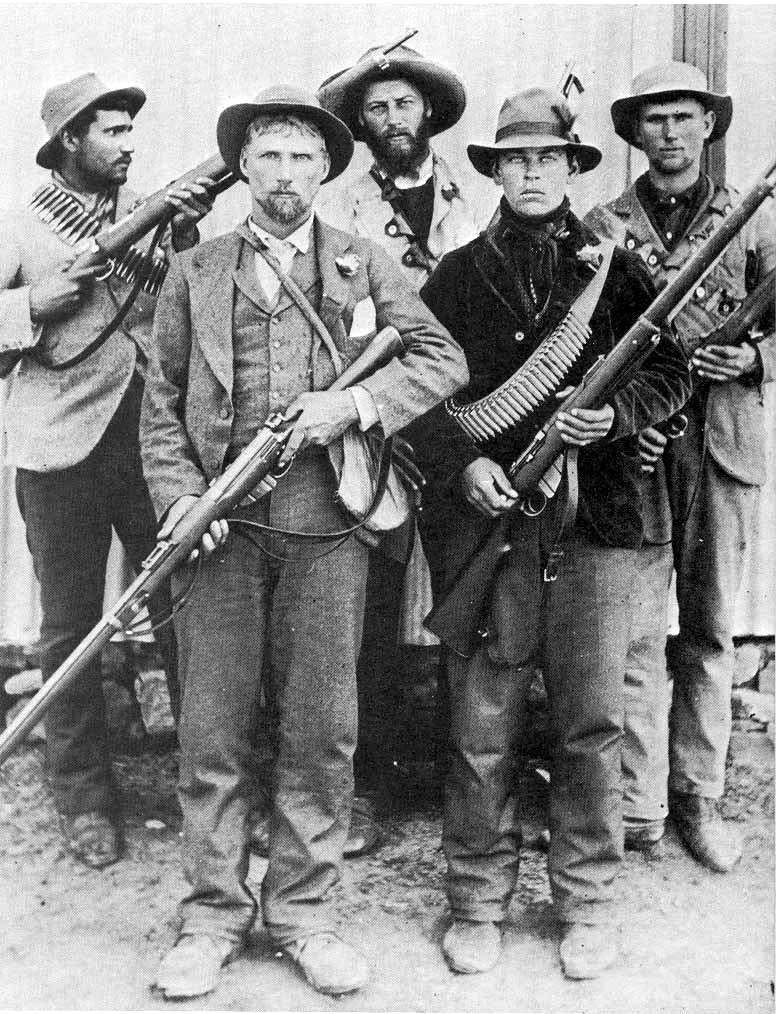
Afrikaner Commandos
In order not to defend their franchise but to establish, in Boer General Jan Smuts’s words, ‘an Afrikaans republic in South Africa stretching from Table Bay to the Zambesi’ [28] before imperial reinforcements could arrive to supplement the existing 15,300 British and local military deployed throughout the colonies, the 48,216 strong Boer forces[29] of the ZAR and the Orange Free State Republic invaded the Natal Colony and Cape Colony in October 1899[30]. But rather than strategically strike through to the coast, they pointlessly besieged three towns and looted others. By February 1900, reinforced imperial forces lifted the sieges and, within 5 months, took Bloemfontein, Johannesburg and captured Pretoria.
It is difficult to assess why the Boers thought the venture would succeed, other than forlorn hopes of German intervention on their side or a Boer revolt in the Cape against the British Empire, then the world’s largest economy. The next phase of the war – of useless guerilla warfare with 20,000 or so Bittereinders (Bitter-enders) Boer commandos against an Imperial army now extending to a fighting force of 163,979[31] in a region of 4.7 million people – is even more difficult to appreciate. But the imperial force had to protect a massive territory, equivalent in area to the combined size of France and Spain, resulting in an active mounted force of only 80,000[32] able to operate in flying columns against the highly mobile Boer commandos.
The railways were so few that the business of supply and movement was always arduous; spaces so vast that large forces were swallowed up; the enormous distances from one strategical point to another, intensified, in difficulty by the almost entire absence of good roads, the scarcity of substantial bridges, of well-built towns, of commodious harbours, and of even such ordinary necessaries as flour or fuel, all these complicated every military problem to a degree not readily intelligible to the student of European warfare alone[33].
The military solution of Lord Roberts and, in particular, Kitchener, though opposed by Milner because it would impede post-war reconstruction and feared by Chamberlain for its political impact[34], was the ‘scorched-earth’ strategy – destroying everything to deny supplies to the Boer commandos who had lost their towns, magazines and railway depots and would now have to rely on Boer farmstead support, native farm raids, civilian loot and captured British supplies.
Milner wrote to Chamberlain noting that the guerilla war ‘makes the area of actual fighting, and consequently destruction, much wider than it would be in the case of a conflict between equal numbers operating in large masses’ and that ‘the fight is now mainly over supplies. … Our forces, on their side, are compelled to denude the country of everything movable in order to frustrate these tactics of the enemy’[35].
The ruthless strategy worked, and with the republics parcelled up into barbed wire sections and supply routes guarded by 8,000 blockhouses, the Boers surrendered within 18 months and ‘the whole fabric of the former rural society had been clean swept away’[36]. The commando son of a Kruger government minister, who had written at the capture of Dundee that ‘the joy of ransacking other people’s property is hard to resist, and we gave way to the impulse’, recalled that ‘every representative had the same disastrous tale to tell of starvation, lack of ammunition, horses, and clothing, and of how the great block-house system was strangling their efforts to carry on the war … Every homestead was burned, all crops and livestock destroyed, and there was nothing left but to bow to the inevitable’[37].
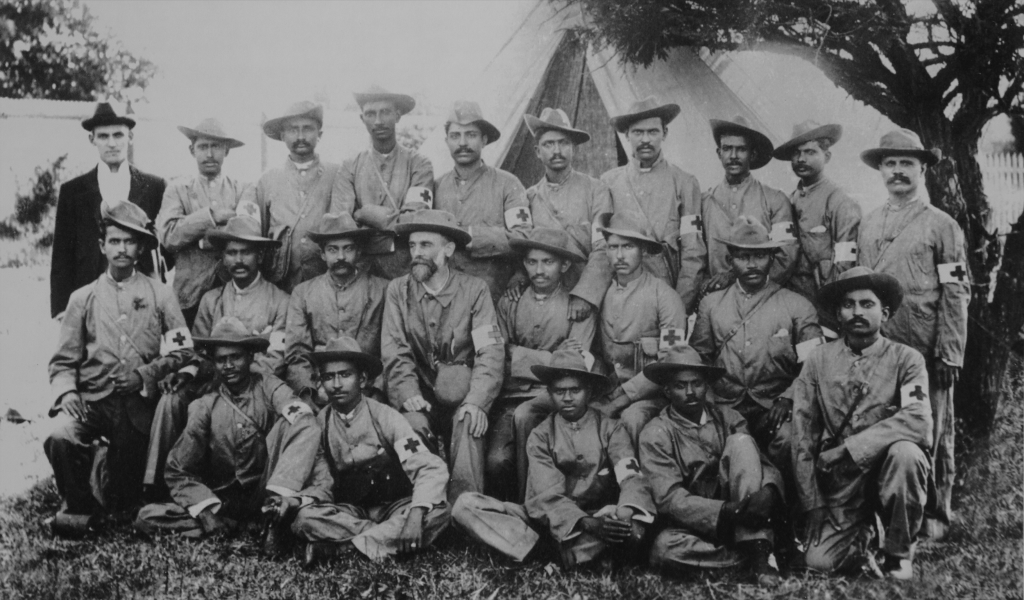
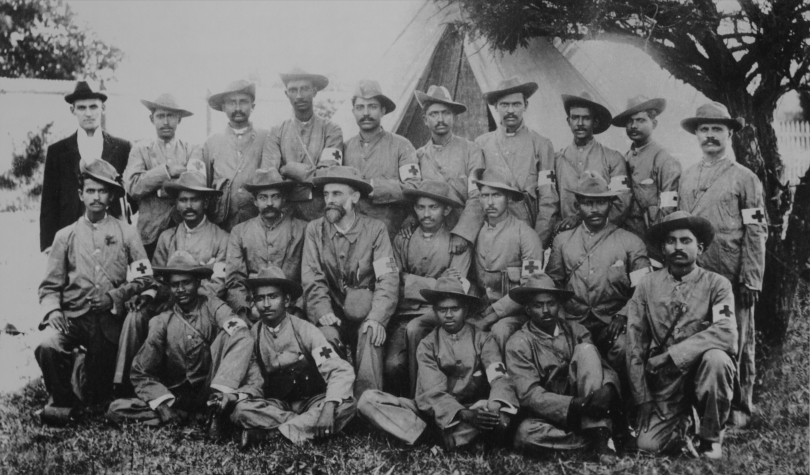
Imperial stretcher-bearers of the Natal Indian Ambulance Corps, including Mahatma Gandhi (middle row, 5th from left) who served the British as a sergeant-major.
It was perhaps the shortest guerrilla war in modern warfare history, but it came at enormous cost in terms of lives, money and a bitter generational legacy. As Chamberlain noted in Parliament five months before the end, ‘Lives are being lost, the country is being ruined, the future of the country is being damaged.’[38].
The war generated waves of refugees with the first, rarely mentioned, being some 53,000 Uitlanders[39] and 78,000 black labourers from Johannesburg after the ZAR edicts of late 1899. The next wave was of Natal loyalists and 20-25,000 surrendered Boers and their families (Hensoppers or Hands-Uppers) whose farms had been burnt, wrecked or ransacked with their stock driven away by the Boer republican forces. Finally, the Bitttereinder families of some 20,000 Boer commandos and 25,000 Boer prisoners held overseas were gathered up as part of the imperial scorched-earth policy, eventually leading to them forming near three quarters of camp internees. The first and second waves of loyalist refugees were largely left to their own devices without state support. One camp internee noted ‘I have two sisters, loyalist refugees at the coast. I should be very happy if I thought they were half as well off as we are in this camp”[40].
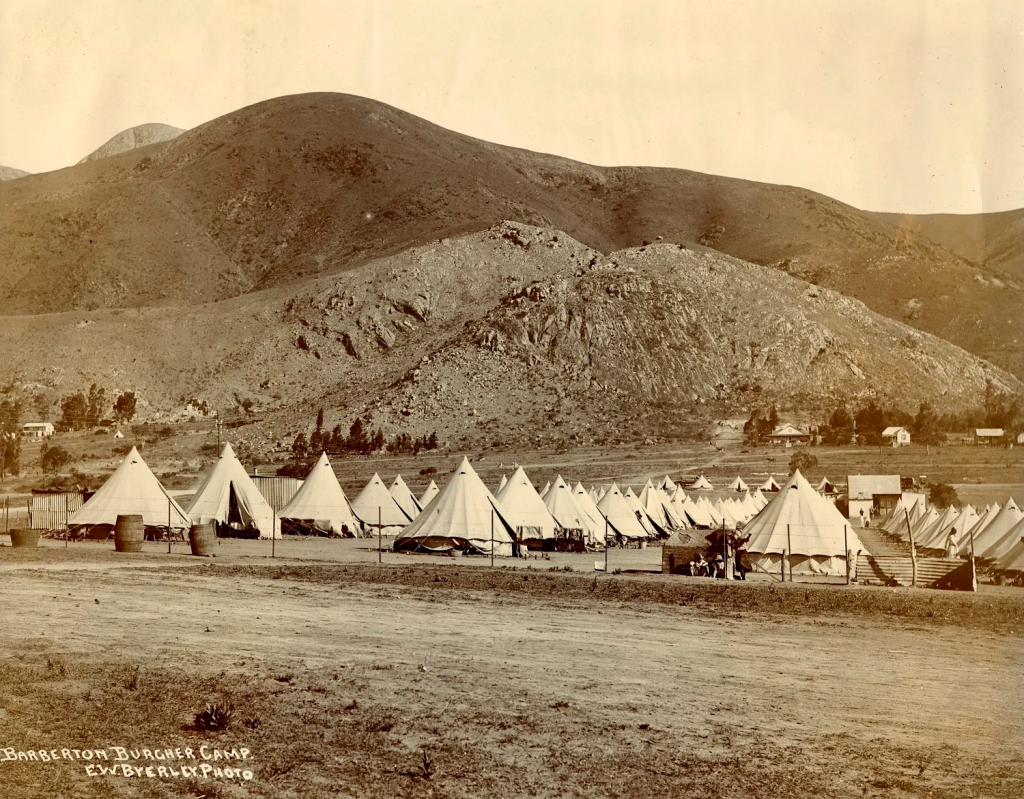
The Barberton Refugee Camp, 1901
The first Hensopper ‘protection’ camps, concentrating those refugees along the railway lines of supply, were set up in late 1900 and by March the following year, the scorched-earth policy brought the Bittereinders’ influx, in what were increasingly then referred to as ‘concentration’ camps. By the end, in May 1902, there had been 102,000 -116,000 whites in 45 concentration camps, with 25,000 -29,500[41] deaths, and 116,000 black Africans in 64 labour camps with 14,154 recorded deaths, possibly up to 20,000[42], although the detailed British records for such were largely lost, mislaid or destroyed. The black Africans faced a ‘no work, no food’ policy and some complained ‘… they receive no rations while the Boers who are the cause of the war are fed in the refugee camps free of charge’[43] .
Many commentators did not recognise that the ‘forced labour’ policy simply reflected the ethos of the British workhouse under the regime introduced by the 1834 New Poor Law that obtained through the Victorian era. Few noted that their employment, at some 100,000, was actually for the British military and those that did, suggested it was for only ‘a meagre shilling per day’, though this was actually then comparable to a regular British army private, who was paid 1s 3d per day before mess deductions. Indeed, there was controversy over many armed black people serving in the Imperial forces receiving a higher pay than the regulars[44].
It was thought right, and militarily necessary, to protect the Hensoppers, native farmers and rural black labourers, from marauding Boers, and later to provide refugee camps for the abandoned victims of the scorched earth policy, probably some 80-85,000. The standard figure cited everywhere is that 30,000 Boer farms were burnt by the British (ignoring the earlier Boer burning, looting or ransacking of over 1,000 Natal farms[45]) which is a figure inconsistent with the republics’ own lands registries’ records of a total of 11,705 Transvaal farms and some 6,000 farms registered in the Orange Free State[46]. The Transvaal farms’ cultivated land represented just 1.26% of the vast republic’s land area, about half of which was farmed by natives. Farm ownership was restricted to the government, large companies and a Boer elite with President Kruger owning at least 46 farms[47] and General Joubert more than a dozen. General Botha owned 6 farms, totalling over 16,000 acres[48]. A significant proportion, possibly more than a third, of the Boer population were landless farming squatters (‘Bywoners’) with the affluent Boers frequently taking refuge in private homes of relatives or friends in the neighbouring colonies or the adjacent Portuguese territory, presumably avoiding the terrible mortality rates in the camps.
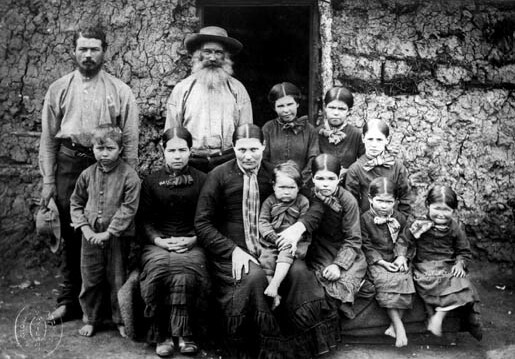
A Bywoner family
The population of the republics forced into the camps of whom nearly three-quarters were Bywoner, had primarily been thinly scattered and ‘epidemiologically isolated’[49] folk, being ‘an impoverished pre-industrial rural peasantry practising a lifestyle that was widespread before the era of public health reforms’[50]. They were swept into near-urbanised, congested and often ill-prepared camps. Given the British thought they would fight and win a conventional war, the imperial forces were entirely unprepared for the consequences of their anti-guerilla campaign which dragged on for another 18 months. There is no evidence that anyone in 1900 foresaw the problem, but the criticism still raised today is that the army was woefully unprepared.
When epidemics hit the camps, the result was disastrous, with a near quarter of all white internees dying, including close to half of the children. Nearly two-thirds died from measles and consequent pneumonia: “there was no therapy and the only means of preventing a serious epidemic was isolation, virtually impossible in these wartime conditions”[51]. Despite common assumptions, ‘starvation and scurvy’ accounted for only 2.9% of recorded deaths in the white camps. It was not, as even Niall Ferguson suggests, that ‘27,927 Boers died in the British camps … mainly as a result of malnourishment and poor sanitation’[52].
Adequate food was a challenge for both the camps and the towns, with supply usually dependent on overburdened single railway lines threatened by Boers striving to interrupt those supplies. The key point, was made by Lord Haldane to his critical Liberal colleagues: ‘Before I pronounce against concentration, I should like to know what other methods are open. I have listened in vain to the speeches on this side of the House for an alternative suggestion’[53]. There are no records of epidemic deaths beyond the camps but data shows that the imperial Army lost more soldiers to disease, principally typhoid, than to combat in the war[54].
The tragic mortality rates, on a par with some modern emergency refugee camps[55], prompted great debate and the Government appointed the Fawcett Commission to investigate. They inspected most of the camps in the last six months of 1901 and critically reported in January 1902 with detailed recommendations, most of which were actioned. Selected parts of this report are often quoted but rarely one conclusion; namely ‘Considering the ample provision of all necessaries for the healthy and luxuries for the sick which has been made, it is rather difficult to find a suitable channel into which to direct the flow of private charity’ [56]. By the time their recommendations came out, the epidemics had largely run their course, before the height of the scorched-earth policy, with mortality declining in the white camps after October 1901 and in the black camps by January 1902. The oft cited ‘magical effects’ of civilian administration and reform conflicts with the data[57].
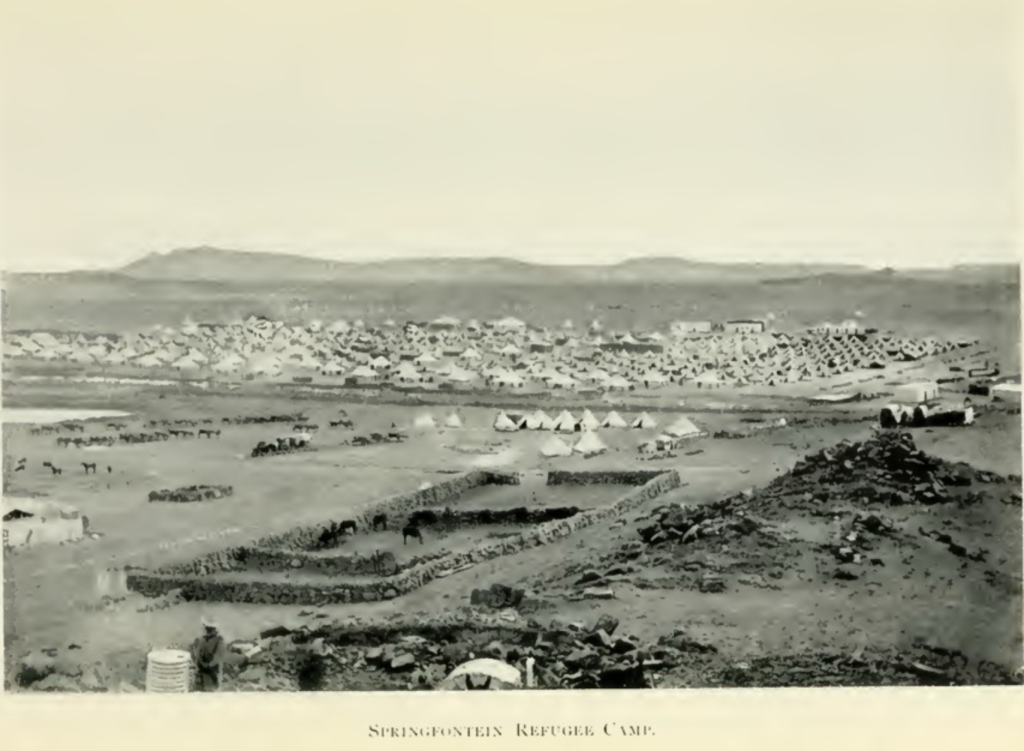
Springfontein Refugee Camp
Yet better food, more medical staff and other facilities continued to improve the camps, guided by Anglo-Indian fever experts. Senior Boers reportedly inspected camps three times and found them ‘content’, ‘expressed much satisfaction’ and were ‘perfectly satisfied’ [58]. Many were not enclosed, most had shops, many allowed freedom to visit town, and the second largest cost, after food, was employment of internees in and around the camps[59]. Free education had been introduced with vastly more Boer children attending school than ever before. The Fawcett Commission noted that ‘One old Boer was heard to exclaim that he believed the British must be God’s chosen people after all, for he had never heard of any other nation paying for the education of the children of their enemies’[60]. Chamberlain maintained in Parliament that ‘never in the whole history of the world, so far as we know it, have there been such gigantic efforts made by any nation to minimise the horrors of war’[61]. After the war, there were 150,000 white civilians (mostly Boer), 50,000 foreigners (mostly British) and one million black refugees to resettle[62] and the political objective was for all to rejoin the Imperial Empire ‘family’ as self-governing Colonies.
The war had cost Britain £205 million (£22.4 billion in current prices), paid for by increasing income tax to 5.8% (!), suspending the Sinking Fund and debt (71%)[63]. It had been, as Chamberlain predicted in 1896, ‘a long war, a bitter war and a costly war, and … it would leave behind it the embers of a strife which I believe generations would hardly be long enough to extinguish’[64]. More was to come with a £35 million Transvaal Loan (1903-1953) to pay off ZAR debts, acquire and expand the railways, pay for public works and land settlement schemes, together with £3 million to be distributed among the Republican Boers, £1.5 million to Natal and Cape Colony, £2 million for British subjects / foreigners, and £0.3 million to natives in compensation for war damages[65]. This was possibly a rare example of the victor compensating the vanquished.
It had been, as Churchill put it, a ‘miserable war – unfortunate and ill-omened in its beginning, inglorious in its course, cruel and hideous in its conclusion’. [66] Afterwards, following the 1909 consolidation of the colonies into a single self-governing state, the first Union government was led by former Boer generals Botha and Smuts until, in 1924, the Afrikaans National Party gained control. As Pakenham observed ‘if the guerillas in South Africa lost the war, they won the peace’[67] albeit with a government model now entirely based on the British system with one crucial exception – that of apartheid.
In the racist view of the Zuid-Afrikaansche Republiek, African blacks were a sub-species and a labour resource. In the imperial view they were children who needed to be wisely governed and protected until they grew up. The Boers preached freedom and independence but hoarded these privileges for a self-elected oligarchy whose Calvinistic righteousness endowed them with this virtue. Puffed up with their unique racial identity, they disastrously decided to violently establish a Boer republic over the entire of South Africa by invading the British colonies. With that hubris, they ‘sowed the wind, reaped the whirlwind’ but then some went on with aimless banditry until the country was ruined and the population was in refugee camps.
There is little plausible evidence that the British wanted or were prepared for the war, sought the gold they already owned or coveted dominion over the Transvaal or the Boers. Instead, they determined to win the conflict forced upon them but, in doing so, went to great effort and cost to minimise the impact with the explicit objective of restoring democratic self-government. What is remarkable is how these events were reworked by the 20th century Afrikaaner governments into a fable of the oppressed Boers victimised by the evil Empire – and how that fable has continued to be accepted.
Alistair Parker
Aug 2026
[67] Pakenham, T. 1979. The Boer War. London: Weidenfeld & Nicolson, p. 572.


