


It is sometimes said that a picture is worth a thousand words and this certainly applies to a selection of Indian postage stamps. They vividly demonstrate the extent to which colonial legacies are valued in India today. This article complements my earlier 2023 essay on ‘Indian Commemorations of British Legacies’ https://historyreclaimed.co.uk/indian-commemorations-of-british-legacies/ and it adds to my argument that modern Indians feel no shame or disquiet in remembering and celebrating aspects of their colonial past.
India has been issuing commemorative stamps since the early twentieth century. One of the first of these celebrated the inauguration of New Delhi in 1931. A series of stamps was subsequently issued to commemorate George V’s Silver Jubilee in 1935. After Independence, a 1947 series featured the Ashoka Lion Capital which embodied the spirit of the independent nation. The first definitive series in 1949 – known as the ‘Chakra‘ series -featured designs symbolizing India’s culture, history and progress. In the subsequent decades thematic and commemorative stamps have highlighted India’s cultural achievements, scientific milestones and historical events. These have included several issues on colonial legacies. Most commemorate an institution such as a court, university or museum, but some commemorate public services such as the railways. The design of the stamps was relatively formal and monochrome in the 1950s, but it became more imaginative and colourful in later years. There are, in fact, many other Indian postage stamps commemorating colonial legacies in addition to those shown below.
The Indian Department of Posts’ guidelines for the issue of commemorative stamps specify that such stamps should be issued on subjects or institutions that have a national or international significance, or that have made a national or international contribution. A stamp illustrating a building may be issued on its centenary, 125th anniversary, or 150th anniversary. The building so honoured must be a heritage site of national or international importance, or a site recognised by the Archaeological Survey of India. The subject must be one that can be depicted in a visually appealing manner so as to be of interest to philatelic collectors. The colonial buildings and institutions commemorated in the stamps shown below clearly conform to these criteria.


The three first-day-covers (1-3 above) commemorated the centenaries of three great modern High Courts which had been established in Calcutta, Bombay and Madras in 1862. Further details of these commemorations are given in my earlier paper. The figure shown on the first-day-cover of the Bombay High Court stamp is taken from the building’s spire.
The next three stamps (4-6) commemorate the centenaries of the founding of the universities at Calcutta and Madras in 1857 and the University of Allahabad in 1887. (A stamp was issued to commemorate Bombay University as well but is not included here). The College of Engineering at Guindy is virtually unknown in the UK but is claimed to be Asia’s oldest engineering and technical institution. It was founded by the East India Company in 1794 in Madras and moved to its present site in Guindy in 1925. A postage stamp commemorating its bicentenary was issued in 1994 (12).
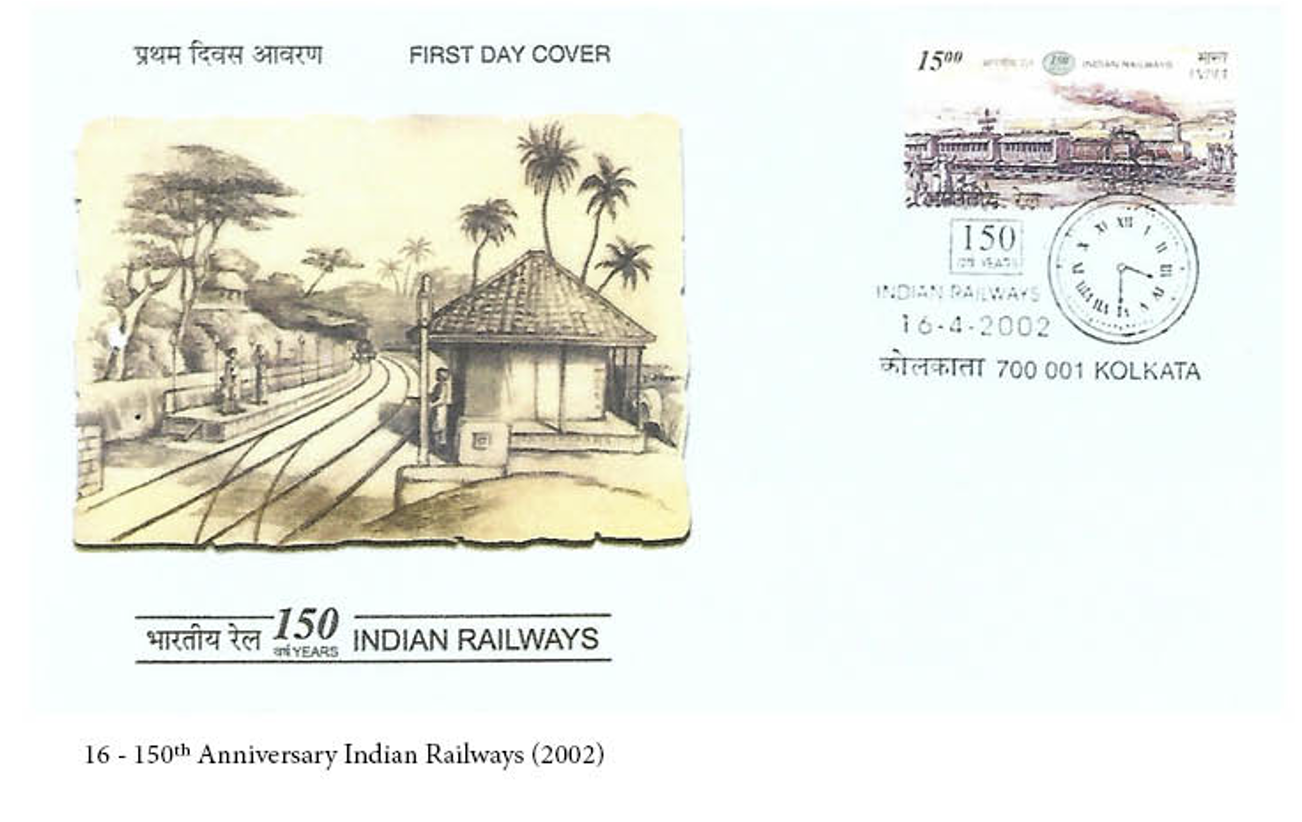
India has issued many commemorative stamps relating to its railways. The centenary stamp (7) shows a 2-2-2 T ‘Express’ steam engine of the type which hauled the first Indian train in 1853 and a modern WP-1 locomotive from 1953. The 150th anniversary commemoration stamp for Indian railways (16) re-created the Indian landscape of 1853 with villagers waiting for a train. The South Eastern Railway originated when the Bengal Railway Company took over the Nagpur line in 1887. It connected Calcutta with Bombay and Madras. Its centenary was commemorated in 1987 (9). Other stamps issued in commemoration of Indian railway lines, though not shown here, include 150 years of Railways in Eastern India (2004), the centenary of the Darjeeling Himalayan Railway (1982), the centenary of the Doon Valley Railway (2000), and the centenary of the Simla Railway (2003).
Important railway stations have also been commemorated in stamps. One such was issued on the centenary of the magnificent Victoria Terminus in Bombay – also the headquarters of the Central Railway – which was designed by F. W. Stevens and completed in 1888 at the time of Queen Victoria’s golden jubilee (8). The centenary of the Churchgate Station in Bombay, also designed by Stevens, was commemorated with the issue of a stamp in 1999. That commemorating the centenary of the Howrah Station in Calcutta was released in 2009.
Another building in Bombay designed by Stevens, and in a similar style to the two railway stations, was the Bombay Municipal Corporation Building. It houses the office of the Mayor, and corporation meetings are still undertaken in its hall. It was completed in 1893 and a postage stamp was issued to commemorate its centenary in 1993 (11).
The Connemara Public Library was originally part of the Madras Museum. However, the need for a free public library prompted the Governor of Madras, Lord Connemara, to establish a new library in 1896. It is one of the four national depositary libraries in India. A postage stamp commemorating its centenary was issued in 1998 (12).
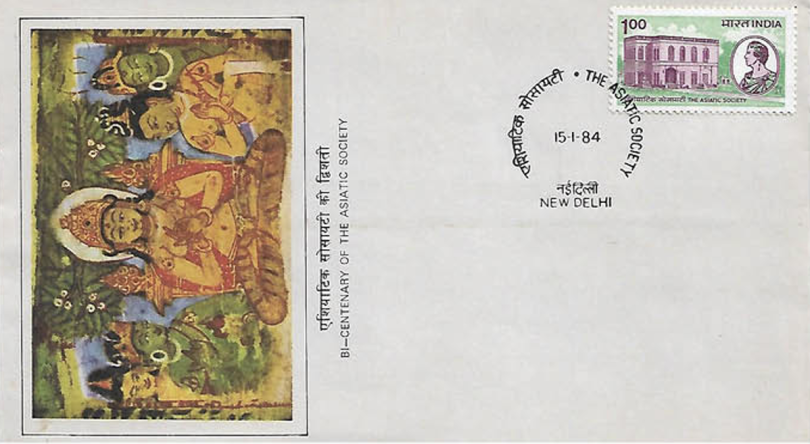
The Asiatic Society of Bengal was founded by Sir William Jones in 1784 and initiated the systematic study of Indian and other Asiatic cultures. It was the first learned society in India. Its bicentenary was commemorated by a stamp issued in 1984 (13). Another commemorated the bicentenary in 2014 of the Indian Museum in Calcutta.
The Mathura Museum was opened in 1874 by Fredric Growse, the District Collector of Mathura, to display his collection of archaeological objects and manuscripts. It was renamed the Curzon Museum of Archaeology as Lord Curzon, Indian viceroy, paid for its maintenance, but in 1974 it moved to a new building and was renamed the Government Museum Mathura. A postage stamp commemorating its centenary was issued in 1974 (14).
The General Post Office in Bombay was founded by the then Postmaster-General Charles Elphinstone in 1794. The present building shares a common design with the Prince of Wales Museum in Bombay (Colonial Museums in India) and was designed by John Begg in the Indo-Saracenic style. Its bicentenary was commemorated in 1994 (15).
As is evident, the Indian post office has commemorated the centenaries, 150th anniversaries, and bicentenaries of many different colonial legacies. It would seem from this brief survey of some commemorative postage stamps that modern Indians recognise a wide range of benefits gained by the country during the colonial era, including architectural and engineering excellence. How different is their view of the Indian past when compared to that held by contemporary liberal elites in the United Kingdom.


