


The support of nations seeking independence and self-determination has an honourable place in British foreign policy, though it is often forgotten or deliberately overlooked by critics of British history. From the Latin American republics that spun out of the Spanish empire at the beginning of the nineteenth century to the struggles of Ukraine to retain its territorial integrity at the beginning of the twenty-first century, Britain has offered recognition and support – whether military, commercial or diplomatic – to new nations struggling to be free. In the nineteenth century, British public opinion was especially exercised in promoting the cause of nations seeking independence from the Russian and Ottoman empires. We supported the Finns, the Poles, the Jews, the Greeks, and Balkan Christians among many groups struggling to sustain their rights and seek independence from overbearing empires. The Armenians were another such people, as the article below by Ara Papian explains. At the end of the First World War, when both the Russian and Ottoman empires had been defeated and had dissolved, a brief opportunity arose to assist a nascent Armenia.
According to the Anglo-Saxon Chronicle, the first inhabitants of this land were Brittons; they came from Armenia, and first settled in the south of Britain.[1]
The collapse of the Ottoman and Russian Empires after World War I marked one of the most significant geopolitical transformations of the 20th century. Their disintegration reshaped the political map of Eastern Europe, the Middle East, and the Caucasus, creating a chaotic environment that gave rise to new nations, conflicts, and power struggles. Amid this turmoil, Armenia emerged as an independent republic for the first time in centuries. The newly established Republic of Armenia (1918–1920) faced immense challenges, including territorial disputes, hostile neighbors, and a humanitarian crisis resulting from the genocide and subsequent refugee influx.
During this period the British Empire played a critical role in the Middle East and Caucasus. British backing for the creation of an Armenian state in 1918 was shaped by a combination of humanitarian sympathy, geopolitical strategy, and post-World War I realities.

Despite Armenia’s neighbors, Georgia and Azerbaijan, siding with Germany and Turkey respectively, the Republic of Armenia firmly aligned itself with the Entente and Britain and heroically resisted the Ottoman Empire. Even as Turkish forces reached the gates of Baku, Armenians continued their struggle with unwavering determination. This period witnessed one of the most remarkable chapters in British-Armenian military cooperation. A small British contingent (less than 1000), mostly known as Dunsterforce after Major-General Lionel Dunsterville, had advanced from Mesopotamia and reached Baku by July 1918. 6,000 Armenians made up the bulk of the defenders of Baku. For two months, until September 15th, the British and the Armenians fought side by side with Armenians, valiantly defending the city against the Ottoman army and local Muslim tribesmen, who later, in 1936, were named by Stalin “Azerbaijanis”. The battle for Baku was intense and ferocious. Dunsterforce suffered about 200 casualties, including those killed, wounded, and missing․ By the night of 14 September, the remnants of British military mission evacuated the city for Persian port of Anzali.[2]
On September 15, 1918, the Turkish army and Moslem militias invaded the city, unleashing a massacre against its peaceful civilian population. Up to 30,000 Armenians of Baku’s Armenian community of 80,000 were killed, with the remaining population forcibly deported.[3] The capital of Azerbaijan was relocated from Ganja to Baku, a puppet government was installed and was absolutely controlled by Turks. However, following the Armistice of Mudros on October 30, 1918, Turkish troops were again replaced by British forces.
Following the armistices of October and November 1918, the Paris Peace Conference commenced in January 1919. Its primary aim was to establish a New World Order and decide the fate of the defeated powers: Germany, Austria-Hungary, Bulgaria, and Turkey. The conference initially focused on European issues. The fate of the Ottoman Empire began to be addressed only from early 1920.
Accordingly, the Republic of Armenia received de facto recognition from the British Empire, along with France and Italy, on January 19, 1920:[4] “It is agreed: (1) that the Government of the Armenian State shall be recognized as a de facto government on the condition that this recognition in no way prejudges the question of the eventual frontier.”[5] This move reflected the Allies’ acknowledgment of Armenia’s aspirations for statehood following the collapse of the Ottoman and Russian Empires.

This move was followed by sending the first Armenian diplomatic envoy to London. Major General Hakob Bagratuni was appointed as Armenia’s diplomatic representative to London, fostering communication and advocating for Armenian interests in the British capital. Six months earlier, the British Empire already had its High Commissioner in Yerevan. On July 5th, 1919, to meet the desperate need of the Armenian population and the Armenian Republic, Colonel William N. Haskell (US Army) was ՛՛appointed High Commissioner to Armenia, representing the United States, Great Britain, France and Italy՛՛.[6]
Following the de facto recognition of Armenia, the issue of the status of Armenia and its borders emerged as a pivotal element in the broader discussions surrounding the post-World War I settlement and the dismemberment of the Ottoman Empire. This topic took center stage during the First London Conference, an integral part of the Paris Peace Conference, held from February 12 to 24, 1920. Britain backed the concept of an independent and united Armenia, envisioning the unification of Armenian-populated regions from the Russian and Ottoman Empires into a single Armenian state.
Under the leadership of Prime Minister David Lloyd George, Britain strongly advocated for the creation of a viable Armenian state, intending it to serve as a buffer against the spread of Bolshevism from Soviet Russia into the Middle East. Consequently, Britain played a central role in the work of the Commission for the Delimitation of Armenia’s Boundaries with Georgia and Azerbaijan. This commission, comprising representatives from the British Empire, France, Italy, and Japan, also contributed to determining the Armenia-Turkey border and finalizing the peace treaty with Turkey. On February 24, 1920, the commission submitted decision, titled the “Report and Proposals of the Commission for the Delimitation of the Boundaries of Armenia,”[7] which established “ethnographical data”[8] as the primary principle for determining Armenia’s borders with neighboring Georgia and Azerbaijan. Additionally, discussions at the succeeding San Remo conference (April 19-26, 1920) explored the possibility of placing Armenia under an international mandate, with the United States considered the most suitable candidate for overseeing the region. The conference ultimately reaffirmed the inclusion of provisions for Armenia in the forthcoming peace treaty with Turkey.

Following these events, Britain began offering limited military support to Armenia, including the provision of arms, equipment, and a modest military presence. However, this assistance proved insufficient to address Armenia’s significant security challenges, which included external threats from neighboring Turkey and Azerbaijan, as well as internal instability exacerbated by economic hardship and a growing refugee crisis.
One of the British military instructors in the Armenian army was Oliver Baldwin, the son of future three-time British Prime Minister Stanley Baldwin. Motivated by a sense of adventure and a commitment to the Armenian cause, Oliver traveled to the region in 1920, where he joined the military efforts of the struggling republic.[9]
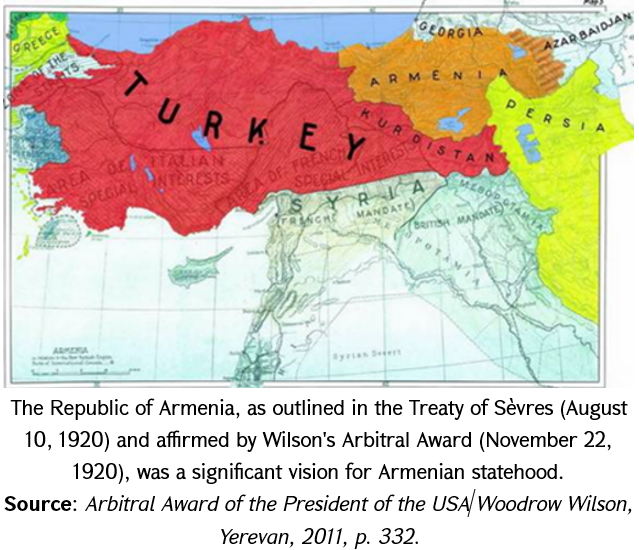
However, despite notable but limited efforts by certain British politicians and military personnel, Britain, primarily due to its internal challenges, began gradually withdrawing its troops from the region by mid-1920. Although the Treaty of Sèvres (August 10, 1920) and U.S. President Woodrow Wilson’s Arbitral Award (November 22, 1920) offered Armenians some hope for a just resolution of the Armenian Question, the signatory countries failed to act consistently and did not make adequate efforts to honour their commitments under these international instruments.
By late 1920, the situation in Armenia had deteriorated rapidly. The Republic of Armenia was beset by internal strife and faced external threats from both Soviet Russia and Turkey. Under the secret Russian-Turkish Moscow Agreement (August 25, 1920) – considered a precursor to the Molotov-Ribbentrop Pact of August 23, 1939 – Armenia was first attacked by Turkey in September, followed by an invasion of Soviet Russia in November-December 1920. As James W. Gerard, former U.S. Ambassador to Germany (1913–1917) and chairman of the American Committee for the Independence of Armenia (ACIA), aptly stated later: “… the Bolsheviks entered into a treaty with Kemal, whereby they ceded to Turkey a part of the Armenian Republic, two other parts to Azerbaijan and the remained labelled “Soviet Armenia,” then annexed to Russia.”[10]
Thus, the Bolshevik takeover of Armenia and Turkey’s unlawful occupation of significant portions of the Republic of Armenia’s territory marked the definitive end of British influence in the region. Preoccupied with post-war recovery and extensive imperial responsibilities, Britain was unable to prevent Soviet expansion into Armenia and the South Caucasus or to counter Turkey’s continuation of its genocidal policies against the Christian populations of the former Ottoman Empire and the wider region.
The period from 1918 to 1920 represented a pivotal chapter in British-Armenian relations in this new era. It was defined by diplomatic efforts, humanitarian interventions, and personal connections, leaving a lasting, though often complex, legacy for both nations.
Ambassador Ara Papian (ret.) is a diplomatic historian, the President of the Yerevan–based Modus Vivendi think tank, and Armenia’s former Ambassador to Canada. He is also a Governing Board member of the National Democratic Alliance, Armenia’s largest pro-Western party.
[1] The Anglo-Saxon Chronicle, by J.A. Giles, London, 1914, p. 3. [2] A more detailed overview of Dunsterforce see: Leslie Missen, Dunsterforce. The Marshall Cavendish Illustrated Encyclopedia of World War I. vol. IX 1917-1918, N.Y., 1984, pp. 2766-2772. [3] Bruno Coppieters, Commonwealth and Independence in Post-Soviet Eurasia, Routledge, 1998, p. 82. [4] G.H. Hackworth, Digest of International Law, Turkish-Armenian Boundary Question, v. I, Washington, 1940, p. 715. [5] Papers Relating to the Foreign Relations of the United States, 1920, vol. III, Washington, 1936, p. 775. [6] Ibid., p. 785. [7] For the full report see: Arbitral Award of the President of the United Stats of America Woodrow Wilson, Full Report of the Committee upon the Arbitration of the Boundary between Turkey and Armenia, Appendix 1, Number 2, Washington, November 22nd, 1920, Yerevan, 2011, pp. 98-112. [8] Ibid., p. 98. [9] Oliver Baldwin has written captivating memoirs about Armenia: Six prisons and two revolutions; adventures in Trans-Caucasia and Anatolia, 1920-1921, by Hodder and Stoughton, London, 1924, 271 pages.
[10] Report [Pursuant to H. Res. 346 and H. Res. 438], Communist Takeover and Occupation of Armenia, 83rd Congress 2nd Session, House of Representatives, Rept. 2684, Part 8, 31 December 1954, p. 14.


