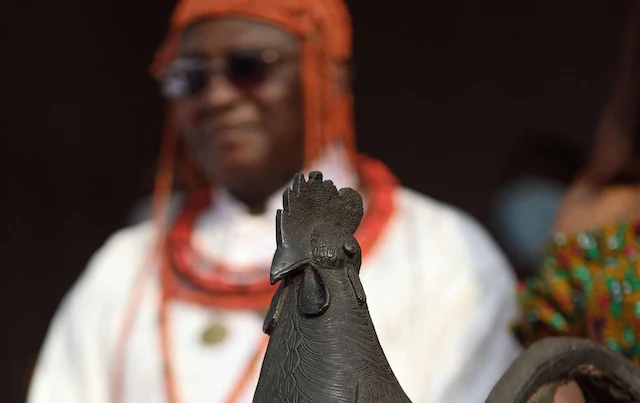

Featured Image: A king and his ancestor’s cock, returned in 2021 by Jesus College, Cambridge. Cambridge’s Benin Bronzes are being handed over to the Oba.
(This article appeared first in the Daily Telegraph, to whom we are grateful for permission to republish it)
Article:
The saga of the Benin bronzes has taken a new turn. Readers may recall that these beautiful and sinister brass objects were seized by British forces in 1897, and subsequently ended up in museums across Europe. One is the Museum of Archaeology and Anthropology in Cambridge, which decided to return 116 bronzes to Nigeria. No valuation was done – it was “too difficult”, said the relevant university official.
The process was held up when it became unclear where in Nigeria the bronzes would go, whether they would be safe, and even who would own them. The lucky owner, it later emerged, would be the Oba of Benin in person, the successor of the slave-trading monarch from whom the blood-stained objects were confiscated.
The University of Cambridge has nevertheless just announced that it “has transferred legal ownership … under a management agreement with the Benin Royal Palace.” The University website carries a bland and sanctimonious video by the Museum’s director, Professor Nicholas Thomas, skating over the circumstances of 1897 and the tyranny of the then Oba.
The Observer quotes him as saying that “We take no view of where [the bronzes] go” – an irresponsible attitude for a museum curator. He claims in his video that “Everyone I’ve spoken to across Cambridge” agrees.
But he has not spoken to descendants of slaves sold by the Oba’s ancestors for the metal to make the bronzes. They object strongly to gifting them to the present Oba. A university committee decided that their wishes were irrelevant and did not even bother to inform them. They’re not in Cambridge, of course, so they don’t count.