
(This article was first published in the Daily Telegraph on 11 November 2025)
The Cenotaph, Whitehall, 9 November 2025
The BBC really can’t help itself. At the Remembrance Day service in Whitehall on Sunday 9th November 2025, just as Commonwealth high commissioners were laying their wreaths at the Cenotaph to pay tribute to African soldiers who died in the two world wars, the BBC presenter declared that “Many never received a proper grave. The Commonwealth War Graves Commission has been mining old documents and records to try to establish the names of soldiers whose deaths were not properly recorded.” Even if this were beyond dispute (and it is not) was this really the moment to say it?
There are many terrible and shameful things in war. Rightly, the BBC does not choose to rehearse them on Remembrance Sunday, which has always been a day of solemn mourning and unity, and without doubt our most moving national ritual.
Imagine if, as Sir Keir Starmer stepped forward to lay his wreath, the BBC commentator observed that “Labour opposition to defence spending in the 1930s seriously hampered Britain’s resistance to the Nazi threat.” Or, as the Irish ambassador laid his wreath honouring the Irish volunteers who died in the British armed forces, the BBC voice intoned that “In 1945 the Irish president went to the German legation to present his condolences on the death of Adolf Hitler.” These things are undoubtedly true, and important, but there is at least one time and place when they are not appropriate: Remembrance Day.
But the BBC did choose to bring up the painful war graves accusation. I am not sure whether this has become part of their yearly November ritual – I don’t monitor all the coverage – though I know that this is not the first time they have given it emphasis. I noted on November 11 2022 that the BBC reported that “The UK Government has apologised for failures properly to commemorate Black and Asian troops who died fighting for the British Empire.”
Perhaps then it was just excusable. It was a fairly new story. It had surfaced in a 2019 television programme for Channel 4 made by the omnipresent David Olusoga (now fronting a BBC series on the British Empire) and the even more omnipresent David Lammy, then an unknown backbench MP.
They accused the War Graves Commission of imposing “apartheid in death”, claiming that white soldiers’ bodies had been treated with respect, whereas those of black or brown soldiers had been unceremoniously disposed of by a racist empire. It is hard to think of a much more hurtful accusation, which was widely reported, including – gleefully – in China.

The gravestone of Rifleman Gyan Bahadur Rana in the CWGC at Florence. He was a Rifleman in the 5th Royal Gurkha Rifles [5th RGR (FF)] regiment. His service number was 7580. He died on September 22nd, 1944, at the age of 21. The gravestone features the Gurkha Rifles cap badge, which includes two crossed kukris. Text in Devanagari script at the top reads “ॐ भगवत नमः” or ‘Om Bhagwat Namah’, which is a Hindu mantra meaning ‘I bow to the Lord who lives in the hearts of all’
The BBC took up and indeed embroidered the story. On April 22 2021, the Breakfast news programme featured a summary by David Olusoga, introduced by Naga Munchetty, in which Olusoga stated as plain fact that the then Imperial War Graves Commission had been “complicit with other imperial organisations … just as committed to not giving equal treatment to black and middle eastern soldiers.”
Almost predictably, Winston Churchill was stated, at Munchetty’s prompting, to have “deliberately signed off” on this policy. Regrettably, the War Graves Commission was seemingly panicked by the publicity into setting up a not-very-independent committee to report, which mostly endorsed the Olusoga-Lammy accusations of “pervasive racism”, and Boris Johnson and the Ministry of Defence feebly apologised.
It was left to the redoubtable Professor Nigel (now Lord) Biggar to do what the government should have done and carry out a proper investigation. He found that the War Graves Commission had nearly everywhere carried out its stated policy that “all the soldiers of the Empire should be treated alike”, and where it did not, that was mostly due to difficult local conditions, and sometimes to respect for differing cultural practices. (See https://www.nigelbiggar.co.uk/p/building-a-racist-mountain )
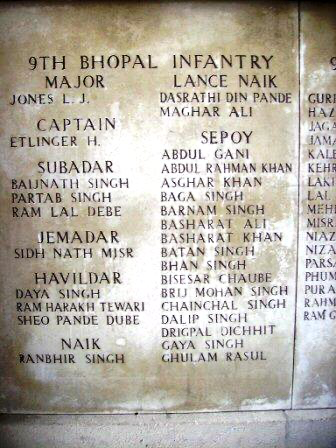
The Menin Gate Memorial to the Missing contains over 4,700 names, of which 412 are Indian soldiers.
The evidence is literally carved in stone: on the Menin Gate “the names of Indians with no known grave join those of fallen British comrades cascading down the walls”, and at the cemetery at Noyelles-sur-Mer, “the burials of members of the Chinese Labour Corps are marked by individual headstones, just like those of British soldiers.” Not “pervasive racism”, then, but pervasive non-racism.
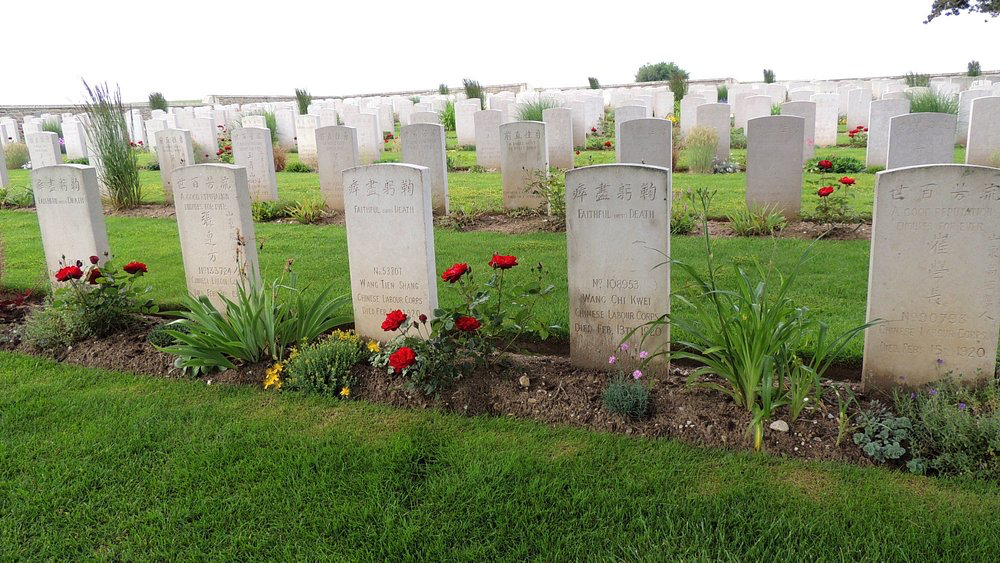
Graves of the Chinese Labour Corps, Noyelles-Sur-Mer. 862 Chinese graves are in this cemetery. Chinese Labourers were recruited by the British Army in 1916 to carry out arduous and dangerous tasks at the rear of the front line.
Biggar’s report was published back in 2021 and predictably received no response from any of the institutions concerned. But the BBC should have realised that its claim on this Remembrance Sunday that “Many never received a proper grave [and] deaths were not properly recorded” is gratuitous, disputed and contentious.
The BBC is now suffering the consequences of distortions that are far more urgent than this one, Donald Trump’s speech being the most obvious. But those things will pass. It worries me that its treatment of our history will create, and has created, a lasting impression on many minds.
The small group of historians of which I am a member, History Reclaimed, submitted a report to the BBC in December 2022 listing distortions and omissions in its programmes on very sensitive historical issues: slavery, the slave trade, the Irish famine, the Benin bronzes, race, the 1943 Bengal famine and Winston Churchill. We concluded that BBC treatment of British history “never errs on the side of nuance and complexity, let alone generosity, but favours extreme and provocative claims [which] cannot be said to reflect serious scholarly opinion or even provide basic factual accuracy.”
We have just learnt, thanks to the release of the internal report by the Corporation’s independent advisor Michael Prescott, that he believed that the case we had made, and our proposals for improvement, were moderate and reasonable. But a suggestion that the BBC should meet us to discuss them was dropped. Our report was ignored.
Writing in these pages on Sunday, Kemi Badenoch warned of the damage done by “a slow erosion of pride in our schools, our institutions, even parts of our media where the story of Britain is too often told through shame.” I am afraid that the BBC has been crucial to this erosion. It has betrayed its own history, and ours. It owes an apology to all of us.