

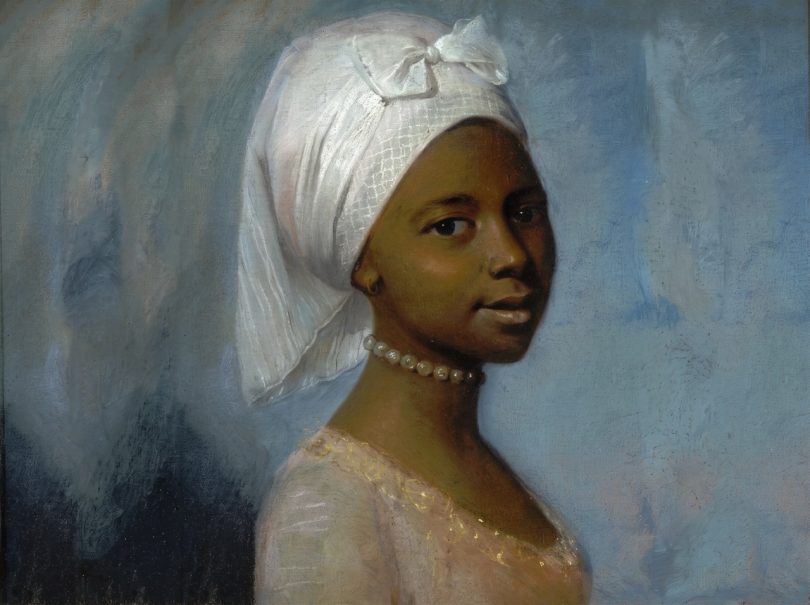

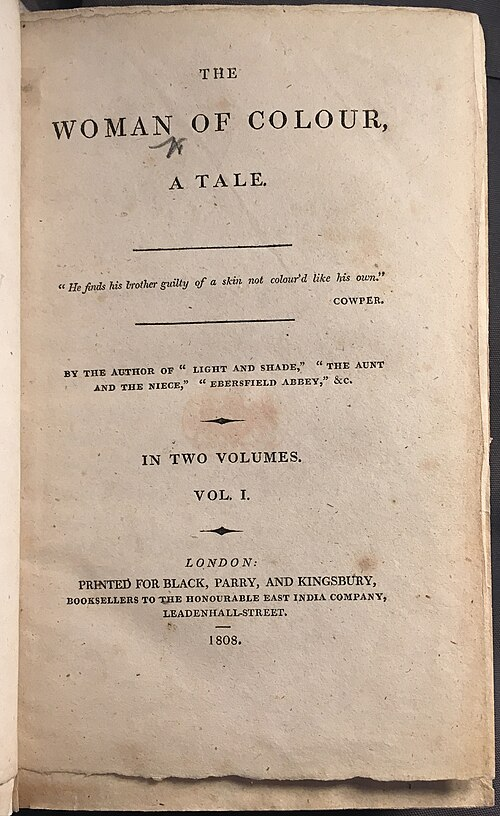
The Woman of Colour, a novel published anonymously in 1808, has long interested literary scholars. But its Christian philosophy and biblical references have neither been recognised nor understood by secular critics. This is also a problem in the study of the antislavery movement which was largely Christian in inspiration. It may explain why, in our secular age, the movement has been overlooked and ignored in recent years.
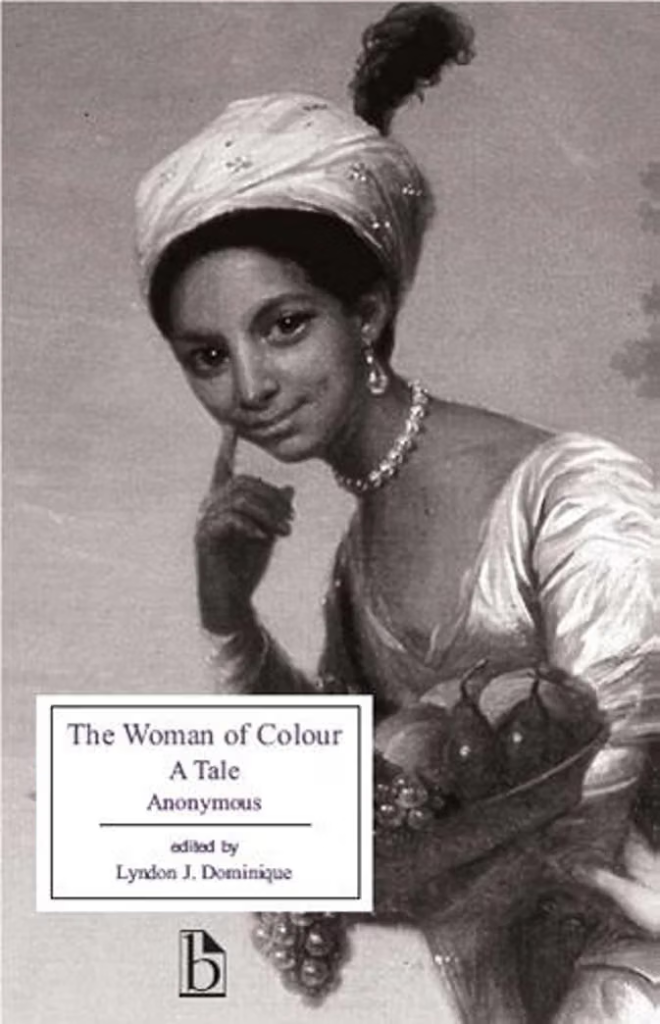
The Woman of Colour, published anonymously in 1808, is unique — so far as we know –amongst novels of its time in having a mixed-race female protagonist. The heroine Olivia Fairfield is the heiress and illegitimate daughter of a Jamaican planter. She travels to England to marry her cousin Augustus in obedience to the terms of her father’s will and chronicles her experiences in letters to her old governess back in Jamaica. Olivia’s married happiness with Augustus is short-lived because his first wife, whom he thought had died, turns out to be alive. Olivia returns to Jamaica to “zealously engage [her]self in ameliorating the situation, in instructing the minds—in mending the morals of our poor blacks” (188). (All quotations are from the 2008 re-edition of the novel edited by Lyndon J. Dominique).
The Woman of Colour has frequently appeared in syllabuses focussing on race, class, gender and imperialism and to balance out reading lists which are “too white”. Scholars acknowledge there are problematic aspects, such as Olivia’s fiercely loyal, pidgin-speaking handmaiden Dido who says she was “proud” to be Olivia’s slave.[1]And, as we will see, the novel’s Christian themes are frequently ignored, despite their ubiquity in the story. The incessant religiosity of the heroine actually struck one contemporary reviewer as being a bit over-the-top: “providence is for ever in her mouth; she indulges a little too liberal in her use of the Most High, and plumes herself too much on her religious duties, and her quotations from Scripture.” Yet, as a survey of the literature on this novel demonstrates, Olivia’s skin colour receives more attention than her religious convictions.[2]
Disinterest could account for this neglect, but I think a lack of biblical literacy plays a part as well. Two hundred and twenty years ago, our anonymous author[3]could take it for granted that her readers would recognize Olivia’s biblical allusions and frequent references to Christian doctrine. This is simply not the case today in our multicultural and secular society, not even amongst academics who study, interpret and teach English literature. Writing for The Spectator, Gwion Wyn Jones asks. “[W]hat use is a scholar of modern Anglophone history whose ears do not prick instinctively at the K[ing] J[ames] V[ersion]’s cadences and inflections, who is unable to spot at a distance an interpolated proverb or an applied parable, even when such things appear disembodied and uncited in profane contexts such as newspapers, diaries, or letters?” The same question applies to scholars of English literature. The following examples are illustrative of the problem and its consequences when we come to interpret this novel.
Conversion and Salvation
Olivia employs Christian idioms (which I have italicized) when she relates the story of her enslaved mother. Marcia loved Olivia’s father and converted to Christianity, but she met the romantic fate of a doomed heroine: “The soul of Marcia panted” for knowledge… “Marcia’s was a strong soul, but it inhabited a weak tenement of clay. In giving birth to me she paid the debt of nature and went down to that grave, where the captive is made free!” (54). Many scholars including Elizabeth Neiman, cannot accept a narrative from 1808 about an enslaved African princess falling in love with her enslaver, while at the same time betraying no awareness of the Christian idioms employed.[4] She argues that Olivia has accepted a false story from her father: “Olivia annotates her father’s love story, calling that love ‘captivity.’”
I would argue that the novel’s first readers would have recognized Marcia’s story as a conversion narrative, a sub-genre of literature aimed at promoting the efforts of missionaries amongst indigenous and enslaved people. A much-reprinted example, variously titled “Conversion of a Negro” or “The Happy Negro” recounts a conversation between an English tourist and an enslaved man owned by a Quaker who “had taught his slaves to read [but had not] conversed with this Negro upon the state of his soul.” As he explains to the tourist:
“I read the [Bible] much before I understand; but at last I felt pain in my heart; I found things in the book that cut me to pieces… God was holy and I was very vile”…
[The narrator adds] In short, he entered into a full account of his conviction of sin… and what scriptures came to his mind… [that] were made the means of light and comfort to his soul… my entering into all his feelings… drew streams of joyful tears down his black face.
As historian Katharine Gerbner explains, “[w]hile individual narratives differed, there were recognizable patterns in these early modern ‘conversions’; an awareness of sin led to humiliation, repentance, and the hope for God’s grace.”
Conversion narratives also emphasized the purity and ingenuousness of the newly saved converts and therefore black converts served as a living rebuke against white Christians. Marcia’s story fits this pattern: once she understood that sex out of wedlock was sinful, she put an end to her intimate relationship with Mr. Fairfield. Olivia recounts, “[t]he wild and uncivilized African taught a lesson of noble self-denial and self-conquest to the enlightened and educated European” (55).
Hyewon Ryu is one of the few scholars to recognize that Olivia’s religious beliefs are central to the narrative.[5] Rather than excuse away the uncomfortable story of Marcia, Ryu points out that Olivia refers to it at a key dramatic moment when she resolves to give up the man she loves:
“I know what is right, and I trust the Almighty will support me in the due performance of it. I had a glorious example in my mother… though an African slave, when once she had felt the power of that holy religion… from that hour she relinquished [my father], who had been dearer to her than existence! And shall I then shrink from a conflict which she sustained? Shall I not go on, upheld by an approving conscience, and the bright hope of futurity?” (148)
But any reader who is repulsed by the Marcia narrative and has no interest in the doctrine of submission to the will of Heaven will be inclined to skip over Olivia’s apotheosis.
Salvation and Enlightened Saviors
Olivia criticizes her late father for leaving his enslaved workers’ minds “to remain in the dormant state in which he found them!” (55). Olivia does not simply mean their minds were not “improve[d] intellectually,” as the editor has it (55f). She means her father failed to awaken them to the Christian faith. This critique was frequently leveled against planters in real life. As Mary Turner noted, “Particular emphasis was put on the fact that, having imposed slavery on the heathen blacks, the slave owners had made no attempt to provide them with religious instruction.” Scholar Olivia Carpenter disapprovingly notes that Olivia sees the enslaved workers as “fundamentally unenlightened subjects waiting for a savior” (30). Ironically, I think Carpenter is denigrating Olivia for being a self-appointed savior, while the author is literally referring to salvation, as in John 3:16. Of course, Olivia grounds her arguments for the essential humanity of the enslaved, on religious principles, just as in real life the campaign for abolition “was formulated in religious terms and, from first to last, practising Christians provided leadership,” as Mary Turner recounts.
Resolutely Ignoring the Moral
In the novel’s afterword (189), the author steps out from behind the curtain, albeit in the persona of the editor of Olivia’s letters. A “Friend” asks her “what do you propose from the publication of the foregoing tale? …I do not see the drift of your labours, as undoubtedly there is no moral to the work!… You have not rewarded Olivia even with the usual meed of virtue—a husband!” The author/editor responds with two motives (I have numbered the motives and italicized the Christian passages to distinguish them from the remainder):
Virtue, like Olivia Fairfield’s, may truly be said to be its own reward—the moral I would deduce from her story is, [1] that there is no situation in which the mind (which is strongly imbued with the truths of our most holy faith, and the consciousness of a divine Disposer of Events) may not resist itself against misfortune, and become resigned to its fate. And if these pages should teach one child of calamity to seek Him in the hour of distress who is always to be found, [2] if they teach one skeptical European to look with a compassionate eye towards the despised native of Africa — then, whether Olivia Fairfield’s be a real or an imaginary character, I shall not regret that I have edited the Letters of a Woman of Colour!
Our modern critics deliberately elide this Christian message. Rebecca Anne Barr reports the editor as saying “‘there is no situation in which the mind… may not resist itself against misfortune and become resigned to its fate.’” Julie Murray quotes the partabout virtue being its own reward, then skips to the part about teaching the “sceptical European to look with a compassionate eye”. In his introduction to the 2008 edition, Dominique omits the first motive entirely. That Christian stuff is just a lot of argle-bargle which can be trimmed out.
Modern academics profess their commitment to elevating hitherto marginalized voices. If this is the case, we might accord the author of this long-forgotten work the courtesy of accurately conveying her worldview. Analyzing The Woman of Colour or using it in the classroom without explicating—I do not say endorsing—the religious convictions that guide Olivia is like describing Da Vinci’s Last Supper as a dinner party where some tension arose.
Lona Manning
(A longer version of this article first appeared in the online journal Voegelin View, on October 26, 2026)
[5] Ryu, Hyewon. “‘I dwell amongst my own people!’: The Reconfiguration of Britishness in The Woman of Colour,” Journal of English Studies in Korea 44 (2023), 137–162. Two other scholars who engage with the Christian content of the novel are Cox, Octavia. “‘I Am Disappointed in England’: Reverse-Robinsonades and the Transatlantic Woman as Social Critic in The Woman of Colour.” Transatlantic Women Travelers, 1688-1843, ed. Misty Krueger, Rutgers, 2021, 144–66; and Runia, Robin. The Woman of Colour: Authorship and Christian Faith. Romanticism, (2026) 32, 181-188. Carpenter strongly critiques Olivia’s “Christian morals”. “According to her thought, enslaved people most particularly need and desire the education and the Christian morals supposedly exemplified by British Protestant values rather than freedom and self-determination.”


