

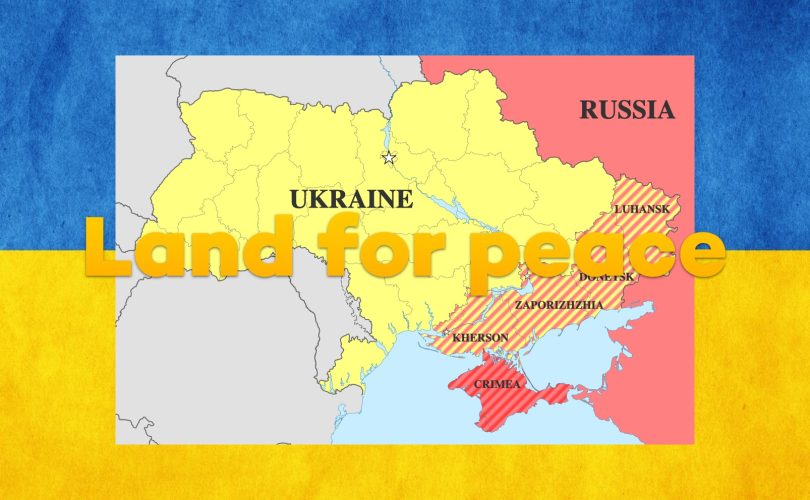

In the Spring of 2025, as hopes rise for a settlement, the formula of ‘Land for Peace’ is widely touted. Many people are convinced that if only Ukraine would surrender the land, which Russia has annexed, then a lasting peace could be signed, Ukraine could flourish, Europe could relax, and everyone could revert to their normal routines. But this is an illusion: land per se is the last thing Russia needs.
Russia already possesses more land than any other state on earth: 17,038,246 km2, clearly exceeding the area of Canada, the USA, Australia, China, the European Union or Antarctica. It is ten times larger than Ukraine, twenty-seven times larger than the United Kingdom. The Russians already sit on more land than they can readily exploit, more than the rest of us can comprehend.
Nonetheless, most Russians genuinely feel that they have been robbed of their birthright. People like Putin, who grew up in the Soviet Union, learned with pride in school not just that their country was the world’s biggest, but also that its rightful possessions spanned 22.4 million km2. They now see that they lost well over 5 of the 22 million in one go – an area exceeding the territory of either the entire EU or of the Indian sub-continent. From their perspective, for Putin to think of reclaiming a little patch like Ukraine is not an immoderate ambition.
All peace negotiations with Putin, therefore, must start with an undertanding both of Russian psychology in general, and of what the Russians really want in particular. If not land, then what?
The list of Russia’s traditional desiderata is extremely long.
It embraces all sorts of things from geopolitical space to religion, history, economic resources and the fruits of power.
Geopolitics.
The Russians still live in the world of Halford Mackinder, the Oxford professor of geography, who framed his ‘Heartland Theory’ some 120 years ago, and wrote the famous sentence; “Who rules the World Island rules the world.” By ‘World Island’ he meant Eurasia. His theory was predicated on Britain’s possession of India, and since our retreat from ‘East of Suez’ the theory has vanished. But it still resonates in Russia, not least because for the last three decades the heart of the Heartland has passed into a new Chinese sphere of influence. Putin can’t have failed to notice. Fearful of challenging in Central Asia, he turned westwards, tried his luck in Georgia in 2008 and Crimea in 2014. Then, on meeting no stern resistance from NATO, moved on to the full invasion of Ukraine in 2022. Yet a small strip of Eastern Ukraine will hardly meet his hopes for a significant geopolitical shift.
Unlike average countries, all great powers are accustomed to erecting an area of control and denial beyond their legal frontiers. Anticipating future attacks on their home fortresses, they like to have a ‘No Man’s Land’ between the opposing trenches. In line with the Monroe Doctrine, for example, the Americans act as if all the Americas, North, South and Central, are ‘theirs’. Donald Trump thinks that Canada, Greenland and Panama are his for the taking. The Russians talk of the fourteen ex-Soviet republics, from Lithuania to Tajikistan as their ‘Near Abroad’. They are pushing an unwilling EU to transform itself and join the club of super-states.
Demographics.
In a country, where land is limitless, population gains extra meaning. And in the past generation, Russia’s population has slumped alarmingly. The last Soviet census put the total at 288 million; in today’s Russia it stands at 144 million – a drop of 50 percent. Moreover the demographic outlook is bleak. Male life expectancy is 67 years and falling. The birthrate is only 1.42 per woman. Without drastic action, the 144 million will slump again. Hence, it is fair to conclude that what Russia aims to take from Ukraine is not land but human beings, especially boys, girls and babies with a lifetime of reproduction before them. Unsurprisingly, the Russian authorities routinely raid orphanages in the occupied oblasts, kidnapping tens of thousands of children, who will never see their homes again.
Slavdom.
Russia’s core population, which originated in the early modern Grand Duchy of Moscow, but spread out into all the provinces of a far-flung empire, speaks Russian – one of the three, East Slavonic languages. Thanks to imperial expansion, large swathes of native peoples were Russified, both through educational policies and mixed marriages. In consequence, 80 or 81 percent of Russia’s present citizens now speak Russian as their first language. Yet it is among them that the demographic crisis looms. The deathrate among Russian speakers is much higher, and the birthrate much lower, than among non-Russians, especially Muslims. Ere long, they fear, they will become a minority in their own land. Hence, some argue, the Slavic element has to be reinforced by forced immigration from elsewhere – meaning from Belarus, other ex-Soviet republics, and above all, Ukraine.
Religion.
Ever since the creation of the Moscow Patriarchate in the Fifteenth Century, and of the ideology of a ‘Third Rome’, it has been a cardinal principle of the Russian Orthodox Church that all the Tsar’s Slavic subjects must recognise the supremacy of the Patriarch of Moscow. In practice, the principle meant that any Belarusian, Ukrainian or Pole who came within Moscow’s grasp, and who traditionally recognised either the Patriarch of Constantinople or the Roman Pope, could be denounced as a renegade, apostate, heretic or traitor. Hence, every single time that Tsarist or Soviet armies marched West (which was often) religious persecution ensued; non-compliant clergy were defrocked or killed; obdurate laity were forcibly converted, deported or ‘disappeared’. Christian believers of non-Muscovite faiths, both Orthodox and Catholic, helped fill the graveyards and the Gulags. This is the tradition to which Putin has reverted. He has appointed a fellow ex-KGB agent to be Patriarch, to dress up in ecclesiastical robes, and to bless the troops on the way to the front. For President Putin and Patriarch Kyril, the ‘special military operation’ is truly a Holy War.
History.
On the eve of the invasion in February 2022, Putin sent a long historical essay to all his soldiers. In it, he elaborated an old historical theory of Tsarist vintage, which maintains that Russia has existed for a millennium and that Ukraine is a fictional, artificial entity lacking any right to sovereignty. Central to the theory are the contentions that Putin’s namesake, Vladimir or Volodymyr the Great (r 978-1015), Prince of Kiev, was a Russian, that his principality of Kievan Rus’ was Russian, not Ruthenian, and that Russian identity and sovereignty took off in ancient Rus, not, as others maintain, in the later Grand Duchy of Moscow. He is severely opposed to the idea that Kievan (or Ki’ivan) Rus gave rise to three modern and separate East Slavic nations and languages – Belarusian, Ukrainian and Russian. His clear aim now is to eradicate the false, heretical historical doctrines of Zelensky & Co.
Minerals.
Donald Trump has learned quite recently that Ukraine is endowed with abundant supplies of minerals, and wants to grab them. Putin would have heard of it 50 or 60 years ago, when all Soviet students and pupils were instructed on the great importance of Ukraine’s minerals for industrialisation and Stalin’s Five Year Plans. Both will now have been told that among the minerals, the 17 so-called ‘rare earths’ are not specially rare, but Trump does not yet show signs of understanding how they are distributed. Putin already has his hands on the richest source of ‘the rare 17’, already being mined in the Donbass. If Trump is out to make a quick buck, he should not be doing a deal with Zelensky.
Emotional Dialectics.
Russians may have abandoned the Marxist-Leninist dialectics of Soviet times, but they still cling to the older, dialectical habits of seeing the world in terms of ‘Us and Them’, ‘Love and Hate’, ‘Loyalty and Disloyalty’. They are taught to think that their neighbours are either for them, or against them, with nothing in between. In that mindset, there is no such thing as well-intentioned neighbours, who have opinions of their own but who nonetheless seek a quiet life. Such people, they think, are delusionary. To be comfortable, they want to compel everyone to think as they do.
Eternal dominance.
Ever since the cruel and incessant wars of the steppes, in which their traditions were forged, the ‘Moskali’ have grown used to fighting and wrangling with all comers – capturing land and subjugating people, whenever they could, assimilating and russifying their captives, changing the names of their acquisitions, surviving extraordinary deprivations, only ceding ground if forced to do so, but never calling it a day, never admitting their adversaries’ claims, never resting until dominance was achieved. In this way, they assembled the largest empire in history, which, recently, to their eternal shame, they allowed to collapse. No wonder that Putin called it “the greatest catastrophe of the century.” Yet, in comparison to his forebears, Putin is weak. In twenty-five years, he has only clawed back a tiny fraction of what was lost. And that weakness only makes him all the more desperate “to take back control”, “to save the motherland”, and, if need be, “to eat grass.”
The China factor.
During the Cold War, Russia was first China’s partner, and then its rival. Today, it is China’s supplicant, a potential vassal. By invading Ukraine, Putin tried to show Xi what a great power could do, to set an example for China to follow over Taiwan. But he made a hash of it. His ‘operation of three days’ turned into a three-year slogging match. China rescued him, supplying all the things which sanctions barred. But the Chinese leadership is not impressed. Their famed patience wears thin.
Negotiations
Given the complexities, President Trump’s chances of fixing a quick deal, or winning the Nobel Peace Prize, are minimal. He can agree what he likes with Putin, but if the Ukrainians are cut out of it, they will keep on fighting. And their capacity to stay in the field, depending on the level of European support, is variously estimated at anything between 9 months and 2 years. Within that time, it is more than likely that the Russian economy will falter, that the Russian Army will pack up as in 1917, that Putin’s opponents will either stage a coup or try to kill him, that the dictator’s health will fail, or that Russia’s backers will throw in the towel. Putin’s nightmare must be that the Chinese will park their ambitions in Taiwan, and, seeing him trapped in the West, in Ukraine, will move to recover their ‘long lost lands’ in Russia’s Far East. On Chinese maps, Vladivostok is not called Vladivostok but ‘Hai-Shen-Wei’ (Sea Cucumber Bay).
Given the exhaustion of both sides, however, a temporary ceasefire could well be in the offing. In that case, the guns could fall silent, and negotiations begin. Once at the table, the Russians will open with the demand that all occupied territories remain in their hands. The Ukrainians will counter with: “Very well, you can keep what you want on condition that all the people living there will be free to leave.” The Russians will follow up with the demand that Ukraine should be de-militarised. The Ukrainians will reply: “Very well, we shall consider it, but only if Crimea is de-militarised, too. We won’t allow the Black Sea Fleet to return to Sevastopol. After all, Crimea is part of Ukraine”. If ever they get round to History, the Russians will fire a withering salvo: “Ukraine and Ukrainians don’t exist”, they will bluster, “they are figments of Zelensky’s imagination.” “In that case,” the Ukrainian delegation will say, “you don’t have anyone to talk to.”
8 March 2025
Norman Davies, CMG, FBA, is one of the foremost historians of Central and Eastern Europe. Among many works, he is the author of God’s Playground. A History of Poland (2 vols., 1979, 1981) and Europe. A History (1996)


