


How many children had Lady Macbeth?
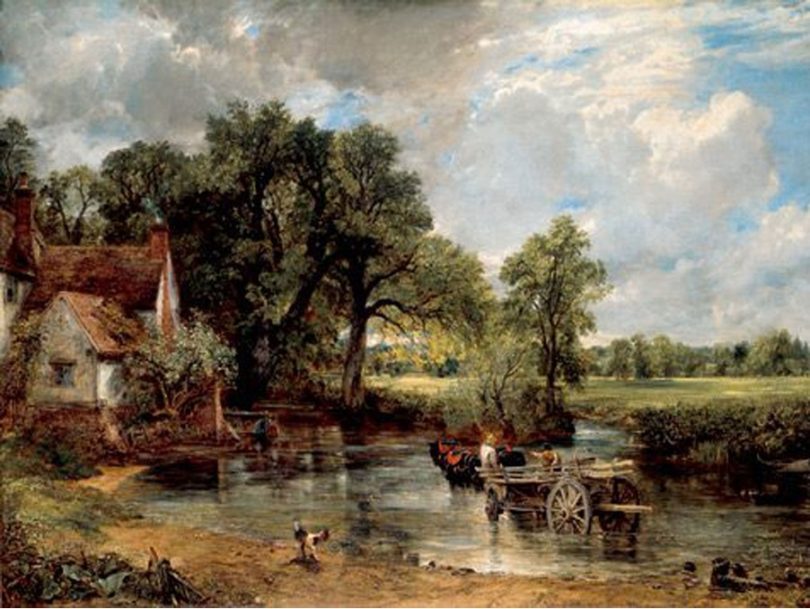
An exhibition of Constable’s paintings is about to open at the National Gallery. Its aim is to set the great landscape artist’s canvases in their social historical setting. Its curator, Dr Mary McMahon, has stated that ‘the British landscape could not be viewed as a neutral space devoid of politics and patriotism, privilege and discrimination’. Like so many art galleries, it would appear that the National has just discovered social history and will treat us to exhibits and lectures on the Corn Laws, poverty among agricultural workers, and the Captain Swing riots. Constable’s most famous painting, The Hay Wain, will be at the heart of the exhibition and according to Dr. McMahon ‘we want to talk about everything that has not been included in this painting’.[i]
Long ago the great literary critic, L. C. Knights, published an essay under the title ‘How Many Children had Lady Macbeth?’ The answer to the question is that we do not know: Shakespeare doesn’t tell us, though he does relate that she had been a mother at some stage: ‘I have given suck, and know / How tender ’tis to love the babe that milks me’ (1.7. 54-5). Knights wrote his essay to deter speculation in criticism.[ii] What we are not told and cannot see is not a proper subject for discussion: all we can do when we read or look is discuss what the author or artist has given us, not what they excluded or what is simply invisible. One can imagine how Dr. McMahon’s principle could be extended so as to criticise Jane Austen for excluding detailed consideration of the Napoleonic Wars. Shakespeare would be fair game for his failure to discuss the Elizabethan Poor Laws of the 1590s or to write a play about the Gunpowder Plot. John Singer Sargent painted many a society hostess: why didn’t he paint the East End poor? An exhibition of L. S. Lowry’s paintings of industrial Lancashire could be complemented by information about the English countryside he chose not to depict. And so on.
History Reclaimed is only too pleased when people approach the past with respect and on the basis of the evidence. But the sudden discovery of social history by our gallery curators who then use it instrumentally and crudely to make fatuous points about the social conditions artists did not depict – ‘and why not?’ I hear them demand – is another example of using the past to signal virtue and declare political allegiances. This exhibition will have little to do with the artistic appreciation of Constable and The Hay Wain. It will consider an absence and tell you what the curators think should have filled it. You might just as well stay at home and read a good textbook on the early nineteenth century.[iii]
Virtue Signalling and Evasion at the Pitt Rivers
Not to be outdone, the Pitt Rivers Museum, a part of the University of Oxford, is at it again. This time it is returning a variety of objects acquired in some way – but it is not clear how – from the Maasai tribe in East Africa. Seven years ago ‘a Maasai activist came to Oxford on a scheme for indigenous leaders’ and on being shown the Museum’s collection of Maasai objects declared that ‘they could only have been obtained by force, by killing their owners’.[iv] From the report in the press, there doesn’t appear to be any evidence that this is the case. Nevertheless, on this basis the Pitt Rivers set up the ‘Maasai Living Cultures Project’. So far, visiting Maasai have lit a bonfire on the iconic green outside the University Museum in Keble Road and representatives from the Pitt Rivers have visited Tanzania and Kenya to give ‘49 cows to each of the five affected communities’. Among the objects identified as being ‘culturally sensitive’ are earrings and a head ornament worn by girls after suffering genital mutilation.
According to the Pitt Rivers Museum, ‘We aim to work collectively with partners across the world towards redress on a case-by-case basis’. As the museum is a great repository for many different collections that were acquired in the Victorian period from all regions of the world, the number of potential ‘partners’ and cases of ‘redress’ (the return of objects) is potentially vast. Is it the intention of the University Oxford to give away its collections in the Pitt Rivers? What is the legal status of actions like this which disperse a collection given to the University by General Pitt Rivers on the basis that it remained intact and displayed according to his wishes?[v]
Search for ‘Female Genital Mutilation’ on the University of Oxford’s website and sadly you will find dozens and dozens of items about this foul procedure. How very odd for a museum in a western university to respect cultural sensitivities over such a thing as FGM. But search more widely across the internet and you’ll find many items about the displacement of the Maasai from their ancestral lands by the Tanzanian government which wants to turn the area into a game reserve.[vi] Human Rights Watch has been following this issue and this summer produced an 86-page report on the persecution and removal of the Maasai.[vii] Surely this would be a matter that could be vigorously pursued by a great anthropological museum and with everyone’s support? Earlier press releases about the Maasai project on the Pitt Rivers’ website at least make reference to their relocation.[viii] More recent items focus almost exclusively on the restitution of objects and the cultural tourism undertaken by Pitt Rivers staff to the remaining Maasai lands.[ix]
Perhaps the Museum’s reticence owes something to this remarkable fact: that it was the British colonial government that in 1959 created ‘a permanent homeland for the people who lived in and around the Ngorongoro Crater, the vast majority of whom are Indigenous Maasai herders.’[x] It is this land that the Tanzanian government wants and from which it intends to move 82,000 Maasai. How inconvenient this must be to the Pitt Rivers’ preferred narrative – that the colonialists protected the Maasai and the post-colonialists are now displacing them.
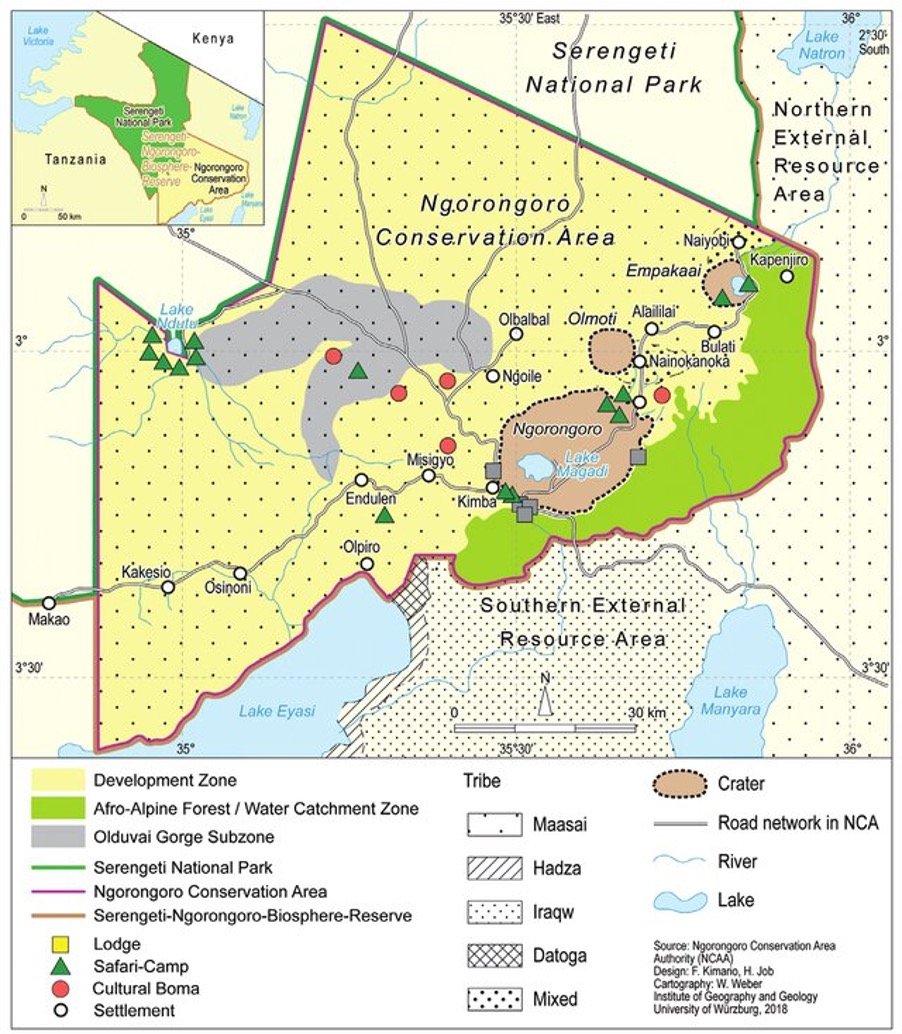
The Ngorongoro Conservation Area
History Reclaimed has often asked why people who are quick to condemn Britain and other western nations for their historic role in slavery are not similarly involved in campaigns to end modern slavery here and now in a sweatshop near you? We could ask the same question of the Pitt Rivers: why are you wasting time and resource denuding the museum of its collections when you could be campaigning loudly to save the endangered indigenous communities from which your collections derive? We should also ask why the Pitt Rivers thinks itself under an obligation to return objects related to the mutilation of children? Admittedly, it is much more comfortable to castigate dead white males who collected and donated these items than African governments.
Tate Britain and the fate of Rex Whistler
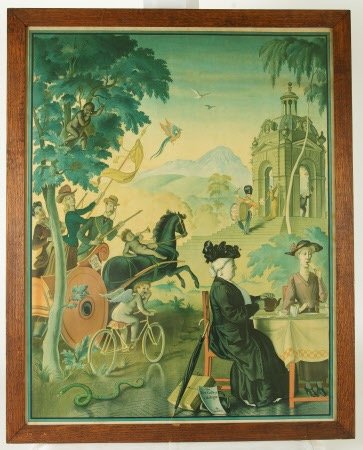
Poster advertising the Tate Gallery Restaurant with murals by Rex Whistler, 1928
And let us now turn to a brave, white male who died for his country and for the freedom of Europe in the fight against Nazism, the artist Rex Whistler. Readers may be aware that Whistler’s murals in what used to be Tate Britain’s restaurant has become controversial. Painted in 1927 and entitled The Expedition in Pursuit of Rare Meats, they are a fantasy, a reverie, a jeu d’esprit, perhaps best understood in terms Oscar Wilde used for fox hunting: ‘the unspeakable in full pursuit of the uneatable’. Generations have eaten in the room, in fact, without complaint, but there is no doubt at all that the murals contain some casually racist images, redolent of the age in which they were painted. What to do?
As from this spring, 2024, the room is now deserted and deliberately kept dark. Enter and you’ll see a film, about 20 minutes long, entitled Viva Voce, in which a female ‘professor’ from today (her subject is not made clear) interrogates an actor playing Rex Whistler as if in the 1930s.[xi] The professor snarls and grimaces, firing angry questions at the hapless Whistler, who is all boyish enthusiasm and ingenuousness in return. It was said by Blake that in Paradise Lost, Milton ‘was of the Devil’s party without knowing it’, and that famous maxim might be applied to this video, which subverts the case it is trying to make by presenting Whistler so sympathetically and his accuser so venomously. Unable to stick to the murals, the film wanders off at the end, accusing Whistler of not knowing that black soldiers fought for Britain in the First World War. As Whistler should have been allowed to reply: ‘I was only 13 years of age and in boarding school (Haileybury) when the war ended. Why would you expect me to know that?’
The room is so dark that it is evidently intended that no one should be allowed to see the murals. It has some very solid furniture in place, suggesting that this is not a temporary solution but one intended to last.
The Director and trustees of Tate Britain could have ‘retained and explained’ Whistler’s fantasy with an explanatory notice and allowed the room to continue as a restaurant. If that was unacceptable, the restaurant could have been moved elsewhere and the murals made accessible to those who wanted to view them. But the new arrangements combine the very worst features of contemporary culture: cancellation, censorship and thought control. Whistler has been cancelled and you may not see his murals, whether you wish to admire them as a work of art or make up your own mind about the offence they cause. If you dare to venture into the room, the film will tell you what to think – though in its very earnestness and propagandising, it actually achieves the reverse, genuine sympathy for Whistler and his fate at the hands of the professor. Tate Britain seeks to infantilise its visitors who cannot be trusted to form their own conclusions. ‘Look away children, look away’.
To the argument that the murals give offence there is an equal and opposite response: that the cancellation of the work of a man who volunteered for military service at an advanced age and died in a tank in the Normandy campaign in June 1944 while fighting a racist foreign power is also offensive to many people, maybe more so. And then there is the further argument that offence is the price we all pay to live in an open society. Something, somewhere, will always give offence to someone. And sometimes we just have to accept that, and live with things we may dislike or detest, such as these murals.
One final point: the admired artist Keith Piper made the film of Whistler and the Professor, Viva Voce. It is deeply dispiriting that one artist should be involved in any way in the censorship of another. It sets a terrible precedent. ‘Ask not for whom the bell tolls…’
Please send us examples of the destruction of our museums and galleries and we will investigate further. My thanks to one of my former students and to another keen supporter of History Reclaimed.
[i] Daily Telegraph, 24 July 2024, https://www.telegraph.co.uk/news/2024/07/24/constable-the-hay-wain-contested-landscape-national-gallery/
[ii] L. C. Knights, How Many Children had Lady Macbeth? An essay in the theory and practice of Shakespeare Criticism (Cambridge, 1933)
[iii] ‘Discover Constable and the Hay Wain’ opens at the National Gallery on 17th October. https://www.nationalgallery.org.uk/exhibitions/discover-constable-and-the-hay-wain
[iv] Oxford Mail, 1 Oct. 2024, ‘Maasai visit Oxford museum to request return of sacred items’, https://www.oxfordmail.co.uk/news/24620161.maasai-visit-oxford-request-return-sacred-items/
[v] See our earlier essay on the Pitt Rivers Museum: https://historyreclaimed.co.uk/a-breach-of-trust-in-oxford-the-pitt-rivers-museum-and-the-destruction-of-the-past/
[vi] Human Rights Watch, ‘Tanzania: Maasai Forcibly Displaced for Game Reserve’, 27 April 2023 https://www.hrw.org/news/2023/04/27/tanzania-maasai-forcibly-displaced-game-reserve; Tanzania: Indigenous Maasai Being Forcibly Relocated’, 31 July 2024, https://www.hrw.org/news/2024/07/31/tanzania-indigenous-maasai-being-forcibly-relocated
[vii] “It’s Like Killing Culture”. Human Rights Impacts of Relocating Tanzania’s Maasai, https://www.hrw.org/news/2024/07/31/tanzania-indigenous-maasai-being-forcibly-relocated
[viii] Living Cultures Press Release, 5 November 2018, https://www.prm.ox.ac.uk/files/livingculturespressreleasepdf
[ix] ‘Maasai Living Cultures 2023’ https://www.prm.ox.ac.uk/maasai-living-cultures-2023 The only reference to Maasai lands in this Pitt Rivers 2023 update is as follows: ‘The project will make meaningful, real-world impacts on Maasai people at a time when they are suffering due to land-rights issues and climate change. The project also enhances the Museum’s knowledge and understanding of Maasai culture and history, which benefits online and on-site visitors who want to learn about the Maasai and indigenous cultures.’
[x] ‘It’s Like Killing Culture’, p. 1.
[xi] Tate Britain. ‘Keith Piper and Rex Whistler’, https://www.tate.org.uk/whats-on/tate-britain/piper-and-whistler


